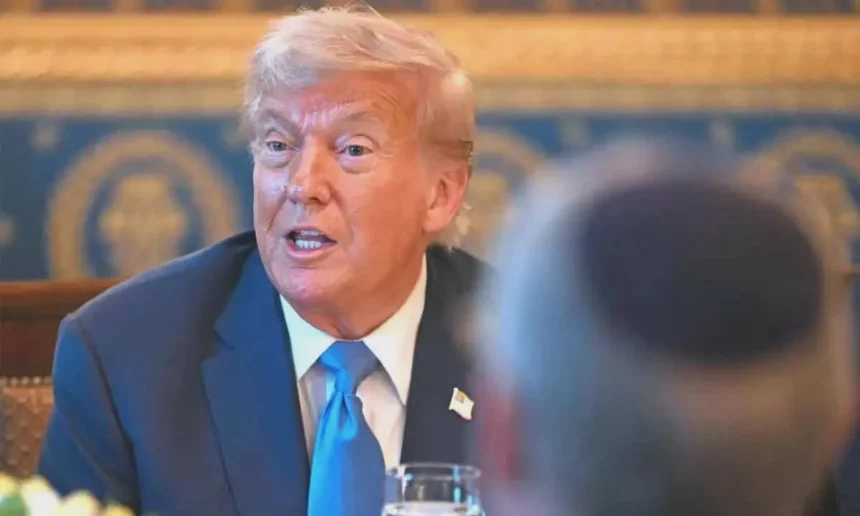
A new legislative push in the United States has triggered widespread concern across global markets after former president Donald Trump signalled support for a sanctions bill targeting countries that continue economic engagement with Russia, particularly in the energy sector. The proposed measure, now moving through the United States Congress, would empower the U.S. administration to impose extraordinarily high tariffs, potentially reaching 500 percent, on imports from nations deemed to be supporting Moscow through trade. The development has drawn sharp attention in India and China, both of which have emerged as major buyers of discounted Russian oil since the Ukraine conflict began, raising serious questions about the future of global trade stability and diplomatic alignment.
The sanctions proposal is rooted in Washington’s broader strategy to economically isolate Russia and restrict the revenue streams that sustain its military operations. While Western nations have already imposed multiple rounds of financial and trade restrictions, the latest bill marks a significant escalation by threatening secondary penalties against third countries. By introducing the possibility of punitive tariffs on unrelated exports, the United States is signalling a willingness to use its market power as leverage not only against adversaries but also against strategic partners who pursue independent economic policies.
Supporters of the bill argue that previous sanctions have not sufficiently curtailed Russia’s energy earnings and that stronger tools are required to compel compliance. Critics, however, warn that such sweeping tariff authority could destabilise global supply chains, undermine the multilateral trading system, and strain relationships with countries that do not view their Russia policy through the same geopolitical lens as Washington.
Why the Tariff Threat Matters for India, China and Global Commerce
The prospect of tariffs as high as 500 percent has sent shockwaves through trade and policy circles, particularly in India, which has rapidly increased imports of Russian crude oil over the past two years. For New Delhi, these purchases have been framed as an economic necessity, driven by the need to ensure affordable energy for a growing population and a fast-expanding economy. Indian officials have repeatedly stressed that their decisions are guided by national interest rather than geopolitical alignment, and that energy security remains a non-negotiable priority.
If the U.S. were to activate the tariff provisions of the bill, the impact on Indian exports could be severe. The United States is one of India’s largest trading partners, and punitive duties would significantly erode the competitiveness of Indian goods in the American market. Key sectors such as pharmaceuticals, information technology services, textiles, auto components, and engineering goods could face major disruptions, affecting employment, investment flows, and long-term growth prospects. Trade experts caution that even the threat of such tariffs could lead to uncertainty among exporters and investors, prompting companies to delay decisions or seek alternative markets.
China faces a similar dilemma, though its economic scale and existing trade tensions with Washington create a different dynamic. Beijing has already been subjected to extensive U.S. tariffs in recent years, and additional penalties linked to Russia could further harden positions on both sides. Analysts note that while China may be better positioned to absorb shocks due to its diversified export base and domestic market, an escalation of tariff pressure would still reverberate across global manufacturing networks, many of which rely heavily on Chinese inputs.
Beyond India and China, the bill has broader implications for the international trading system. By tying tariff policy to foreign policy objectives in such an explicit and punitive manner, the United States risks blurring the lines between economic regulation and political coercion. Several countries in Asia, Africa, and Latin America that maintain trade relations with Russia could find themselves caught between competing pressures, forced to choose between access to the U.S. market and their own economic and diplomatic priorities.
Energy markets are also likely to feel the effects. Russia’s ability to sell oil at discounted rates has reshaped global energy flows, with buyers outside the Western bloc benefiting from lower prices. A clampdown on these transactions through secondary tariffs could tighten supply, push up prices, and add to inflationary pressures worldwide. For developing economies already struggling with high energy costs, the consequences could be particularly acute.
*Sanctions, Strategy and the Shifting Balance of Economic Power*
The sanctions bill reflects a broader shift in U.S. thinking about the use of economic tools in international politics. Under this approach, trade policy is increasingly viewed not merely as a means of promoting economic growth but as a strategic instrument to influence the behaviour of other states. By endorsing legislation that authorises extreme tariff measures, Donald Trump has reinforced his long-standing belief in the power of tariffs as leverage, a stance that defined much of his earlier trade agenda.
Within the United States, the bill has attracted bipartisan attention, underscoring the depth of concern about Russia’s actions and the limits of existing sanctions. Proponents argue that without targeting the countries that purchase Russian energy, sanctions will remain porous and ineffective. They contend that the sheer scale of the proposed tariffs would leave targeted nations with little choice but to reassess their trade ties with Moscow.
Opponents counter that such an approach could backfire, driving affected countries to deepen cooperation with each other and accelerate efforts to reduce dependence on the U.S. dollar and American markets. India, for instance, has steadily expanded trade settlements in alternative currencies and strengthened economic ties with partners in Asia, the Middle East, and the Global South. An aggressive tariff regime could reinforce these trends, weakening U.S. influence over time rather than strengthening it.
The debate also raises fundamental questions about sovereignty and autonomy in an increasingly multipolar world. Many countries resist the idea that their economic decisions should be dictated by the foreign policy priorities of another state, even a powerful one. For India, which has long pursued a strategy of strategic autonomy, the sanctions bill highlights the delicate balancing act required to maintain productive relationships with multiple global powers while safeguarding national interests.
At the same time, the uncertainty surrounding the bill’s implementation leaves room for negotiation and diplomacy. Some analysts believe the threat of 500 percent tariffs may be intended as a pressure tactic rather than a measure that will be applied uniformly or immediately. By creating leverage, Washington may seek to extract concessions, shape behaviour incrementally, or bring reluctant partners into broader discussions about energy flows and sanctions enforcement.
As global reactions continue to unfold, governments and businesses alike are closely watching the progress of the legislation. The outcome will not only influence U.S. relations with India, China, and Russia, but also signal how far the United States is willing to go in redefining the rules of global trade to serve strategic ends. In an era marked by geopolitical rivalry and economic uncertainty, the proposed sanctions bill stands as a stark reminder that trade and politics are becoming ever more tightly intertwined.