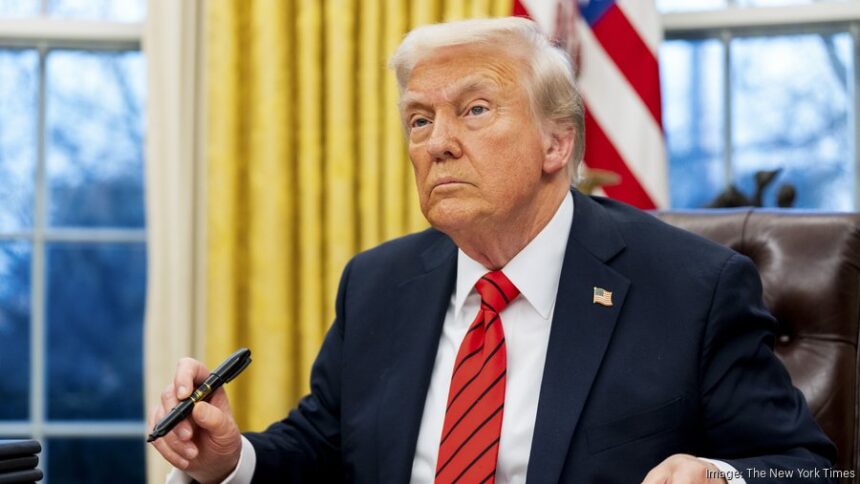
The White House under President Donald Trump has asked nine of America’s most prestigious universities to align with its political priorities in exchange for greater access to federal funding, a move that has stirred debate over academic independence, free speech, and the role of government in higher education. According to documents obtained by the Associated Press, the administration circulated a proposed agreement titled the “Compact for Academic Excellence in Higher Education,” which lays out requirements for universities on admissions, women’s sports, campus free speech, tuition, and international enrollment. While the White House has framed the pact as a step toward reforming higher education to better reflect national priorities, critics warn it could be seen as an attempt to use public money to enforce ideological conformity on America’s campuses.
The 10-page draft compact was sent on Wednesday to a select group of universities, including Vanderbilt, the University of Pennsylvania, Dartmouth College, the University of Southern California, the Massachusetts Institute of Technology, the University of Texas, the University of Arizona, Brown University, and the University of Virginia. These institutions, regarded among the most competitive in the United States, were invited to sign onto the plan in exchange for preferential treatment in federal grants and access to White House-led discussions with policymakers. A White House official, speaking on condition of anonymity, confirmed the outreach but insisted that federal money would not be limited exclusively to signatories. Nonetheless, the administration’s message was clear: colleges willing to fall in line with the government’s priorities would be rewarded.
Admissions, Tuition, and Restrictions on International Enrollment
Among the most controversial provisions in the compact are those related to admissions and enrollment. The draft agreement explicitly calls on colleges to stop considering race, gender, or other demographic factors in admissions, reversing decades of affirmative action policies that many institutions still practice. It further mandates that all undergraduate applicants be required to submit SAT or ACT scores, reestablishing standardized testing as a central requirement in the admissions process at a time when numerous universities have moved toward test-optional systems.
International enrollment, another sensitive area, is tightly capped in the proposed compact. Under the rules, no more than 15 percent of the undergraduate student body at a participating institution could consist of international students, and no more than 5 percent could come from any single country. This restriction would significantly alter the demographic makeup of many elite institutions, where international students often make up a much larger share, and could cut into the diversity and global competitiveness of U.S. higher education.
The compact also ties participation to tuition policies. It requires institutions to freeze tuition rates for domestic students for five years. Moreover, the wealthiest universities would be prohibited from charging tuition to U.S. students pursuing “hard science” programs, a condition that could reshape financial aid structures and university budgets. The administration presents these measures as part of an effort to make higher education more affordable for American families, but critics argue that such sweeping mandates could undermine universities’ autonomy and financial stability.
Free Speech, Gender Policies, and Government Oversight
The Trump administration has also embedded cultural and ideological issues into the compact. One clause requires institutions to adopt the government’s definition of gender and apply it uniformly to bathrooms, locker rooms, and women’s sports teams, a directive likely to intensify debates about transgender rights and inclusion on campuses. Colleges would also have to recommit to protecting free speech, with an explicit mandate to promote a wide range of political views. The compact further demands that schools “transform or abolish” units or offices seen as punishing or silencing conservative ideas, suggesting that current campus diversity or equity offices might be targeted.
To monitor compliance, the compact requires each institution to conduct annual polls of students and faculty, measuring the campus climate on free speech and adherence to the pact’s terms. Violations would be enforced by the Department of Justice, with penalties ranging from loss of federal privileges for at least one year to two years for repeated breaches. While the document notes that institutions remain free to pursue “models and values other than those below,” it makes clear that doing so would mean forfeiting the benefits tied to federal funding and White House access.
Responses from the targeted universities were mixed. Kevin Eltife, chair of the University of Texas Board of Regents, issued a statement welcoming the invitation, describing it as an “honor” for the Austin campus and highlighting the “potential funding advantages” that come with participation. Other universities, including Ivy League institutions like Dartmouth and Brown, did not immediately respond to requests for comment. The administration has in the past cut off research money to schools such as Harvard and Columbia, using its control of federal funding to push for changes in governance and policies.
The proposal marks one of the Trump administration’s most aggressive attempts to reshape higher education according to its ideological vision. While the plan is framed around accountability, affordability, and patriotism, its critics argue that it risks eroding the independence of universities and politicizing the country’s academic institutions. For now, the fate of the compact rests on whether these elite universities choose to sign and what consequences await those that refuse.