West Bengal has once again found itself at the epicentre of political turbulence, as the alleged suicide of a man in North 24 Parganas and a suicide attempt by another in Cooch Behar have ignited a fierce confrontation between the ruling Trinamool Congress (TMC) and the opposition Bharatiya Janata Party (BJP). The controversy revolves around the Special Intensive Revision (SIR) of electoral rolls announced by the Election Commission (EC), which the Trinamool claims is a covert attempt to reintroduce the contentious National Register of Citizens (NRC) through the backdoor. Amid accusations, counter-allegations, and charged rhetoric, the incidents have sparked fears, protests, and an intensifying political battle ahead of the state’s upcoming polls.
Political Tempest Erupts Over SIR and NRC Fears
The controversy began after the Election Commission announced the schedule for the Special Intensive Revision (SIR) of electoral rolls across 12 states and Union Territories, including poll-bound West Bengal. The announcement followed the EC’s recent completion of the same exercise in Bihar, where over 45 lakh ineligible voters were reportedly deleted from the rolls. While the EC described the move as a routine process to ensure voter list accuracy, the Trinamool Congress interpreted it differently — as a politically motivated move aimed at manipulating the electorate and spreading fear under the guise of a bureaucratic procedure.
The situation escalated on Tuesday when 57-year-old Pradeep Kar, a resident of Panihati in North 24 Parganas, allegedly died by suicide after reportedly expressing fear over the SIR exercise. A handwritten note found near his body mentioned anxiety over the NRC, an issue that continues to stir deep unease in the state. The NRC, or National Register of Citizens, is an initiative of the central government aimed at identifying legal Indian citizens and deporting illegal immigrants, a process that has so far only been implemented in Assam.
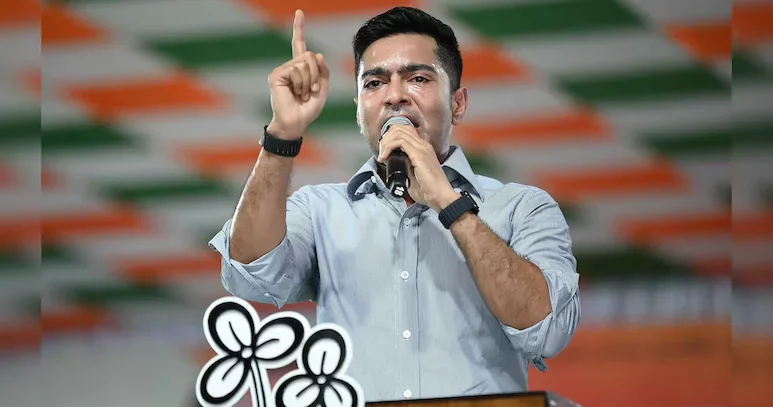
The Trinamool Congress was quick to link Kar’s death to the “panic created by the BJP’s NRC agenda.” Party’s national general secretary Abhishek Banerjee visited the deceased’s family and launched a scathing attack on the BJP and the Election Commission. He alleged that both were complicit in creating a climate of fear that drove citizens to despair. Banerjee demanded a criminal investigation against Union Home Minister Amit Shah and Chief Election Commissioner Gyanesh Kumar, accusing them of being directly responsible for “the climate of anxiety and tragedy.”
“Kar died due to anxiety over NRC and SIR. An FIR should be filed against Amit Shah and Gyanesh Kumar,” Banerjee declared, surrounded by party leaders Partha Bhowmick, Nirmal Ghosh, and Debraj Chakraborty.
As tensions mounted, another incident added to the political firestorm. A 63-year-old man named Khairul Sheikh from Cooch Behar district allegedly attempted suicide by consuming poison. According to police, Sheikh feared his name had been wrongly recorded in the 2002 voter list and was anxious about the consequences of the SIR exercise. He was admitted to the Cooch Behar District Hospital and remains under treatment.
Trinamool leaders seized on the second incident, accusing the BJP and the Election Commission of “triggering panic across Bengal.” They argued that the SIR exercise, though officially administrative, has become a tool of fear, particularly among minority and economically vulnerable communities. “Two lives, two tragedies, one cause — BJP’s politics of hate,” the party posted on X, directly blaming the central government and the EC for the distress.
Chief Minister Mamata Banerjee also waded into the issue, describing the BJP’s NRC and SIR campaigns as “politics of fear and division.” She claimed that the BJP was deliberately sowing confusion to polarize voters and gain an electoral advantage ahead of the polls. “The BJP’s campaign around NRC has created panic among the people of Bengal,” she said, adding that her government would stand firmly against any attempt to intimidate citizens or question their citizenship.
Accusations, Counter-Attacks, and Protests Deepen the Divide
As the controversy deepened, the political language turned increasingly aggressive. During his visit to Kar’s family, Abhishek Banerjee made an incendiary remark urging citizens to confront local BJP leaders demanding birth or legacy documents. “Next time local BJP leaders come to your area, stop them and ask them to furnish their parents’ certificates. Tie them to a tree or a lamp post and tell them they won’t be released until they produce their parents’ and grandparents’ documents,” he said. Though he added that “violence should not be used,” his words triggered strong reactions across the political spectrum.
The BJP immediately condemned Banerjee’s remarks, calling them a “provocative attempt to incite mob behaviour.” Leader of Opposition Suvendu Adhikari accused the Trinamool Congress of “exploiting a tragedy for political gain.” Adhikari claimed that Pradeep Kar’s death had no connection to the NRC or SIR issues, insisting that he was a registered voter who had participated in previous elections. “Kar’s death is in no way related to NRC and SIR. The unfortunate incident must be due to some other reasons,” Adhikari said, accusing the TMC of “building false narratives in an insensitive manner.”
Adhikari further stated that the TMC was resorting to fearmongering to distract the public from its own administrative failures. “The people of Bengal will give a befitting reply to such propaganda,” he asserted. The BJP maintained that the SIR process was a routine administrative exercise designed to update voter lists and had nothing to do with NRC or citizenship verification. A local BJP leader remarked, “The allegations are baseless. They are trying to give a political twist to every incident.”
Despite the BJP’s clarification, the TMC continued to mobilize public sentiment around the issue. Abhishek Banerjee announced a protest rally in Panihati demanding “justice for Pradeep Kar,” while Adhikari declared a counter-rally in the same area on November 4, setting the stage for a potentially volatile confrontation between the two rival camps.
Barrackpore Police Commissioner Muralidhar Sharma confirmed that Kar was found hanging at his residence and that preliminary investigations indicated he was “in depression following the announcement of SIR.” The discovery of his handwritten note, expressing fear of documentation requirements, has further inflamed suspicions that bureaucratic and political pressures played a role in his death.
Adding to the political drama, TMC leader Partha Pratim Roy alleged that the SIR exercise has created widespread panic, particularly among former enclave residents in Cooch Behar who fear being declared “outsiders in their own land.” He called for the Election Commission to take full responsibility for the growing unrest. “The Commission must take responsibility. Two consecutive incidents show how the SIR is affecting lives,” he said.
While opposition parties such as the Congress and the Left have largely stayed on the sidelines, several of their leaders have quietly echoed concerns over the SIR exercise, calling for greater transparency from the Election Commission. They have also accused the BJP of “weaponising bureaucracy to create fear among voters,” a charge the saffron party has categorically rejected.
As Bengal prepares for another heated election season, the SIR controversy has taken on larger symbolic significance. For the TMC, it has become an opportunity to revive its “Bengal versus Delhi” narrative — portraying itself as the defender of citizens’ rights against what it calls the Centre’s coercive tactics. For the BJP, on the other hand, the row provides a chance to accuse the TMC of playing identity politics and obstructing lawful administrative processes.
The unfolding events underscore a growing mistrust between the state and the Centre, with the Election Commission caught in the crossfire. As both parties prepare to take their fight to the streets, Bengal once again stands at the intersection of politics, identity, and fear — a familiar yet volatile mix that has come to define the state’s political narrative in recent years.
Both incidents — the suicide of Pradeep Kar and the attempt by Khairul Sheikh — have thrown light on the psychological toll of politicized citizenship debates. What began as a bureaucratic voter list revision has spiralled into a charged confrontation that blurs the line between governance and intimidation. In Bengal’s fraught political landscape, the line between administrative exercises and electoral manoeuvres remains dangerously thin — and every tragedy, it seems, becomes another weapon in the battle for perception.