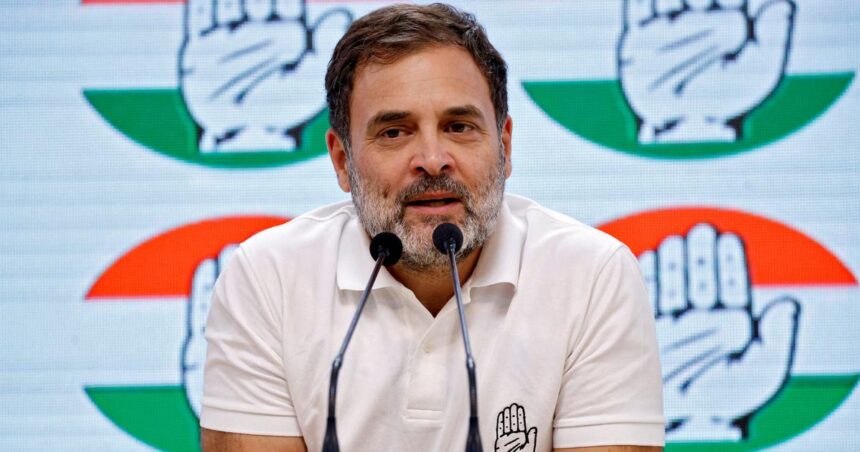
The Budget Session of Parliament was thrown into turmoil after Leader of Opposition Rahul Gandhi’s brief reference to an unpublished memoir by a former Army chief sparked sharp objections from the treasury benches, leading to repeated adjournments of the Lok Sabha and an intense political confrontation between the ruling party and the opposition.
Proceedings in the Lok Sabha were disrupted on Monday when Rahul Gandhi attempted to read from the unpublished memoir of former Army chief Manoj Mukund Naravane during his speech. Gandhi was stopped after uttering only four words, “Chinese tanks in Doklam,” as members from the treasury benches immediately objected, triggering loud protests and disorder in the House. The Speaker adjourned the House first until the afternoon, then again, before finally adjourning proceedings for the entire day as the uproar showed no signs of subsiding.
The incident quickly escalated into a broader political row, with the government accusing the opposition of violating parliamentary norms and endangering national security, while opposition leaders alleged that the ruling dispensation was deliberately suppressing debate and silencing uncomfortable questions. What might have been a routine speech during the Budget Session thus turned into a flashpoint reflecting deeper tensions over free speech, parliamentary privilege and the limits of political criticism.
Government cites constitutional limits and parliamentary rules
Soon after the disruption, senior leaders of the ruling Bharatiya Janata Party defended the objections raised in the House by invoking constitutional provisions and parliamentary conventions. BJP MP Nishikant Dubey said that while Members of Parliament enjoy freedom of speech under Article 105 of the Constitution, this freedom is not absolute and is subject to regulation by the Speaker in the interest of orderly proceedings. He also referred to Article 19, which allows reasonable restrictions on speech in matters concerning national security and relations with foreign countries.
According to Dubey, quoting from unpublished material, particularly one related to military and strategic matters, was against established parliamentary practice. He argued that references to such sensitive content could have implications beyond the House and therefore warranted intervention by the Chair. Union Minister Giriraj Singh echoed similar sentiments, accusing Rahul Gandhi of disregarding repeated appeals from the Speaker and undermining the dignity of Parliament by persisting with the reference.
Government leaders maintained that the objection was procedural rather than political, insisting that the issue was not about who was speaking but about adherence to rules. They contended that Parliament is not a forum for reading out excerpts from books or memoirs, especially unpublished ones, and that such actions disrupt the legislative agenda at a time when crucial Budget-related discussions are underway.
The ruling side also sought to frame the controversy as an attempt by the opposition to divert attention from substantive policy debates. By repeatedly stalling proceedings, government members argued, the opposition was preventing discussion on economic priorities, pending legislation and governance issues that directly affect citizens.
Opposition accuses centre of silencing debate
Opposition parties strongly rejected the government’s defence, accusing it of hiding behind procedural arguments to avoid scrutiny. Leaders from the Congress and other opposition parties said the aggressive reaction to a brief reference exposed the government’s sensitivity and unwillingness to confront questions related to national security and foreign policy.
Rashtriya Janata Dal MP Manoj Kumar Jha said the government’s objections only amplified the importance of the issue, suggesting that if the remarks were unfounded, they could have been countered through debate rather than disruption. He argued that Parliament should be a space where even uncomfortable truths can be discussed openly, especially when they relate to matters of public interest.
Congress MP Karti Chidambaram went further, calling the government’s response unprecedented. He said it was unusual for a ruling dispensation to object so strongly to a reference from the autobiography of a former Army chief, even if unpublished. According to him, the repeated adjournments reflected an attempt to suppress Rahul Gandhi’s voice rather than uphold parliamentary decorum.
Opposition leaders also questioned the selective invocation of rules, pointing out that references to books, reports and external material have been made in Parliament in the past without similar objections. They alleged that the current reaction stemmed from political considerations rather than genuine concern for procedure or national security.
The controversy has added to a series of disruptions that have marked the ongoing Budget Session, raising concerns about Parliament’s ability to function effectively amid heightened political polarization. With both sides digging in, the episode has become emblematic of the broader struggle between the government and the opposition over narrative control, accountability and the scope of debate within democratic institutions.
As the Budget Session continues, the fallout from Monday’s uproar is likely to influence the tone of future proceedings, with opposition parties expected to press harder on issues they believe are being avoided, and the government seeking stricter enforcement of parliamentary rules to maintain order.