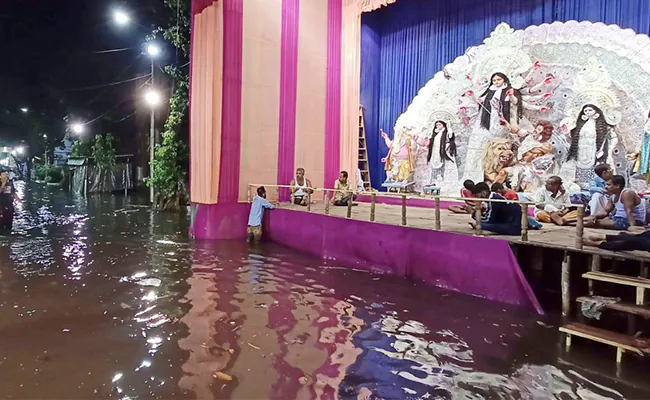
At least ten people were killed in West Bengal after one of the heaviest spells of rainfall in four decades lashed Kolkata and adjoining districts overnight, leaving the city and its surrounding areas paralyzed. According to officials, eight people died of electrocution in different parts of Kolkata, while one death each was reported from Bishnupur in Amtala and from North 24 Parganas. The unprecedented downpour—over 300 millimetres recorded in just a few hours—brought air, rail, and road traffic to a grinding halt, shut down schools and colleges, and even forced the state government to advance Durga Puja holidays. While the administration scrambled to manage the crisis, the tragedy has triggered a heated political confrontation in the state, with the opposition accusing the Trinamool Congress (TMC) government of negligence and the ruling party hitting back against what it described as the politicisation of a natural calamity.
Rain Havoc and Administrative Response
The torrential downpour, which the India Meteorological Department described as one of the heaviest in recent decades, plunged Kolkata into chaos. Several areas were inundated with knee- to waist-deep water, stranding thousands of commuters and forcing many to abandon their vehicles on waterlogged streets. Flights were cancelled, long-distance trains were delayed, and several suburban railway services were suspended due to flooding on tracks. The state transport network collapsed as buses, taxis, and even app-based cabs refused to ply on submerged routes.
Educational institutions across Kolkata and the surrounding districts were ordered shut, while the government announced an early start to Durga Puja holidays in view of the disruption. The civic body and disaster response teams were pressed into service to pump out water, rescue stranded passengers, and restore some semblance of order in the battered city. Kolkata Mayor Firhad Hakim, speaking exclusively to News18, admitted that the intensity of the rainfall was beyond anything he had experienced in his lifetime. “This kind of unprecedented rain, I have never seen in my life. No sewerage system in the world could have handled this situation. Still, our workers have done their best,” he said, defending the civic response amid widespread criticism.
Yet, the human toll was grim. Electrocution claimed eight lives in Kolkata alone, with several victims reported to have stepped into flooded streets where electrical wires were exposed. The tragic deaths have intensified the debate over preparedness and accountability, especially as power supply in many areas had to be deliberately cut off to prevent further casualties.
Political Face-Off Over Negligence Allegations
The disaster quickly spiralled into a political battle. Leader of the Opposition Suvendu Adhikari launched a scathing attack on Chief Minister Mamata Banerjee and her government, accusing them of failing to heed warnings issued by the India Meteorological Department. “EXPOSED: Mamata Banerjee’s shameless lies and incompetence… The IMD had issued an orange warning for very heavy rainfall in Gangetic West Bengal. Yet the government did nothing to prepare. This is not an act of God, it’s a failure of leadership,” Adhikari posted on social media.
Adhikari alleged that the Chief Minister was attempting to shift the blame to private power suppliers like the Calcutta Electric Supply Corporation (CESC) and Damodar Valley Corporation (DVC), rather than accepting responsibility for ignoring forecasts. In a controversial remark, he went further, claiming that the tragedy was a “curse from Ma Durga” because Mamata Banerjee inaugurated Durga Puja festivities before Devi Paksha and did so wearing a hijab. His remarks sparked outrage across political lines, with many accusing him of communalising a natural disaster.
BJP leader Amit Malviya echoed Adhikari’s criticisms, accusing the government of negligence and incompetence. The Bharatiya Janata Party (BJP) sought to portray the deaths and chaos as evidence of systemic governance failure under the TMC.
The TMC, however, hit back sharply. Party spokesperson Kunal Ghosh dismissed the criticism, arguing that such extreme weather events were beyond administrative control. “What do you mean by unprecedented? Even Mumbai and other cities get flooded. These are natural calamities,” Ghosh said. Chief Minister Mamata Banerjee herself condemned attempts to politicise the tragedy. “Some people are making political comments over this disaster—this should not be done. Even after the massive landslides in Uttarakhand or floods in Delhi and Maharashtra, we never said a word. But remember, nature is not in our control. There is a limit to civility,” she said in a public statement.
Her comments, while aimed at calming the political storm, have not prevented the opposition from sharpening its attacks as the state heads into the festive season, with Durga Puja—a politically sensitive period in Bengal—just days away.
CESC Under Fire Amid Electrocution Deaths
The electrocution deaths have brought CESC, Kolkata’s primary electricity distributor, under intense scrutiny. Several of the fatalities were reported to have occurred when residents stepped into flooded areas where live wires were exposed. Mamata Banerjee said she had personally spoken to CESC Chairman Sanjiv Goenka and asked the company to ensure immediate safety measures. She also directed that families of the deceased be given a compensation of ₹5 lakh each.
CESC, however, issued a statement clarifying its position. The utility stressed that it had proactively switched off power supply in certain areas to protect residents from electrocution risks due to extreme waterlogging. “As a matter of abundant caution, considering public safety and extreme waterlogging, supply to certain areas has been proactively switched off. Power will be restored only when water recedes to safe levels. Street light poles and traffic lights are not owned, maintained or managed by CESC. Our teams are working round the clock in coordination with authorities,” the statement read.
The company’s defense has not pacified critics, many of whom argue that the electrocution deaths point to longstanding deficiencies in Kolkata’s infrastructure. Power cuts, meanwhile, continue to affect large swathes of the city, adding to the misery of residents already struggling with waterlogged homes, damaged belongings, and disrupted livelihoods.
The India Meteorological Department has forecast an improvement in weather conditions over the next 24 to 48 hours, but the political storm shows little sign of abating. With Durga Puja preparations underway and public anger simmering over the loss of lives and widespread disruption, the heavy rain has not only drenched Kolkata but also set the stage for a fierce political confrontation that may dominate the state’s political discourse in the coming weeks.