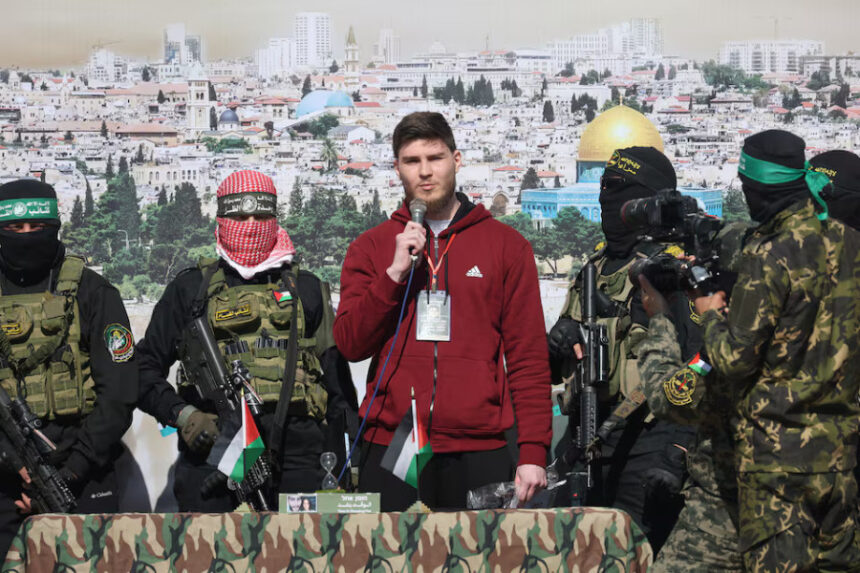
In a significant development, three Israeli hostages—Iair Horn, Sagui Dekel-Chen, and Sasha (Alexander) Troufanov—were freed in Gaza on Saturday as part of a hostage-prisoner exchange. In return, Israel began the process of releasing 369 Palestinian prisoners and detainees. The swap, facilitated by international mediators, helped avert the collapse of an ongoing ceasefire, which is in its first 42-day phase since taking effect on January 19.
The exchange took place in Khan Younis, where the three hostages were brought onto a stage with armed Hamas militants standing beside them, before being handed over to Israeli forces. Live footage captured the moment as they were taken into Israel. Shortly after, a bus carrying freed Palestinian prisoners left Ofer jail in the Israeli-occupied West Bank, arriving in Ramallah to a large, cheering crowd waving Palestinian flags.
In Tel Aviv, at what has become known as Hostage Square, people erupted in cheers and tears upon learning that the Red Cross was transporting the freed hostages to Israeli military forces in Gaza. Unlike three previously released hostages who appeared weak and emaciated, the newly freed trio were seen in relatively better physical condition. Israeli residents near the Gaza border lined the roads, waving Israeli flags as the vehicles carrying the hostages passed by.
The hostages had been taken captive on October 7, 2023, when Hamas militants stormed Kibbutz Nir Oz, one of the hardest-hit communities near Gaza. Troufanov, a Russian-Israeli, was abducted along with his mother, grandmother, and girlfriend, who were released in a November 2023 truce, while his father was killed in the attack. Dekel-Chen, a U.S.-Israeli, had left his pregnant wife and two daughters in the family safe room to fight off the attackers. With his release, he will now meet his youngest daughter for the first time. Argentina-born Horn, 46, who managed the Nir Oz pub, was taken captive alongside his younger brother Eitan, who remains in captivity.
The handover was symbolically charged as militants presented Horn with an hourglass and a photo of another hostage, along with a message stating “time is running out” for those still held in Gaza. The exchange eased fears that the fragile ceasefire could collapse before the first phase of negotiations concluded.
So far, 19 Israeli hostages and five Thais have been freed, while 73 remain captive, with half of them presumed dead, according to Israeli authorities. Hamas had threatened to halt further releases, accusing Israel of blocking humanitarian aid to Gaza, prompting Israel to call up reservists and put its forces on high alert. The poor condition of some previously released hostages, along with accounts of mistreatment, has fueled Israeli protests demanding the government maintain the ceasefire and push for the release of all captives.
In response to criticism over hostage treatment, Islamic Jihad, an ally of Hamas, released a video of Troufanov on Friday, showing him eating and fishing on a Gaza beach in an apparent attempt to counter reports of abuse.
Meanwhile, political tensions over Gaza’s future have grown following former U.S. President Donald Trump’s call for Palestinians to be permanently relocated and for Gaza to be redeveloped under U.S. control—a proposal rejected by Palestinian groups, Arab states, and Western allies.
Hamas had agreed to a six-week truce last month, under which 33 hostages, including women, children, and sick or wounded men, would be freed in exchange for hundreds of Palestinian prisoners. Before Saturday, 16 of the 33 hostages had been released, along with five Thai nationals, leaving 76 hostages still in Gaza, with only about half believed to be alive.
The ceasefire was intended to facilitate negotiations for a complete withdrawal of Israeli forces and a final end to the war, allowing for the rebuilding of Gaza, which has been left in ruins with severe shortages of food, water, and electricity.
The conflict began on October 7, 2023, when Hamas launched an attack on Israeli communities, killing approximately 1,200 people and taking 251 hostages, according to Israeli figures. Israel’s subsequent military campaign in Gaza has resulted in over 48,000 Palestinian deaths, according to Gaza’s health ministry, while widespread destruction and displacement continue to mount.