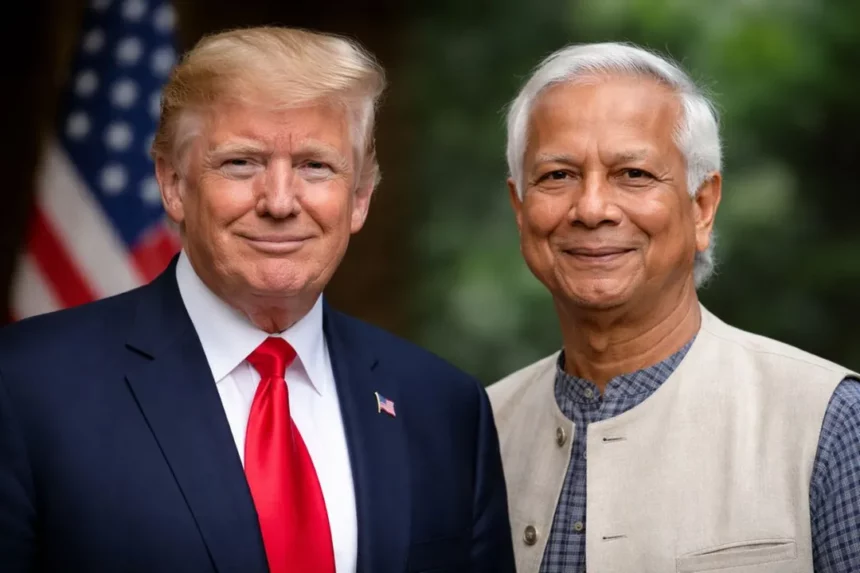
The global diplomatic landscape witnesses a series of consequential developments as the United States prepares to formalise a trade agreement with Bangladesh on the eve of a politically sensitive election cycle in Dhaka. The timing of the deal, coming shortly after a significant trade understanding between India and Washington, has placed South Asia at the centre of renewed geopolitical attention. While trade negotiations dominate headlines, parallel developments across Asia-Pacific and the Middle East underline the interconnected nature of diplomacy, governance, and global security.
For Bangladesh, the impending agreement represents more than a commercial arrangement. It unfolds against a backdrop of domestic political uncertainty, long-awaited elections, and heightened international scrutiny. For the United States, it forms part of a broader recalibration of economic engagement in South Asia, balancing strategic interests, supply chain diversification, and political signalling.
Elsewhere, developments ranging from judicial proceedings in Hong Kong to diplomatic engagements in Australia reinforce how domestic events increasingly carry global resonance. Together, these stories reflect a world where economic policy, political legitimacy, and international norms are deeply intertwined.
Bangladesh–US Trade Negotiations and Strategic Timing Ahead of Dhaka Polls
The anticipated Bangladesh–US trade agreement emerges at a moment of heightened political sensitivity in Dhaka. With national elections approaching, the deal has acquired significance beyond tariffs and market access. It signals Washington’s willingness to engage economically with Bangladesh even as questions surrounding democratic processes and governance remain part of international discourse.
Bangladesh’s urgency in concluding the agreement has been shaped in part by recent developments involving India. After New Delhi secured reduced tariff access to the US market, regional competition intensified. For Dhaka, delaying engagement risked economic disadvantage, particularly in sectors such as textiles and manufacturing that form the backbone of its export economy.
From Washington’s perspective, the agreement aligns with broader efforts to diversify supply chains and reduce overreliance on single manufacturing hubs. Bangladesh’s growing role in global apparel production makes it an attractive partner, especially amid shifting trade dynamics and geopolitical realignments.
The political timing, however, has drawn attention. Signing a trade deal days before elections inevitably raises questions about external influence, even when negotiations are framed as long-term economic arrangements. While the United States has avoided overt political commentary, the optics of the agreement have not gone unnoticed by regional observers.
Within Bangladesh, the deal is expected to be presented as a validation of economic stewardship and international confidence. At the same time, critics argue that trade benefits must be weighed against labour standards, regulatory reforms, and broader democratic accountability. These tensions underscore the complex relationship between economic diplomacy and domestic legitimacy.
The agreement also reflects a subtle recalibration of US engagement in South Asia. Rather than viewing the region solely through a security lens, Washington increasingly emphasises trade, investment, and economic integration as tools of influence. Bangladesh’s inclusion in this framework highlights its rising strategic relevance.
Global Developments: Justice, Diplomacy, and the Politics of Symbolism
Beyond South Asia, the day’s developments illustrate how domestic events in one region resonate internationally. In Hong Kong, the impending sentencing of a prominent media figure under a national security framework imposed by Beijing continues to attract global attention. The case has become emblematic of broader debates over press freedom, judicial independence, and the evolving governance model in the territory.
For many governments and rights advocates, such proceedings are not isolated legal matters but indicators of shifting political norms. They influence diplomatic postures, trade considerations, and international perceptions of legal certainty in global financial centres.
Meanwhile, in Australia, the visit of a foreign head of state to honour victims of a past attack underscores how acts of remembrance have become part of diplomatic engagement. Such gestures serve multiple purposes: expressing solidarity, reinforcing bilateral ties, and acknowledging shared values in the face of violence.
These events, though disparate, share a common thread. They demonstrate how symbolism, timing, and context shape international relations as much as formal agreements do. A trade deal signed before an election, a court sentence handed down under a contested law, or a commemorative visit following tragedy all carry messages beyond their immediate circumstances.
Together, the developments reflect a global environment where economic policy, political authority, and moral positioning intersect. Governments increasingly operate in a space where domestic decisions are instantly globalised, scrutinised, and interpreted through geopolitical lenses.