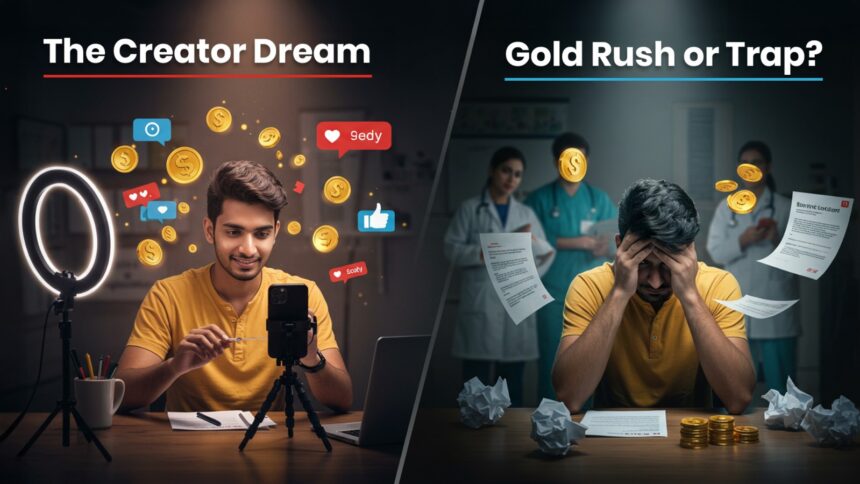
In today’s digital-first world, the meaning of ambition has changed drastically. Where once Indian youth dreamed of becoming doctors, engineers, or IAS officers, many now aspire to be YouTubers, Instagram influencers, and full-time content creators. It is no longer surprising to hear a 16-year-old declare they want to be the “next CarryMinati” or make crores from Instagram reels. This shift has been brought on by the explosive growth of the creator economy—a rapidly expanding digital ecosystem where individuals can earn money by producing and sharing content online. It is the first time in history that so many people have had direct access to a global audience and the ability to monetize their ideas, talents, and personalities without a traditional gatekeeper. But behind the bright lights of viral fame, a more complex and often darker reality exists—one that demands deeper reflection.
What is the Creator Economy?
The creator economy refers to the world of individuals—known as creators—who build their careers and incomes by engaging audiences through content. This can include videos on YouTube, reels on Instagram, podcasts on Spotify, or newsletters on Substack. What connects them all is a direct relationship with an audience. These creators don’t work for a company in the traditional sense. They create value in the form of entertainment, education, or inspiration and monetize it through various channels. These include ad revenues (as on YouTube), brand sponsorships, affiliate links, merchandise sales, online courses, fan donations (such as on Twitch or Patreon), or exclusive content subscriptions.
This model has democratised creative expression. Anyone with a smartphone, a decent internet connection, and a spark of originality can technically become a content creator. From rural vloggers to urban finance educators, India has witnessed an explosion of new-age digital entrepreneurs, blurring the line between influencer and educator, artist and entertainer, hobbyist and professional.
The Scope and Scale of the Creator Economy
The creator economy is not a fringe phenomenon—it is a global force. As of 2024, it is valued at approximately $250 billion, and investment firms such as Goldman Sachs predict that this figure could nearly double to $480 billion by 2027. Platforms such as YouTube alone pay between $15–20 billion annually to creators, while TikTok, Twitch, Patreon, and OnlyFans also distribute billions across their ecosystems. This economy is supported not only by advertising but also by consumer tipping, paid subscriptions, and massive brand collaborations.
India is a unique engine within this space. With over 80 crore internet users, the cheapest mobile data rates in the world, and one of the largest youth populations globally, the country is experiencing a digital revolution. Regional content in Hindi, Tamil, Bengali, Bhojpuri, and other Indian languages has opened up creator opportunities far beyond the English-speaking elite. Yet despite this growth, the rewards remain highly uneven. Studies and platform data suggest that less than 2% of creators earn enough to make a sustainable, full-time income. The rest either do it as a side hustle or drop out entirely after seeing little return on effort.
What It Takes to Succeed
Success in the creator economy is not determined by luck alone. It requires an intricate combination of creativity, business acumen, technical skills, and emotional resilience. Successful creators often spend hours researching content ideas, scripting, filming, editing, analyzing performance data, and engaging with their audience. The process is closer to running a startup than uploading a few funny clips. Building a niche is critical, as audiences today crave authenticity and expertise. Whether it’s tech unboxings, cooking recipes, educational explainers, or lifestyle vlogs—standing out means offering consistent value.
Moreover, platforms reward regularity. Algorithms on YouTube, Instagram, and TikTok prioritize creators who post frequently and keep viewers engaged. Thus, creators must commit to a schedule, constantly optimize their content, and adapt to new formats. Even after achieving some recognition, they are expected to diversify their income through merchandise, partnerships, online classes, or fan support. In essence, to succeed as a creator today is to become a mini-enterprise, complete with its own brand, operations, and audience strategy.
The Hidden Dangers of the Creator Dream
However, the bright surface of the creator economy hides many cracks. One of the biggest problems is oversaturation. Every minute, thousands of creators publish content, leading to fierce competition. For a new voice to be heard amid this digital noise is increasingly difficult. Algorithms, which determine which videos go viral and which disappear, are often opaque and unpredictable. This creates anxiety and instability. A change in YouTube’s policies or Instagram’s reach mechanics can dramatically affect a creator’s income overnight.
Burnout is another critical issue. The constant need to remain visible, relevant, and engaging takes a heavy emotional toll. Creators report high levels of stress, anxiety, and depression—especially when videos underperform or online trolls target them. There is also the danger of financial insecurity. For most creators, income is highly volatile. Some months may bring in lakhs, while others bring in almost nothing. Without benefits such as insurance, retirement plans, or job security, creators live in a high-risk professional space.
Scams and unethical practices are rampant too. Many young creators, eager to grow fast, fall for fraudulent brand deals, fake collaborations, and even phishing attacks that steal their channel credentials. Moreover, the platform-centric nature of the economy means that creators are essentially building their careers on rented property. If a platform decides to ban their account or change their monetization rules—as YouTube did in July 2025 with stricter AI content enforcement—creators can lose years of work in an instant.
Why Not Everyone Should Become a Creator
Given these challenges, it is important to recognize that content creation is not a one-size-fits-all career. The romanticism around “working from anywhere” and “earning crores” masks the brutal reality that most creators do not make it. Many young people today start YouTube channels or Instagram pages not out of passion, but out of a desire to get rich quickly. They drop out of college, abandon skill-building, and chase virality. But fame is fleeting. And in the creator world, there is no fallback if things go wrong.
It is also vital to understand that India needs more than just entertainers. We need teachers, doctors, civil engineers, scientists, farmers, and researchers. These are not backup options—they are professions that build society. The economy does not need every student to become a content creator; it needs people who know when and how to use digital platforms to amplify real, meaningful work.
India’s Unique Role and Youth Responsibility
That said, India’s potential in the creator economy remains unmatched. The next wave of successful creators may not come from metro cities, but from Tier-2 and Tier-3 towns. Youth who speak in regional languages, share their lived experiences, or teach others through YouTube or podcasts have a genuine shot at success. But they must also be taught digital ethics, storytelling skills, platform literacy, and financial discipline.
Rather than seeing content creation as an “escape” from education or employment, Indian youth should see it as an extension of their career and identity. A science student explaining physics on YouTube is just as much a creator as a fashion stylist showcasing their work on Instagram. By combining technical education with content production, young people can create careers that are both sustainable and impactful.
Conclusion: Create with Clarity, Not Just Hype
The creator economy is here to stay. It is one of the most exciting and accessible industries for a digitally connected generation. But it is not a shortcut to success. It is a long, uneven, often lonely journey filled with experimentation, rejection, reinvention, and sometimes, recognition.
For Indian youth, the message is clear: Create, but create consciously. Don’t follow trends blindly. Don’t compare your journey with influencers showing only the highlights. Learn. Build skills. Start small. Think long-term. And remember, a smartphone can give you access—but only wisdom can give you direction.
In the end, becoming a creator isn’t about gaining followers. It’s about creating value—for yourself, your community, and your country.