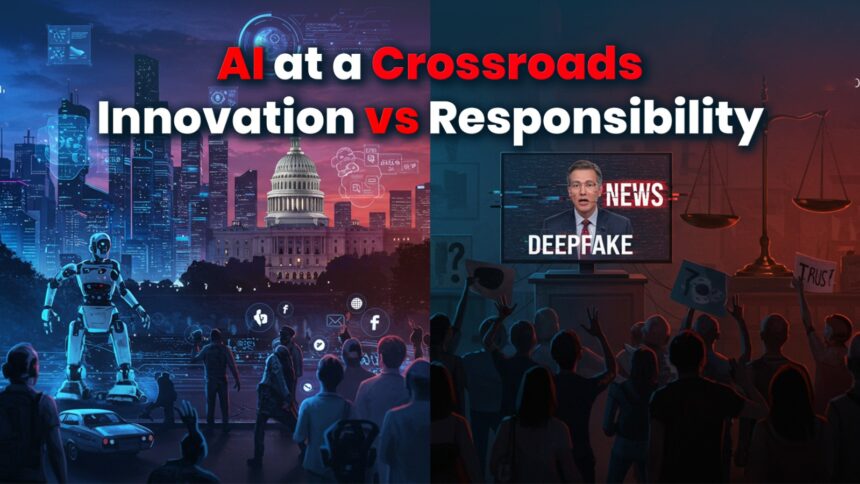
In May 2025, a video began circulating on social media that appeared to show a well-known U.S. senator resigning from office amidst scandal. Within hours, it was trending across platforms, fueling speculation, outrage, and even market tremors. But 48 hours later, forensic analysts confirmed what many had feared, it was a deepfake, a hyper-realistic, AI generated video. By the time the truth was clarified, reputations had been damaged, political fallout had begun, and public trust had eroded. This incident was not an isolated prank, it was a powerful warning of what unregulated artificial intelligence is capable of.
Artificial intelligence is no longer confined to the labs of Big Tech or the backend of search engines. It is now crafting stories, manipulating voices, generating images, writing code, producing art, and even shaping public discourse. This growing influence has ignited a global debate that is currently playing out with full intensity in the United States. The central question is urgent and complex: How do we embrace AI’s transformative potential without compromising privacy, truth, safety, and democracy?
To understand this debate, it is essential to first grasp what AI regulation entails and why it is becoming a cornerstone of policy discussion across the world. AI regulation refers to the creation of laws, standards, and frameworks that govern the development and deployment of artificial intelligence systems. These rules are designed to prevent harmful uses of AI, protect user privacy, ensure fairness and transparency, and establish accountability for the outcomes generated by machines. In essence, AI regulation aims to strike a balance, encouraging innovation while placing necessary guardrails to safeguard individuals and institutions.
In the United States, the regulation of AI has now become a defining issue of the political landscape. In July 2025, President Donald Trump unveiled a sweeping “AI Action Plan” as part of his campaign to regain political leadership. This plan included a series of three executive orders that promote rapid AI growth by minimizing federal oversight and encouraging technological expansion. The orders aim to fast-track infrastructure development for data centers, promote international exports of American AI technologies, and strip away what the plan describes as “ideological filters”, a direct reference to banning AI systems that exhibit so-called “woke” or politically progressive behavior. Perhaps the most controversial part of the plan is its mechanism to penalize state governments that attempt to regulate AI more stringently by cutting off federal funding for AI related infrastructure. In Trump’s vision, AI should remain a free, unshackled tool for American dominance, not a tightly controlled or censored technology.
In sharp contrast, Congress has responded with a series of legislative proposals that reflect growing public concerns about privacy, misinformation, and manipulation. A bipartisan bill known as the AI Accountability and Personal Data Protection Act was introduced in July 2025 by Senators Josh Hawley and Richard Blumenthal. This proposed law would give individuals the right to sue technology companies if their personal data or intellectual property was used without consent in training AI models. It would also impose transparency obligations on companies, requiring them to disclose how their models are trained and what data is involved. In addition, the TAKE IT DOWN Act, signed into law earlier in May, mandates that platforms remove AI generated deepfake content if it is non-consensual or defamatory, particularly in cases involving sexual imagery or reputational harm. These legislative moves reflect a growing realization among lawmakers that without legal consequences, AI misuse will only accelerate.
Beyond the halls of Congress, U.S. state governments are actively passing their own AI related laws. States like Montana have banned the use of AI for government surveillance, while others like California are pushing for stricter guidelines on transparency and disclosure in AI generated content. These statelevel initiatives show that lawmakers at all levels recognize both the opportunities and the risks AI presents. However, under Trump’s AI Action Plan, these same states could see their federal support for AI infrastructure and broadband expansion withdrawn, setting up a complex federal-state conflict that may play out in courts as well as in upcoming elections.
The urgent need for regulation becomes clearer when we look at the real-world risks and harms already emerging. One of the most visible dangers is the proliferation of deepfakes. These synthetic videos and audio recordings can be used to impersonate politicians, journalists, or private citizens, leading to misinformation, public panic, and personal devastation. They blur the line between truth and fiction, making it increasingly difficult for the public to know what to trust.
Another critical concern is data piracy. Many large language models and generative AI systems have been trained on vast troves of data scraped from the internet, including copyrighted books, personal blogs, artworks, medical records, and social media conversations. Much of this data was used without consent, compensation, or even notification, raising serious ethical and legal concerns about intellectual property and digital rights.
There is also the issue of algorithmic bias and discrimination. Multiple studies have shown that AI systems can produce skewed results when used in hiring, criminal sentencing, facial recognition, or credit scoring. These biases often reflect historical inequalities embedded in the data used to train the systems. The consequences of such bias are not theoretical, they are already impacting lives in the form of denied jobs, wrongful arrests, and unequal treatment.
Mental health is yet another front where AI poses growing challenges. Platforms powered by AI algorithms can manipulate user behavior by optimizing for engagement, often reinforcing addictive behaviors or pushing harmful content. Teenagers and young adults are particularly vulnerable to these influences, which can lead to anxiety, depression, and other psychological effects.
Finally, the lack of coordinated global regulation has led to a fragmented and often chaotic AI environment. While Europe has passed the EU AI Act, a structured legal framework that classifies AI by risk and imposes strict requirements for high-risk systems—the United States has no national law of similar scope. India, meanwhile, has adopted a light-touch approach, issuing ethical guidelines and promoting innovation but without clear enforcement mechanisms. This global regulatory gap creates a “Wild West” where companies can exploit jurisdictions with weaker laws, bypassing accountability and undermining fair competition.
India now stands at a strategic crossroads. As the world’s fastest growing digital economy and a rising force in AI development, it has both the opportunity and the responsibility to shape the ethical landscape of global technology. Indian youth, in particular, have a chance to lead this change. They can build AI tools that prioritize transparency, fairness, and inclusion. They can create regional language models that reflect local cultures without replicating global biases. They can also contribute to open-source projects, launch ethical tech startups, and demand legal frameworks that protect creators and consumers alike.
Regulation should not be viewed as a barrier to innovation. Instead, it must be seen as a guide rail, something that ensures technological progress moves in a direction that is beneficial, inclusive, and accountable. Without rules, AI can become a weapon of misinformation, surveillance, and inequality. With thoughtful governance, it can be a force for empowerment, education, and economic growth.
The AI debate unfolding in the United States is not merely a policy discussion; it is a reflection of the kind of society we want to build. As deepfakes erode trust and data misuse challenges privacy, the future of AI will depend not only on engineers and entrepreneurs but also on lawmakers, educators, and an informed public. It is no longer a question of whether to regulate AI, but how and how soon.
As India, the U.S., and the rest of the world chart their course, the most important voices in this conversation may well come from the youth. They are the users, the creators, and the future leaders of this technology. It is time they shape it with clarity, courage, and conscience.