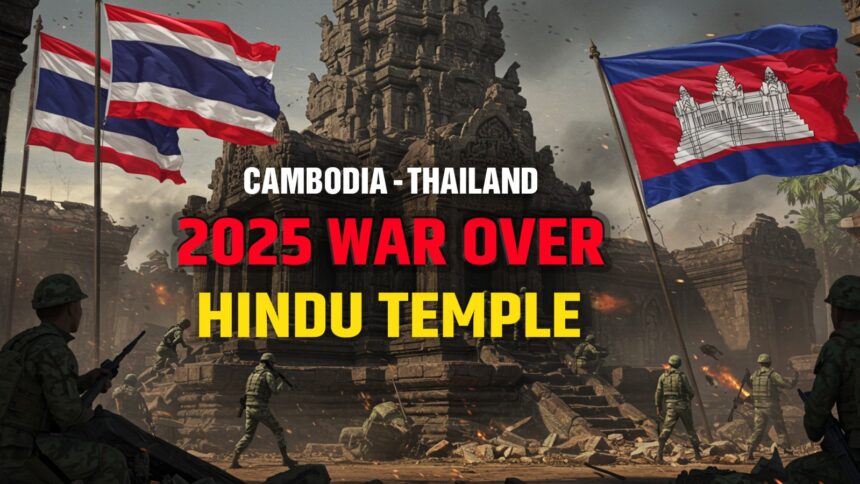
On July 26, 2025, the world woke up to the news of escalating conflict between Thailand and Cambodia. Airstrikes, rocket launches, and artillery exchanges transformed the quiet border into a full-blown warzone. This is not just a battle over lines on a map—it is a crisis rooted in history, faith, and pride. With over 32 people killed and more than 130 injured, including children and civilians, the world is watching with bated breath. This article explores the roots of the conflict, its cultural underpinnings, its humanitarian toll, and how India is intrinsically tied to this ongoing crisis.
Historical Background: A 900-Year-Old Dispute
The conflict between Thailand and Cambodia over the Preah Vihear temple and its surrounding territory is not new. Dating back to the era of the Angkor Empire, the temple has been a symbol of Khmer pride and spiritual significance. In 1907, a French-made map assigned the temple to Cambodia, then under French colonial rule. Thailand never accepted the map’s validity. The International Court of Justice ruled in 1962 that the temple belonged to Cambodia. However, Thailand continued to assert claims over the adjacent land, creating a long-standing territorial dispute that has periodically flared into violence. The situation intensified in 2008 when Cambodia secured UNESCO World Heritage status for the temple, a move Thailand opposed strongly.
The Present Conflict: Why Now?
In 2025, a combination of political instability in Thailand and strategic leadership assertion in Cambodia led to renewed hostilities. Thailand, currently under an acting Prime Minister after the suspension of Paetongtarn Shinawatra, launched ‘Operation Yuttha Bodin’ involving F-16 airstrikes on Cambodian positions. Cambodia retaliated with BM‑21 rocket attacks on Thai border towns. A leaked call suggesting backdoor deals between Thailand’s former PM and Cambodia’s Senate President further inflamed public and military sentiments. Both nations accused each other of war crimes, including targeting civilians and using banned weapons like cluster munitions.
Humanitarian Impact: Civilians Caught in the Crossfire
The border conflict has displaced more than 1.5 lakh people. Thailand alone has seen over 138,000 civilians evacuated from the Trat and Sisaket provinces. Cambodia reports at least 20,000 displaced in the Preah Vihear and Oddar Meanchey provinces. Infrastructure like schools and hospitals has been damaged or destroyed. Reports of children sheltering in bunkers instead of going to school, and families cooking over open fires in makeshift camps, paint a grim picture of the human cost of war. Accusations have flown from both sides—Thailand blames Cambodia for targeting ambulances, while Cambodia condemns Thailand for deploying cluster bombs in civilian zones.
Cultural Ties to India: A Legacy of Shared Heritage
India’s influence in Southeast Asia, particularly in Thailand and Cambodia, is profound. Angkor Wat in Cambodia, the world’s largest Hindu temple complex, is dedicated to Vishnu. Preah Vihear itself is a 9th-century Shiva temple. In Thailand, the national epic ‘Ramkien’ is based on India’s Ramayana. Sanskrit has influenced both Khmer and Thai languages. Indian cultural footprints—yoga centers, temples, classical dance, and spiritual institutions—are actively maintained in both nations. This conflict, in essence, also reflects a fracture in what was once a harmonious civilizational exchange.
Global Reaction and ASEAN’s Struggle
The United Nations Security Council convened an emergency meeting urging both parties to cease hostilities. Cambodia expressed willingness to accept a ceasefire proposed by ASEAN chair Malaysia. Thailand, however, rejected third-party mediation, demanding bilateral resolution. ASEAN’s inability to enforce peace among its members exposes structural limitations in its framework. Countries like the U.S., China, France, and India have called for restraint and offered to facilitate peace. Yet, violence continues with no clear diplomatic breakthrough.
India has maintained a position of neutrality, calling for peace while protecting its citizens in the region. Travel advisories have been issued for Indians in Cambodia and Thailand, particularly near the conflict zones. India has strong economic and cultural ties with both nations through its Act East policy. Indian yoga institutions, embassies, and businesses operate across both borders. Though not a direct participant, India’s strategic interests in regional stability and cultural legacy make it an indirect stakeholder in this conflict.
What Indian Youth Can Learn
Indian youth have a lot to gain from studying and understanding such international conflicts. Students can explore career paths in diplomacy, international law, and conflict resolution. Aspiring journalists can use this as a live case study in conflict journalism. Cultural preservationists can engage in cross-border NGO projects to restore damaged sites. Most importantly, youth must counter misinformation through digital literacy and promote narratives of peace and historical unity. With India’s cultural DNA embedded in these lands, young Indians have a moral and strategic reason to stay informed and involved.
Path to Peace: Potential Solutions
A few clear solutions emerge from this crisis. First, the deployment of a UN peacekeeping team could stabilize the area. Second, a joint heritage agreement between Thailand and Cambodia could allow shared management of the Preah Vihear temple. Third, ASEAN should consider forming a neutral border tribunal to resolve similar disputes in the future. Cross-border cultural exchange programs and youth-led initiatives can also help rebuild trust. India and other neutral countries like Vietnam and Indonesia could facilitate non-partisan dialogues. History teaches us that peace comes not by choosing sides, but by choosing sense.
The Cambodia–Thailand border war is a tragedy of pride, politics, and historical grievances. Yet within this crisis lies a deeper reminder of the shared culture that once united these nations through Indian influence. As borders burn and diplomacy falters, it becomes the responsibility of the next generation—to preserve peace, to uphold history, and to rebuild broken ties with wisdom, not war.