Imagine this, Elon Musk announces that his AI company will launch open-source language models specifically trained for Indian languages. At the same time, India’s Ministry of Defence sets aside thousands of crores to modernize its cybersecurity systems. Just a few weeks later, Google announces that it will open a quantum computing research lab in Bengaluru, the first of its kind in Asia.
These events are not just headlines. They are signals. The world is changing faster than ever, and India is playing a bigger role in that change every single day. Technologies like artificial intelligence, cybersecurity and quantum computing are not part of some distant future anymore. They are here, and they are shaping how we work, learn and even how our country defends itself.
For students in India, especially those finishing school or college, this raises one huge and urgent question. If this is what the future looks like, what kind of education should you pursue? Should you try to crack an entrance exam and get into a top-tier academic institution like an IIT? Should you join a job-focused bootcamp and learn practical skills in a few months? Or should you look for something that offers a mix of both?
Let’s look at what each of these options really means, and more importantly, which one might actually work for you.
What Academic Institutions Offer
In India, academic powerhouses like IIT Bombay, IIT Madras, IISc Bengaluru or IIIT Kharagpur are considered the gold standard of education. These institutions focus heavily on theoretical understanding, research exposure and intellectual rigor. If you want to understand the science behind how a neural network works, why quantum particles behave the way they do or how complex systems are designed, these places will teach you that with depth and precision.
Many of the people leading global research teams, writing advanced papers and filing deeptech patents have studied at such places. The environment in these institutions encourages you to think deeply, solve problems over time and engage with faculty who are often global experts in their field.
But this path isn’t for everyone. These institutions are extremely competitive, often require years of preparation, and their curriculum tends to focus more on conceptual mastery than immediate industry relevance. You will have a strong foundation in computer science, but you might still need to build practical skills outside the classroom when you enter the job market.
What Skilling Institutions Do Differently
Now let’s look at the other end of the spectrum. In the last five years, many private education companies have built fast-paced, job-oriented programs that teach coding, data science, machine learning, cybersecurity and more. These include institutions like Scaler, Masai School, Newton School and others that train students not for exams or research, but for real-world jobs.
The difference here is speed and focus. Instead of spending years in a classroom, students here learn by building projects, solving coding problems, getting feedback from mentors and preparing directly for interviews. These programs are often just a few months long. Some even allow you to pay the fees only after you get a job.
For students who want to enter the workforce quickly, these institutions offer a very practical route. Especially for those who may not have cleared a top-tier entrance exam, or who want to switch into tech from another background, these programs open up real opportunities.
But there are trade-offs here too. You might not get the research experience or theoretical depth that academic institutions offer. If you’re aiming for cutting-edge R\&D, a fast-paced bootcamp might not prepare you fully for that journey.
What Hybrid Institutions Are Doing Right
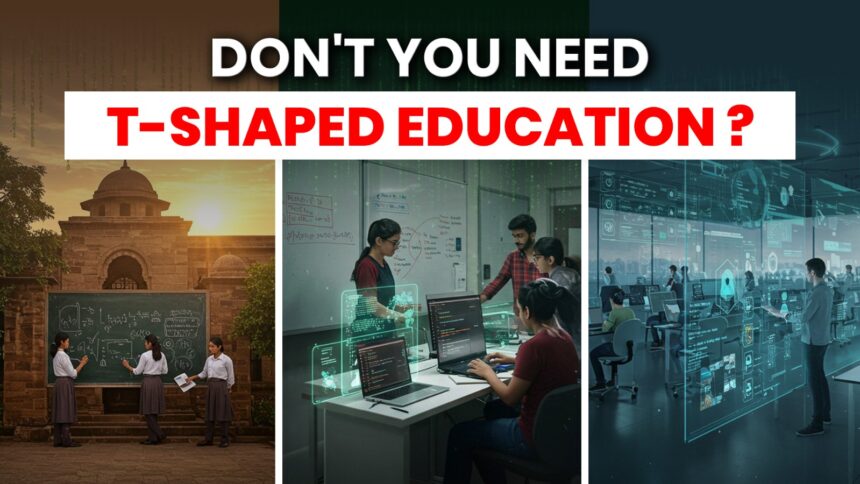
There is also a third kind of education model emerging in India. These are hybrid institutions. They combine the academic structure of a degree with the real-world application and pace of a bootcamp. This model is still new in India, but it is growing fast and showing very promising results.
One of the most prominent examples of this is Plaksha University in Mohali. Founded by a group of global entrepreneurs and tech leaders, Plaksha blends engineering, AI, public policy, entrepreneurship and leadership into one integrated learning experience. Students there don’t just study AI models, they build real-world applications for problems in agriculture, mobility, and healthcare. They don’t just learn theory, they also engage with mentors from companies like Google and Microsoft and present to global panels.
Then there is IIIT-Hyderabad’s research program on cybersecurity, where students are trained in both academic theory and live threat simulations. This is not just classroom learning. Students here get a taste of real cybersecurity operations. At Ashoka University, students study computer science with a parallel focus on ethics, humanities and philosophy. So instead of learning AI in isolation, they understand the impact of AI on society, policy and ethics.
This hybrid model works well because it does not force students to choose between depth and speed, or between degrees and skills. It offers a flexible, interdisciplinary, and industry-connected experience. This is particularly useful for students who want to stay open to multiple paths. You can work after your degree, go abroad for a master’s, or launch your own startup. You are not locked into one route.
The Education-Industry Gap in India
Here’s the uncomfortable truth. Even though India produces over six million graduates every year, very few of them are truly job-ready. Most companies in tech say that they have to spend months retraining new hires before they can contribute meaningfully to real work. This is because many colleges continue to teach outdated syllabi. Students often graduate without writing a single complete program or building a single working product.
Reports like the India Skills Report and NASSCOM surveys have shown that less than 25 percent of engineering graduates in India are employable in the core domains they are trained in. Most colleges do not offer proper labs, up-to-date teaching tools or exposure to tools like TensorFlow, PyTorch, Wireshark or Qiskit, which are standard in the industry.
So even though a student may have a computer science degree, they still struggle to build a basic portfolio or solve real-world problems. This gap is not due to a lack of talent, but because the system has not kept up with the times.
The best way forward is not to wait for the system to fix itself. As a student, you can take charge of your own path. This starts with exploring a few domains early. You can begin by spending a few weeks trying out courses on AI, cybersecurity or quantum computing from free or low-cost platforms. Use resources like Google AI, Kaggle, TryHackMe or IBM’s Quantum Lab to get a taste of what each domain feels like. Once you find a direction that excites you, start building small projects. Put them on GitHub. Share them on LinkedIn. Ask for feedback. Don’t aim for perfect. Aim for progress.
Next, look for internships. You can find plenty on Internshala, AngelList or even by directly messaging startup founders on LinkedIn. Surround yourself with peers who are learning too. Join Discord groups, attend meetups, and participate in hackathons. These experiences teach you far more than textbooks ever can. As you grow, you’ll find your own ideal combination of academic depth and practical skill. You may decide to pursue higher studies. You may get a job at a startup. You may even launch your own product. But you’ll be doing it by design, not by default.
India is at the edge of a massive shift. The next decade will belong to those who are not only educated, but skilled. The world is not asking for just degrees anymore. It is asking for builders, thinkers, and problem-solvers.
You don’t need to be from a big city. You don’t need a famous surname. What you need is curiosity, consistency and the courage to choose your own path. If you are a student wondering whether to go for a degree, a bootcamp or a hybrid option, know that there is no one-size-fits-all answer. The right path is the one that fits your pace, your interest, and your dreams. Use what’s available. Learn what’s necessary. Build what matters. The future is unfolding in real-time. And you have everything you need to be a part of it.