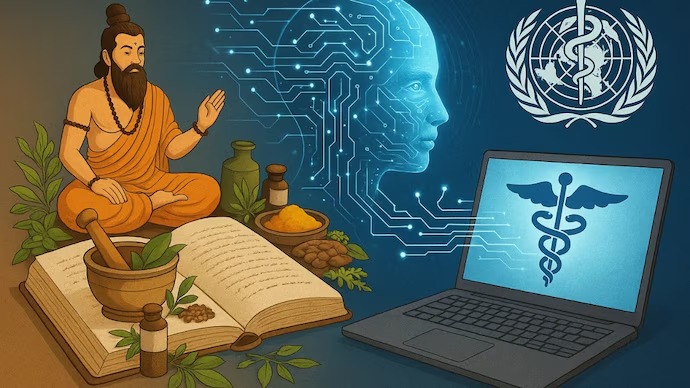
In a milestone for global healthcare innovation, India has launched the world’s first Traditional Knowledge Digital Library (TKDL) powered by Artificial Intelligence (AI). This pioneering initiative not only digitises centuries-old medical knowledge systems such as Ayurveda, Siddha, Unani, Sowa Rigpa, and Homoeopathy but also uses advanced AI tools to transform them into dynamic frameworks for modern healthcare research and delivery.
Supported by the World Health Organization (WHO), India’s TKDL showcases how technology can bridge traditional wisdom with contemporary healthcare, enabling precision, accessibility, and evidence-based integration.
Preserving Heritage, Preventing Exploitation
India’s traditional medicine systems are deeply rooted in oral traditions, palm-leaf manuscripts, and classical texts spanning thousands of years. However, the absence of systematic documentation has led to instances where foreign entities patented herbal formulations and treatments long used in Indian households.
The TKDL was conceptualised to address this exploitation by digitising and translating traditional medical knowledge into multiple languages while structuring it in a format recognisable by patent offices globally. This ensures that India’s heritage remains protected, preserving intellectual property rights while opening avenues for structured scientific exploration.
The Power of AI in Organising Ancient Knowledge
What sets India’s TKDL apart globally is its integration of AI and machine learning tools for organising complex medical texts, tracking historical usage patterns, and establishing scientific correlations between traditional remedies and contemporary illnesses.
These advanced AI tools facilitate semantic analysis, text mining, and knowledge mapping, making ancient medicinal practices not just a cultural asset but a living, evolving part of modern healthcare research.
By digitising its traditional systems with AI, India has positioned itself as a leader in reimagining healthcare, demonstrating a model where the convergence of tradition and technology can solve modern health challenges while retaining cultural identity.
WHO’s Endorsement and Global Impact
The World Health Organization (WHO), in its first-ever technical brief titled “Mapping the Application of Artificial Intelligence in Traditional Medicine”, has formally recognised India’s pioneering strides in integrating AI with traditional medicine.
The report acknowledges India’s Ayush systems (Ayurveda, Unani, Siddha, Sowa Rigpa, Homoeopathy) as a global model for blending ancient practices with advanced technology, thereby strengthening diagnostic accuracy, facilitating personalised healthcare, and creating validated, evidence-based therapeutic frameworks.
WHO’s endorsement highlights India’s potential to influence global healthcare policy, providing a roadmap for countries with rich traditional knowledge systems such as China, South Korea, and Indonesia to digitise and modernise their heritage using AI.
Advancements in Ayurgenomics: Personalised Health Insights
A highlight in WHO’s report is Ayurgenomics, a cutting-edge discipline that merges genomics with Ayurvedic principles. By using AI to map genetic markers and individual constitution types (Prakriti), Ayurgenomics provides a scientific basis for personalised preventive care and disease prediction.
This interdisciplinary approach allows scientists to decode DNA data alongside ancient Ayurvedic categories, leading to customised treatment plans grounded in both traditional wisdom and modern molecular biology. This represents a significant stride towards precision medicine rooted in culturally contextual practices.
AI-Powered Diagnostic Innovations
India’s application of AI extends to enhancing diagnostic methodologies within Ayush systems. Traditional practices like pulse reading and tongue analysis are now augmented with machine learning algorithms and deep neural networks, enabling higher diagnostic precision and consistency across practitioners.
These innovations are particularly transformative in rural and underserved regions, where traditional diagnostic expertise is often inaccessible, and AI-powered tools can bridge critical healthcare gaps.
Chemical Sensors Measuring Traditional Parameters
A unique technological leap has been the use of AI-based chemical sensors to quantify traditionally qualitative Ayurvedic attributes like Rasa (taste), Guna (quality), and Virya (potency). This transition from subjective evaluation to objective scientific measurement enhances the credibility of traditional medicine within modern pharmaceutical and clinical frameworks.
Such tools are facilitating the standardisation of herbal formulations, drug repurposing for modern ailments, and comparative studies across different traditional systems, including Traditional Chinese Medicine (TCM) and Unani.
Digital Platforms Empowering Ayush Practitioners
India’s commitment to digital healthcare extends through platforms such as the SAHI Portal, NAMASTE Portal, and the Ayush Research Portal. These are integral components of the Ayush Grid, a national digital health ecosystem launched in 2018, providing tools for:
* Online consultations and telemedicine services.
* Digital health records for Ayush practitioners.
* Interoperability between Ayush systems and allopathic medicine.
* Building digital literacy among practitioners.
These platforms have empowered Ayush professionals with seamless integration into the broader healthcare system, ensuring accessibility and quality care while preserving the unique diagnostic and therapeutic approaches of traditional medicine.
Government Leadership and Vision
Prime Minister Narendra Modi’s vision of AI for all” has been instrumental in shaping India’s technological interventions in healthcare. At the GPAI Summit 2023, he emphasised India’s commitment to leveraging AI for inclusive growth and societal benefit, with healthcare as a primary focus.
Union Minister Prataprao Jadhav reiterated India’s resolve to innovate and blend ancient knowledge with advanced science, stating that India’s initiatives reflect its dedication to making healthcare accessible globally while maintaining cultural authenticity.
The Economic Dimension: Ayush as a Growth Driver
India’s Ayush sector, currently valued at \$43.4 billion, plays a significant role in the nation’s economy while promoting holistic healthcare models worldwide. The WHO’s recognition amplifies the sector’s relevance in addressing chronic diseases and rising healthcare costs through affordable, preventive, and personalised care pathways.
This positions India’s Ayush systems not only as a healthcare solution but also as a potential driver for global wellness tourism, medical exports, and international collaborations in healthcare research.
Integration into Global Health Frameworks
The WHO brief underscores India’s AI-led initiatives as a template for global health systems, demonstrating how integrating traditional medicine with modern technology can support sustainable healthcare models.
India’s structured approach to digitisation, supported by its scientific community and governmental policies, has created a replicable framework for nations seeking to preserve indigenous medical knowledge while addressing contemporary health challenges.
Future Directions: Research and Collaboration
With the establishment of the AI-powered TKDL, India is well-positioned to:
* Enable collaborative research on herbal drug pathways and efficacy validation.
* Support AI-led clinical trials assessing traditional formulations for modern diseases.
* Foster data-driven insights into preventive care models.
* Build frameworks for global policy formulation in traditional medicine.
By inviting global researchers to engage with its digitised repositories, India is catalysing a new era of open, collaborative research in healthcare innovation rooted in ancient systems.
A Global Example in Blending Tradition with Technology
India’s Traditional Knowledge Digital Library represents more than a digital archive; it is a dynamic, evolving platform that demonstrates how ancient health practices can be modernised responsibly using AI.
It safeguards cultural heritage, prevents intellectual property exploitation, and creates opportunities for advanced research while addressing global healthcare needs sustainably.
As the world grapples with escalating healthcare challenges, India’s model presents a scalable, culturally sensitive, and technologically advanced pathway that others can emulate in the journey towards holistic global healthcare.
The launch of India’s AI-powered Traditional Knowledge Digital Library is a landmark achievement, positioning the nation at the forefront of global healthcare innovation while honouring its rich traditional wisdom. Supported by WHO and driven by visionary leadership, this initiative is a testament to how digital innovation can revitalise centuries-old practices, making them relevant and impactful in the 21st century.
By blending the past with the future, India is crafting a healthcare narrative that is inclusive, evidence-based, and rooted in cultural authenticity, offering a beacon of innovation for the world to follow.