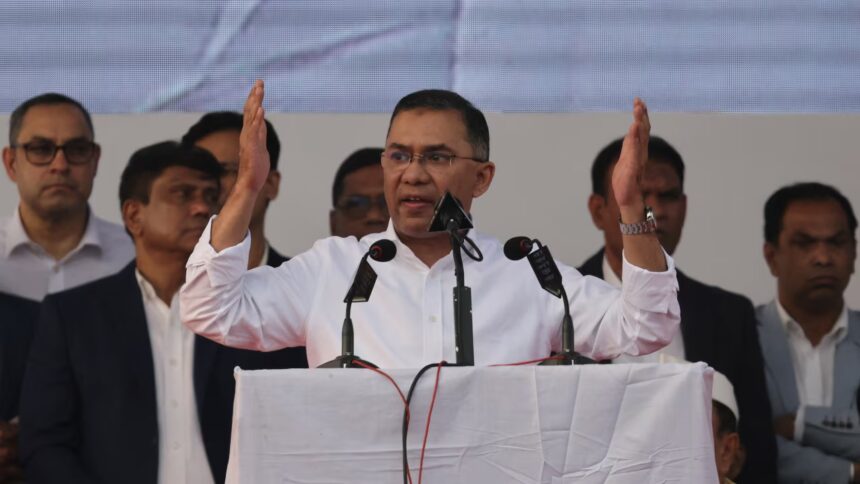
Bangladesh is poised for a significant political transition as Tarique Rahman is set to take oath as the Prime Minister, marking the return of the Bangladesh Nationalist Party to power after years in opposition. The oath-taking ceremony follows the February 12 general elections, which delivered a landslide victory to the BNP and reshaped the country’s political landscape after the removal of Sheikh Hasina in 2024. The new government will be sworn in alongside newly elected Members of Parliament, signaling the formal beginning of a new administration amid expectations of political stability, constitutional continuity and recalibrated regional engagement.
BNP’s Electoral Sweep and Tarique Rahman’s Political Comeback
The general elections marked one of the most decisive verdicts in Bangladesh’s recent political history. Under the leadership of Tarique Rahman, the Bangladesh Nationalist Party secured more than 151 seats in the 300-member Jatiya Sangsad, comfortably crossing the majority mark. The BNP-led alliance expanded this dominance further, winning a total of 212 seats, according to figures released by the Bangladesh Election Commission. The scale of the victory underscored voter appetite for political change and brought the BNP back to the center of governance after a prolonged period in the opposition.
Tarique Rahman’s rise to the premiership carries strong symbolic and political significance. The son of former Prime Minister Khaleda Zia, Rahman returned to Bangladesh after spending 17 years in exile. His comeback transformed the electoral contest into a referendum on leadership, legacy and renewal within the BNP. Throughout the campaign, Rahman projected himself as a figure of continuity and reform, promising to restore democratic norms, strengthen institutions and address economic challenges facing the country.
The election also reshaped the broader party hierarchy. Jamaat-e-Islami, contesting independently after years of alliance with the BNP, emerged as the second-largest party with 77 seats. This marked a significant shift in parliamentary arithmetic and altered opposition dynamics within the legislature. In contrast, the Awami League, led by Sheikh Hasina, was barred from contesting the polls, a development that fundamentally altered the competitive landscape and removed one of the country’s most dominant political forces from the electoral arena.
The oath-taking ceremony is scheduled in two phases at the national parliament complex. Newly elected MPs will take oath in the morning session, followed by the swearing-in of the prime minister and members of the council of ministers later in the day. BNP leaders have emphasized that the ceremony will reflect constitutional norms and parliamentary traditions, highlighting their intent to project institutional continuity despite the dramatic political change.
International representation at the ceremony reflects Bangladesh’s regional and diplomatic priorities. India will be represented by Om Birla, a move described by New Delhi as a reaffirmation of close bilateral ties and shared democratic values. Senior Indian officials have stated that the presence of the Lok Sabha Speaker underscores the importance India attaches to its relationship with Bangladesh and its support for democratic processes in the region. Notably, leaders from some neighboring countries are not expected to attend, underscoring the selective and calibrated nature of diplomatic engagement at the event.
Constitutional Questions, Governance Priorities and Regional Signals
Even as preparations for the oath-taking proceed, political debate continues over the future direction of governance and constitutional reform. One of the key issues under discussion is whether newly elected MPs will be required to take an additional oath as members of a proposed constitutional reform council. The idea of such a council has been linked to proposals under the July National Charter, a document that has generated both interest and controversy within political circles.
Reports indicate that uncertainty persists over whether the constitutional reform council will be constituted immediately or at a later stage. Within the BNP, there is a strong preference for adhering strictly to the existing constitution, which предусматри only the swearing-in of MPs and does not make any provision for an additional reform council. Party sources have argued that introducing a second oath without constitutional amendments could raise legal and procedural questions, potentially complicating the early days of the new administration.
BNP leaders have also questioned the legal basis of the July National Charter Implementation Order, suggesting that any move toward constitutional reform must follow established parliamentary procedures. This cautious approach reflects an awareness of the need to balance reformist ambitions with institutional stability, particularly after a period of political upheaval. The new government is expected to prioritize governance continuity while gradually addressing demands for reform through legislative processes.
From a policy perspective, the incoming administration faces a complex set of challenges. Economic management, inflation control, employment generation and restoring investor confidence are expected to feature prominently on the government’s agenda. During the campaign, Tarique Rahman emphasized economic revival and social welfare, signaling a focus on pragmatic governance rather than ideological confrontation. Observers note that the BNP’s overwhelming mandate provides political space to pursue reforms, but also raises expectations for quick and visible results.
Regionally, the change in leadership is being closely watched across South Asia. Bangladesh’s relationship with India, in particular, carries strategic, economic and cultural significance. Indian officials have described the transition as an internal democratic process and reiterated their commitment to working with the new government. The decision to send the Lok Sabha Speaker as India’s representative is seen as a gesture of respect for parliamentary democracy and an indication of continuity in bilateral engagement.
At the same time, the absence of certain regional leaders from the ceremony has sparked speculation about future diplomatic alignments. BNP leaders have downplayed these discussions, emphasizing that foreign policy under the new government will be guided by national interest, regional stability and balanced relations with all major partners. Early signals suggest that the administration will seek constructive engagement while asserting its independent policy positions.
The political transition also marks a generational shift within the BNP. Tarique Rahman’s leadership represents an attempt to modernize the party’s image while retaining its core support base. His long exile and subsequent return have shaped public perceptions, with supporters viewing him as a leader tempered by experience and critics questioning his readiness to govern. The scale of the electoral victory, however, has strengthened his position and given him a clear mandate to lead.
As Bangladesh prepares for the formal transfer of power, attention remains focused on how the new government will navigate constitutional debates, parliamentary management and regional diplomacy. The oath-taking ceremony is not merely a procedural event, but a symbolic moment that encapsulates political change, public expectations and the challenges of governance in a rapidly evolving regional context.