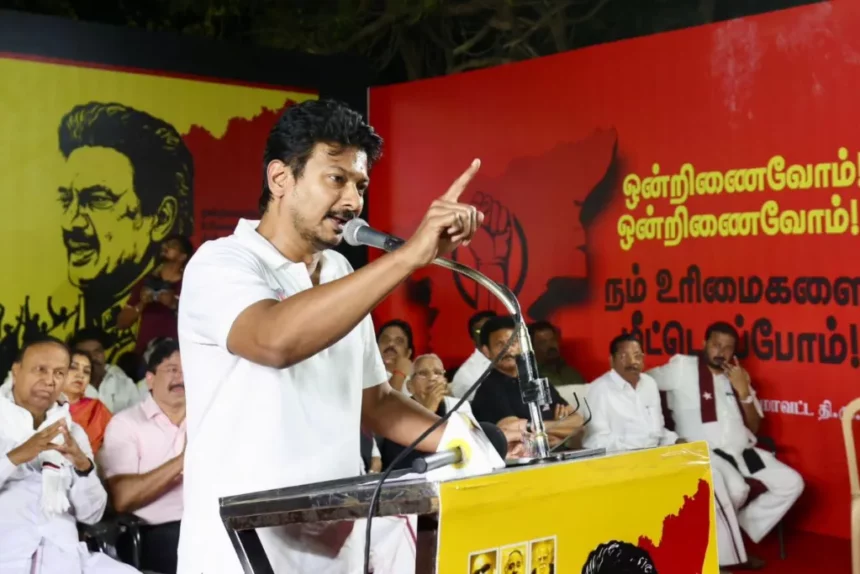
The ongoing tussle between Tamil Nadu’s ruling Dravida Munnetra Kazhagam (DMK) and the Bharatiya Janata Party (BJP) over the central government’s three-language policy escalated further on Tuesday, with Deputy Chief Minister Udhayanidhi Stalin asserting that states accepting Hindi risk losing their mother tongue. He declared that Tamil Nadu is prepared for a ‘language war’ to resist any imposition of Hindi, reinforcing the state’s long-standing opposition to the National Education Policy (NEP) and its three-language formula.
Udhayanidhi Stalin’s sharp response came amid the controversy surrounding Union Minister of Education Dharmendra Pradhan’s remarks, in which he indicated that Tamil Nadu would not receive ₹2,400 crore in central education funds unless it fully implements the NEP. The funds in question are part of the Samagra Shiksha mission, a centrally sponsored scheme aimed at improving school education across states. However, Tamil Nadu has historically adhered to a two-language policy, emphasizing Tamil and English, and has opposed Hindi imposition since the pre-independence era, with large-scale agitations in the 1930s and 1960s.
The remarks by Tamil Nadu leaders underline the state’s firm stance against what they view as an encroachment on linguistic and cultural identity. Chief Minister Muthuvel Karunanidhi Stalin had earlier criticized the central government for attempting to strong-arm Tamil Nadu into accepting the NEP by withholding funds, accusing Dharmendra Pradhan of engaging in ‘blackmail.’ His son, Udhayanidhi Stalin, reiterated this sentiment, emphasizing that the state was merely demanding its rightful share of tax revenue and central allocations.
“We are only asking for our tax money and our rights. We are asking for money that is rightfully ours… Dharmendra Pradhan openly threatened us that funds would be released only if we accept the three-language formula. But we are not asking for your father’s money… we aren’t begging,” Udhayanidhi Stalin said, making it clear that the state would not compromise on its policy under financial duress.
The latest standoff highlights Tamil Nadu’s historical resistance to the imposition of Hindi. The state has been a vocal opponent of the NEP’s language policy, arguing that it disrupts the existing education system and undermines regional linguistic identities. The DMK-led government has repeatedly stated that Tamil and English are sufficient for students’ academic and professional development, rejecting the need for a third language, especially Hindi.
As the war of words intensifies, the confrontation between the central government and Tamil Nadu over linguistic and financial matters is set to deepen, with the DMK standing firm against any perceived infringement on the state’s linguistic autonomy.