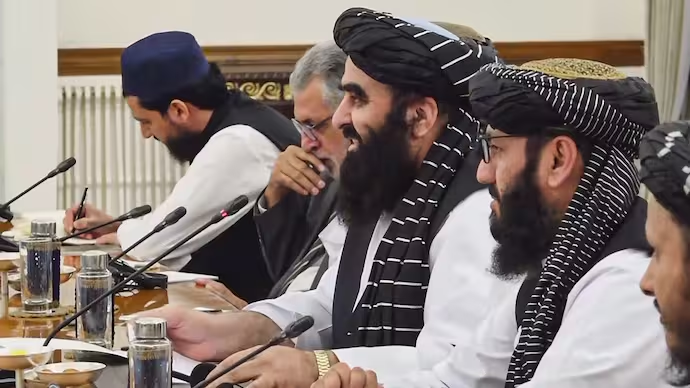
The recent press conference held by Afghanistan’s Foreign Minister Amir Khan Muttaqi at the Afghan Embassy in New Delhi has ignited a major political and public debate in India, following allegations that women journalists were barred from attending the event. The move has drawn sharp criticism from several opposition leaders, journalists, and rights activists who condemned the exclusion as a violation of India’s democratic ethos and gender equality principles. The Ministry of External Affairs (MEA), however, has distanced itself from the controversy, clarifying that the Indian government had no role in organizing or facilitating the interaction. The incident, coinciding with the Taliban’s first high-level visit to India since 2021, has once again brought to light the delicate balance New Delhi maintains between diplomatic pragmatism and its global stance on women’s rights and inclusivity.
Political backlash over exclusion of women journalists
The controversy erupted after reports confirmed that no women journalists were allowed to attend the Taliban Foreign Minister’s press conference in the Indian capital. Former Union Minister and senior Congress leader P. Chidambaram was among the first to voice his outrage, describing the incident as both “shocking” and “unacceptable.” He took to social media to criticize the Taliban’s gender-exclusive practice and also questioned the silence of male journalists who attended the briefing without protesting against the discriminatory exclusion of their female counterparts.
“I am shocked that women journalists were excluded from the press conference addressed by Mr Amir Khan Muttaqi of Afghanistan,” Chidambaram said in a post on X. “In my personal view, the male journalists should have walked out when they found that their female colleagues were excluded or not invited.” His statement captured the growing sentiment among political circles that India should have taken a stronger stand against such exclusionary behavior, especially when it occurred on Indian soil.
The outrage deepened when Chidambaram’s son, Congress MP Karti P. Chidambaram, issued an even more scathing statement, directly blaming the Narendra Modi-led government and External Affairs Minister S. Jaishankar for allowing such a “male-only” event to take place in the capital. “How dare our government allow Taliban Foreign Minister Amir Muttaqi to exclude women journalists and hold a ‘male-only’ news conference on Indian soil with full protocol?” he wrote on X. “How dare EAM Jaishankar agree to this? And why did our emasculated spineless male journalists remain in the room?”
Karti Chidambaram’s remarks highlighted the growing frustration among opposition parties, who viewed the incident as a moral and diplomatic failure. He further said, “I understand the geopolitical compulsions that force us to engage with the Taliban, but to accede to their discriminatory and primitive mores is outright ridiculous. It’s disappointing to note the conduct of the Ministry of External Affairs and S. Jaishankar in excluding women journalists from the press briefing of the Taliban Minister.”
Other political voices and activists echoed similar concerns, emphasizing that India’s engagement with Afghanistan should not come at the cost of compromising fundamental values such as gender equality and press freedom. Many journalists’ associations and women’s groups also condemned the exclusion, arguing that it sets a dangerous precedent by normalizing the Taliban’s gender-based restrictions within Indian borders.
The controversy has thus evolved into a larger debate about India’s diplomatic ethics—whether realpolitik should justify engagement with regimes that are internationally criticized for their human rights record, particularly concerning women.
MEA distances itself, says no involvement in Taliban’s event
Amid the growing uproar, the Ministry of External Affairs issued an official statement to clarify India’s position, asserting that it had no involvement in the event or in determining the list of attendees. “MEA had no involvement in the press interaction held yesterday by Afghanistan’s Foreign Minister, Amir Khan Muttaqi, in Delhi,” the ministry stated, making it clear that the Afghan Embassy, not the Indian government, was responsible for organizing the press conference.
Officials familiar with the matter said that the Afghan Embassy in New Delhi, which continues to function despite the absence of a formally recognized Taliban government in India, had arranged the press event independently. Sources suggested that the MEA was informed of Muttaqi’s visit and meetings but had no operational role in managing the press briefing.
This clarification was crucial for the Indian government, which found itself under fire for allegedly allowing gender discrimination during a diplomatic event. The MEA’s statement was aimed at emphasizing that while India engages with the Taliban for humanitarian and strategic reasons, it does not endorse or support their ideological practices, particularly those that contradict India’s constitutional values of equality and inclusivity.
The ministry’s distancing came against the backdrop of heightened scrutiny over India’s evolving relationship with the Taliban regime. Since the Taliban’s return to power in August 2021, India has maintained limited but pragmatic contact with Kabul, focusing mainly on humanitarian assistance and development projects rather than formal diplomatic recognition. However, this latest controversy has reignited concerns over whether engagement with the Taliban can be pursued without compromising on principles of gender justice and human rights.
The timing of the incident added to the sensitivity, as Muttaqi’s visit marks the first high-level Taliban delegation’s official presence in India since their takeover of Afghanistan. The visit, spanning from October 9 to October 16, includes several bilateral discussions on cooperation, regional stability, and reconstruction assistance. On his first day in India, Muttaqi met with External Affairs Minister S. Jaishankar, during which both sides discussed potential avenues to strengthen cooperation, particularly in healthcare, trade, and capacity-building initiatives.
The Indian government also announced several new projects aimed at supporting Afghanistan’s healthcare sector as part of its continuing humanitarian engagement with the country. According to officials, the discussions focused on expanding India’s role in rebuilding key Afghan institutions and ensuring essential services reach Afghan citizens, especially women and children affected by years of conflict and instability.
Despite these efforts, the optics of a Taliban official holding a male-only press event in New Delhi have cast a shadow over the diplomatic outreach. Critics argue that even if the MEA was not directly involved, India should have intervened to prevent such exclusionary practices, especially given its own constitutional commitment to gender equality and its vocal support for women’s empowerment globally.
The controversy also reignited questions about India’s recognition policy toward the Taliban regime. While New Delhi has not officially recognized the Taliban government, it continues to maintain limited engagement to safeguard regional security interests and ensure the continuity of development projects initiated before 2021. Analysts suggest that this pragmatic approach is driven by geopolitical realities, including India’s concerns over terrorism, trade routes, and the influence of Pakistan and China in Afghanistan.
However, political leaders and commentators argue that such engagement must be accompanied by a firm moral stance. They contend that by allowing events like the Taliban’s male-only press conference to take place in India, the government risks undermining its credibility as a democracy committed to equality and freedom of the press.
The debate surrounding this episode reflects the broader dilemma facing Indian diplomacy—how to balance strategic imperatives with ethical consistency. The Taliban’s return to international visibility through engagements like this one tests not just India’s foreign policy prudence but also its ability to uphold democratic values while navigating complex geopolitical realities.
As Amir Khan Muttaqi’s visit continues, the government faces mounting calls for transparency and accountability regarding how it manages interactions with the Taliban. Whether this controversy will alter India’s approach toward Kabul remains uncertain, but the incident has undeniably stirred a national conversation about the limits of diplomatic pragmatism in the face of ideological extremism.