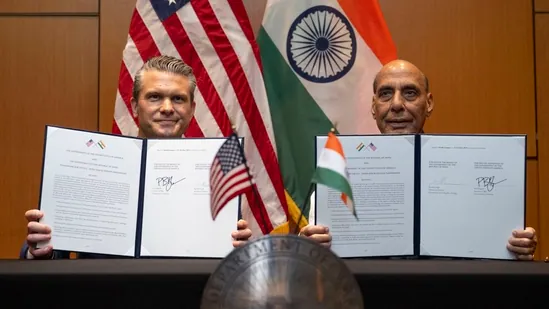
In a major milestone for global defence and strategic relations, India and the United States have signed a historic 10-year Defence Framework Agreement that sets the course for enhanced collaboration in military technology, intelligence sharing, and regional security. The agreement, described as “ambitious” by US Secretary of War Pete Hegseth, marks the most comprehensive roadmap yet for the two countries’ defence partnership — one that he said has “never been stronger.” The framework, signed during the ASEAN Defence Ministers’ Meeting in Kuala Lumpur, underscores a deep mutual trust and long-term commitment to ensuring peace, prosperity, and deterrence in the Indo-Pacific region.
Strengthening Strategic Ties and Shared Security Vision
Announcing the landmark pact on Friday, Pete Hegseth stated that the new 10-year framework is designed to elevate defence cooperation to a level of unprecedented depth. He emphasized that both nations are now enhancing coordination, information sharing, and technological collaboration — key areas that will serve as the foundation for military modernization and joint readiness. “Our defence ties have never been stronger,” Hegseth declared, describing the deal as a “critical step forward for both militaries.”
The meeting between Hegseth and Indian Defence Minister Rajnath Singh symbolized a defining moment in the evolution of India-US relations. Expressing gratitude toward Singh, Hegseth said, “It’s one of the most consequential US-India relationships in the world. Our strategic alignment is built on shared interests, mutual trust, and a commitment to a secure and prosperous Indo-Pacific.”
The Secretary of War highlighted that the 10-year framework lays a “roadmap for deeper and even more meaningful collaboration ahead.” It emphasizes joint defence production, innovation in emerging technologies, maritime security, and integrated command exercises that aim to strengthen regional deterrence mechanisms. “It underscores America’s long-term commitment to our shared security and strong partnership,” Hegseth added.
The announcement came during the second ASEAN-India Defence Ministers’ Informal Meeting, which coincided with the ASEAN Defence Ministers’ Meeting-Plus (ADMM-Plus) in Kuala Lumpur. The forum brought together key defence leaders from across Asia, reinforcing multilateral efforts to maintain regional stability.
Rajnath Singh, in his address before departing for Malaysia, reiterated that the ASEAN meetings would further strengthen India’s security cooperation with member nations and advance New Delhi’s ‘Act East Policy.’ His engagement with Hegseth followed closely on the heels of high-level diplomatic discussions between Indian External Affairs Minister S. Jaishankar and US Secretary of State Marco Rubio during the East Asia Summit.
Jaishankar confirmed that both sides had discussed the broader contours of India-US ties, emphasizing the importance of aligning on regional and global issues ranging from maritime security to counter-terrorism. He noted that the two democracies share a growing sense of convergence on critical matters affecting Asia and beyond.
Defence Cooperation Amid Broader Economic and Geopolitical Context
The signing of the long-term defence agreement takes place amid a dynamic global environment marked by shifting alliances, energy market disruptions, and evolving trade challenges. The United States and India, while deepening their military relationship, are also navigating complex trade negotiations, particularly in the wake of renewed tariff tensions under the Trump administration.
Recent trade frictions have centered around Washington’s decision to double tariffs on Indian goods due to New Delhi’s continued purchases of discounted Russian oil. At the East Asia Summit, Jaishankar addressed these concerns, warning of the growing constriction in global energy trade and supply chains. He called for an equitable and transparent approach to international trade, asserting that “principles are applied selectively and what is preached is not necessarily practiced.” His remarks were widely interpreted as a veiled criticism of the US policy that penalizes India for exercising energy sovereignty.
Jaishankar stressed that the world must follow a zero-tolerance policy for terrorism and step up efforts to resolve global conflicts such as those in Gaza and Ukraine, both of which have disrupted food and energy supply chains. “Energy trade is increasingly constricted, with resulting market distortions,” he cautioned, urging world leaders to focus on fairness and stability rather than short-term political gains.
Meanwhile, Indian Commerce Minister Piyush Goyal reaffirmed that India would not enter into any trade deal under pressure or accept terms that compromise its economic independence. He emphasized that trade partnerships should be built on mutual respect, long-term trust, and sustainability. “India will not sign any trade deal in a hurry,” Goyal said. “It’s not just about selling steel to America; it’s about building a foundation for lasting cooperation.”
He further added that negotiation teams from both sides are making progress, and the discussions are “moving toward a fair and equitable agreement.” This balanced approach, according to analysts, complements the strategic and defence engagements that are now the centerpiece of India-US relations.
Beyond trade, the newly signed Defence Framework also strengthens joint research and development in emerging areas such as artificial intelligence, cyber defence, space technology, and unmanned systems. Both governments have reportedly agreed to foster greater collaboration between private sector innovators and defence startups through funding programs and exchange initiatives.
The framework also envisions more frequent high-level exchanges between military commanders, structured war games, and intelligence-sharing mechanisms to counter terrorism, piracy, and regional threats. Indian defence officials described it as a blueprint for transforming India-US defence cooperation into a “future-ready partnership.”
Regional experts see the deal as a reflection of the shared vision of Washington and New Delhi to maintain a free, open, and rules-based Indo-Pacific, especially amid China’s expanding military footprint in the South China Sea and the Indian Ocean. While the United States seeks to strengthen its strategic foothold in Asia through partnerships like AUKUS and the Quad, India remains a central pillar in this framework.
The new 10-year pact is being hailed as a natural progression of the defence cooperation roadmap first outlined during Prime Minister Narendra Modi’s visit to Washington. It also builds on previous foundational agreements such as LEMOA (Logistics Exchange Memorandum of Agreement), COMCASA (Communications Compatibility and Security Agreement), and BECA (Basic Exchange and Cooperation Agreement for Geospatial Intelligence). Together, these frameworks have transformed the India-US defence relationship from transactional to deeply institutionalized cooperation.
In his closing remarks, Hegseth said the United States views India as a “trusted partner and a pillar of regional peace.” He reaffirmed Washington’s long-term commitment to India’s defence modernization efforts and the shared goal of ensuring deterrence in the Indo-Pacific. Rajnath Singh echoed this sentiment, emphasizing that the new framework “will empower both nations to jointly shape a more secure and stable world.”
The 10-year Defence Framework between India and the US thus stands not merely as a policy document, but as a symbol of evolving trust between two of the world’s largest democracies — one that extends beyond immediate geopolitical concerns toward a shared vision for global stability, prosperity, and peace.