A deeply unsettling public execution took place in Afghanistan’s Khost province when the Taliban compelled a 13-year-old boy to shoot and kill a man convicted of murdering more than a dozen members of his family. The execution was held inside a sports stadium filled with an estimated 80,000 spectators, an event that has drawn widespread condemnation from the international community—including the United Nations, which denounced it as an inhumane and cruel spectacle. The incident highlights the Taliban’s continued reliance on extreme punitive measures under its interpretation of Sharia law, reviving global concern about the direction Afghanistan has taken under its renewed rule.
The events leading to the public execution and the Taliban’s justification under Sharia
The man who was executed, identified as Mangal, had been convicted of killing 13 relatives of the teenager assigned to carry out the execution. The victims included several children and women, making the case one of the most severe family murder incidents in the region. According to Taliban authorities, the punishment was carried out under the Islamic legal principle of Qisas, which applies the doctrine of retributive justice often described as “an eye for an eye.” Three different levels of Taliban-controlled courts—the lower court, the appeals court and the Supreme Court—reviewed the case and confirmed the death sentence. The final approval came from the Taliban’s supreme leader, Hibatullah Akhundzada, whose endorsement enabled the public execution to proceed.
Taliban officials released a statement explaining that the victim’s family had been offered the option to forgive the killer, which in the context of Qisas would have spared the man’s life. Under this legal doctrine, heirs of the victims hold the authority to choose retribution or forgiveness, and the Taliban claim that the family firmly insisted on the execution. The Supreme Court framed the entire event as the implementation of a divine ruling, describing it as an act intended to reinforce religious justice. The statement further added that prayers were held at the conclusion of the gathering for national security, for protection of public rights and for the proper application of Islamic law throughout Afghanistan.
During the preparation for the execution, the Taliban imposed a ban on camera phones inside the stadium, likely in an attempt to limit international scrutiny. Despite this prohibition, video footage captured from outside the venue showed massive crowds of men entering the stadium, demonstrating both the scale of public attendance and the Taliban’s ability to mobilise large audiences for such events. These scenes evoked memories of the group’s earlier rule in the 1990s, when public punishments—including executions, amputations and floggings—were routinely carried out in stadiums packed with spectators.
Reports indicate that two additional individuals convicted in the same murder case were also slated for execution. However, their sentences could not be carried out because some heirs of the victims were not present, which prevented the legal finalisation of the Qisas process. Taliban authorities have stated that once the necessary family members are present, those executions will also proceed.
This was the 11th execution carried out under the Taliban’s restored government since 2021. Their judicial system, governed by strict interpretations of Sharia, prescribes punishments such as public execution, amputation and flogging for crimes including murder, theft and adultery. While Taliban officials defend these actions as religiously mandated, the global community continues to reject them as violations of human rights and international law. The United Nations special rapporteur for Afghanistan, Richard Bennet, had warned that such an execution was imminent and called for its cancellation. After the execution went ahead, he reiterated that public executions are categorically inhumane, constitute cruel and unusual punishment and violate established international legal norms.
International condemnation, social impact and broader concerns over the Taliban’s governance
The involvement of a child in carrying out the execution has triggered particular outrage among international organisations and human rights bodies. Experts emphasise that forcing a minor to kill, even under legal sanction, can cause long-term psychological harm and violates the fundamental principles of protection owed to children under international conventions. The act also raises concerns about the Taliban’s use of public punishment as both a tool of intimidation and a demonstration of absolute authority. Analysts frequently argue that such displays serve not only to punish offenders but also to reinforce the Taliban’s control and ideological dominance in Afghan society.
Following their takeover in 2021, the Taliban have enacted a series of severe measures that have dramatically reshaped Afghan life. One of the most alarming trends has been the imposition of sweeping restrictions on women and girls. They are banned from secondary and university education, barred from most workplaces and excluded from many public spaces. Women’s rights groups have repeatedly warned that Afghanistan under the Taliban has become the most repressive country in the world for women, with the public justice system serving as a visible reminder of the regime’s broader ideological framework.
The execution in Khost is consistent with broader patterns of Taliban rule. Public punishments, which were hallmarks of their governance in the 1990s, have re-emerged as visible instruments of control. The first public execution after their return to power was carried out in December 2022 in Farah province, where a father executed his son’s killer in front of a large crowd. Since then, several similar incidents have been reported. The latest case, however, stands out because of the involvement of a 13-year-old—a level of participation that human rights observers say signals an alarming escalation in the Taliban’s tactics.
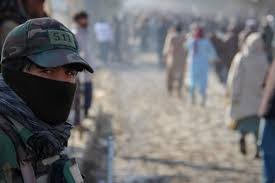
Images captured by news organisations show crowds of men entering the stadium on the day of the execution, while a Taliban policeman stood watching as spectators gathered. The irony of banning cameras inside the stadium while tens of thousands witnessed the event in person underscores the contradictions in the Taliban’s attempts to manage their global image. Even without direct footage from inside, the presence of such a massive crowd was enough to evoke worldwide condemnation.
The Taliban’s continued use of public punishment has complicated Afghanistan’s international relations and hampered efforts to gain official recognition as the legitimate government of the country. The global community has refused to formally recognise the Taliban due to the systematic erosion of human rights under their rule. Incidents like the Khost execution deepen concerns among global agencies, humanitarian groups and foreign governments that Afghanistan is diverging further from international standards of justice, governance and human rights protection.
Humanitarian organisations have also warned of the psychological effects these public spectacles have on the Afghan population. Children witnessing violent state-sanctioned punishment may suffer long-term trauma, while communities may experience collective fear or internalised acceptance of extreme punitive practices. Experts caution that normalising public executions creates cycles of violence that can damage the social fabric for generations.
In the broader context, Afghanistan remains beset by economic hardship, food insecurity and limited access to healthcare and education. The Taliban’s focus on public punishment rather than institutional strengthening or economic development has raised concerns that human rights will continue to deteriorate, making life more difficult for millions of Afghan citizens.
The execution also underscores the widening gap between Afghan citizens and the global community. While the Taliban assert that such acts reflect religious justice and cultural values, international law unequivocally prohibits public executions. The involvement of a minor adds yet another layer of severity to the violation. Despite the global outcry, there is no indication that the Taliban intend to reduce or restrict the use of public punishments.
As the world reacts to the chilling images emerging from Khost, the future of justice and human rights in Afghanistan remains uncertain. The Taliban’s reinforced commitment to their interpretation of Sharia suggests that public punishments may continue, even escalate. The fate of individuals awaiting execution in similar cases remains unclear, as does the psychological future of the child compelled to carry out the killing.
The Khost execution stands as one of the starkest examples of the Taliban’s governance approach, raising critical questions about the trajectory Afghanistan will follow under a regime that continues to defy global norms.