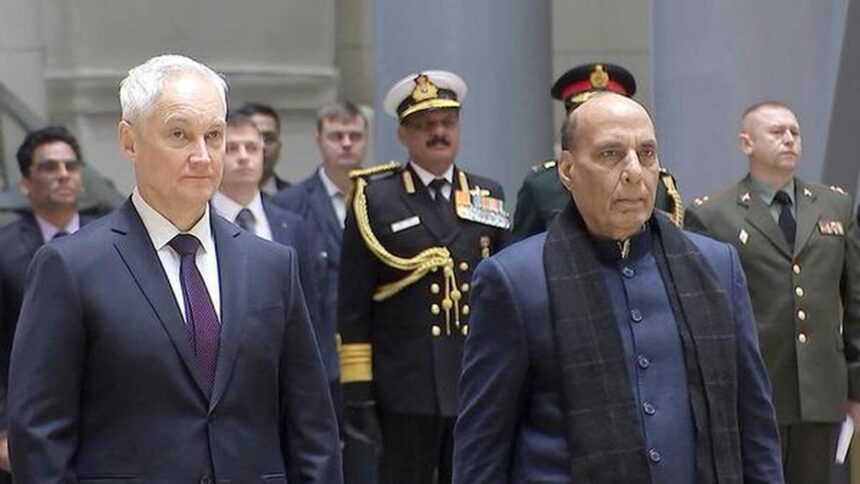
India and Russia are set to hold one of their most significant high-level defence engagements of the year as Defence Minister Rajnath Singh and Russian Defence Minister Andrei Belousov meet in New Delhi to co-chair the 22nd session of the Inter-Governmental Commission on Military and Military Technical Cooperation. The meeting comes at a crucial diplomatic moment, just ahead of Russian President Vladimir Putin’s visit to India for the annual bilateral summit—his first visit in four years following the geopolitical shifts and tensions brought on by the Ukraine conflict. The gathering is expected to review the entire spectrum of defence cooperation, ranging from ongoing equipment deliveries and joint production programmes to new avenues of technological collaboration, underscoring the enduring strategic partnership between the two countries.
The commission meeting and its strategic significance for bilateral defence cooperation
The Inter-Governmental Commission on Military and Military Technical Cooperation has long served as the principal institutional mechanism for steering defence ties between India and Russia. This year’s ministerial session in New Delhi carries particular importance as both nations navigate a changing global security landscape that has reshaped supply chains, defence procurement routes and the operational priorities of major military powers. According to officials, the agenda of the meeting includes a comprehensive review of ongoing defence cooperation projects, with a particular emphasis on ensuring timely delivery schedules, eliminating bottlenecks and identifying promising areas for expansion.
Central to the discussions will be the status of the S-400 air defence system deliveries. India had originally placed an order for five S-400 regiments, three of which have already been delivered. The remaining two are expected to arrive between 2026 and 2027. Despite global supply chain disruptions and competing military demands on Russia’s defence industry due to the Ukraine conflict, Moscow has continued to reiterate its commitment to meeting India’s delivery timelines. During a previous meeting in Qingdao earlier this year, Minister Belousov reaffirmed that Russia would adhere to the schedule, a pledge that New Delhi considers vital for strengthening its long-range air defence architecture.
Beyond completing the current S-400 order, India is also expected to explore the possibility of acquiring additional units or even assessing future procurement of Russia’s next-generation S-500 system. Capable of intercepting ballistic missiles at distances up to 600 kilometres and engaging airborne threats at ranges up to 400 kilometres, the S-500 represents a significant technological leap in layered air defence. Officials have indicated that while discussions remain exploratory, India’s interest stems from its evolving strategic requirements and the success of existing Russian air defence systems in Indian deployments. The S-400 system, now designated “Sudarshan Chakra” in Indian service, demonstrated its operational value during recent air defence missions conducted under Operation Sindoor.
Another major agenda item will be collaboration in ship-building and ongoing joint weapons development. India and Russia have maintained a long-standing partnership in this sphere, most notably through the BrahMos missile programme. With plans to develop advanced BrahMos variants already under consideration, the meeting is expected to examine timelines, production coordination and newer avenues for co-development. Discussions are also likely to look at areas where Russian technological expertise can complement India’s expanding defence manufacturing capabilities, particularly under the broader thrust of indigenous defence production.
Officials have confirmed that the Russian delegation will also be given an overview of India’s growing ecosystem of defence manufacturing, including new facilities, public-sector undertakings and private-sector partners that have emerged as key suppliers of components and subsystems. This exposure is intended to strengthen collaborative prospects under the “make in India” framework and encourage participation in joint manufacturing projects that reduce dependence on imports.
The meeting will conclude with a private dinner attended by senior defence officials from both sides. Such engagements often provide space for strategic-level conversations beyond formal agendas, allowing leaders to explore additional initiatives that might not be explicitly listed in official documents. Historically, India–Russia defence ties have often evolved through such behind-the-scenes discussions, which later culminate in formal agreements or joint declarations.
Broader geopolitical context and the evolving trajectory of India–Russia defence ties
This ministerial meeting is occurring in a larger geopolitical context marked by shifting alliances, economic sanctions, and growing global interest in India’s strategic decisions. President Putin’s scheduled visit for the 23rd India–Russia Annual Summit is a significant development given the strained relations Russia has with several Western nations following the Ukraine conflict. India’s balancing act—maintaining its historic defence ties with Russia while expanding cooperation with the United States, Europe and key Indo-Pacific partners—has drawn considerable attention from international observers. The ministerial discussions therefore carry implications not only for bilateral defence cooperation but also for how India positions itself within the broader geopolitical framework.
India continues to rely on Russia for a substantial portion of its legacy military platforms and ammunition supply. At the same time, the country is working steadily to diversify procurement sources and scale up indigenous manufacturing. The challenge for both nations is to sustain high-level defence cooperation in an environment where technology transfer, timely delivery and global supply chain constraints are increasingly influential variables. The 22nd commission meeting is expected to address some of these complexities and refine mechanisms that ensure predictability and efficiency in ongoing joint programmes.
Another important dimension is the expanding scope of India–Russia defence cooperation beyond traditional weapons procurement. Military technical cooperation now includes joint production, training exchanges, naval ship-building, maintenance support and long-term logistics arrangements. In recent years, India and Russia have engaged in several initiatives that deepen operational synergy, including agreements on joint logistics that facilitate easier access to each other’s facilities for refuelling, repairs and maintenance. The Russian parliament recently ratified a major pact to strengthen such cooperation, paving the way for expanded logistical support and enhanced operational interoperability in the future.
Minister Belousov’s visit will also include a solemn ceremony at the National War Memorial in New Delhi, where he will lay a wreath to honour fallen Indian soldiers. This gesture underscores the ceremonial and symbolic aspects of bilateral defence ties, which have historically been rooted in shared military traditions, longstanding trust and decades of cooperation that span the Cold War era to the present day.
Officials expect that regional and global security issues will also feature prominently during the talks. Increasing instability in Eurasia, evolving strategic dynamics in the Indo-Pacific, and the role of global powers in conflict resolution are among the contemporary issues likely to be discussed. India will seek updates on Russia’s assessments of the Ukraine conflict and its broader strategic outlook, while Russia will be keen to understand India’s perspective on regional challenges such as border security, maritime tensions and the evolving security architecture in Asia.
The timing of President Putin’s visit also adds weight to the discussions. Scheduled on the same day as the ministerial meeting, the summit is expected to bring forward concrete agreements and announcements. The coincidence of the two events signals a coordinated approach to strengthening bilateral ties at both political and operational levels. Officials view this dual engagement as an opportunity to lock in progress on long-standing defence programmes and to set achievable new targets for the coming years.
As India continues to strengthen partnerships across multiple global blocs while maintaining strategic autonomy, its defence cooperation with Russia remains a pillar of its military readiness. The upcoming meeting therefore carries strategic resonance beyond simple programme reviews. It will shape the future trajectory of bilateral defence engagement, influence procurement decisions, and impact collaborative projects whose outcomes will extend well into the next decade.
The ministerial meeting is ultimately a reflection of the resilience of India–Russia relations at a time of global uncertainty. As the defence ministers prepare to review programmes ranging from S-400 deliveries to joint weapons development and ship-building, both nations reaffirm their long-established commitment to cooperation. With President Putin’s visit adding further diplomatic weight, the coming days are likely to define a key phase in the next chapter of India–Russia defence relations.