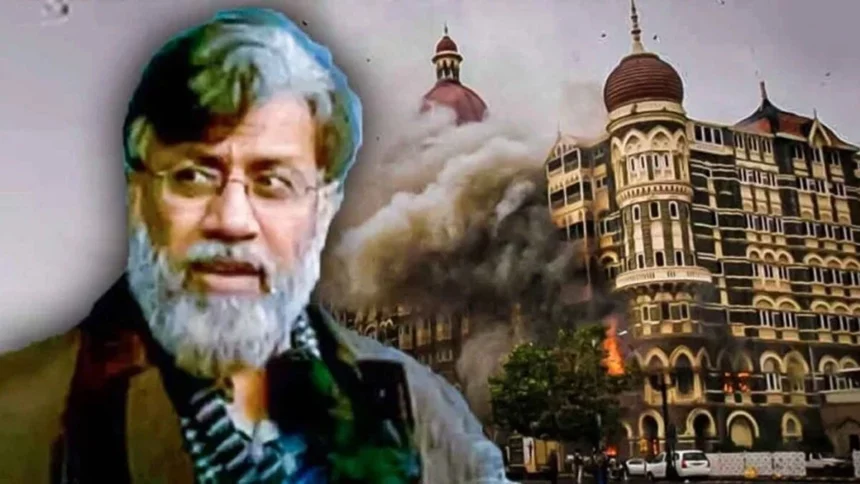
After years of legal battles and diplomatic negotiations, Tahawwur Hussain Rana, a key accused in the 2008 Mumbai terror attacks, was finally extradited to India from the United States. The extradition comes after Tahawwur Hussain Rana exhausted all legal avenues in the US. He is currently in the custody of the National Investigation Agency (NIA), which is conducting an extensive interrogation to uncover the details of his involvement in the 26/11 attacks, an assault that killed 166 people and left over 300 injured.
The NIA is now focusing on piecing together the conspiracy behind the attacks, including Tahawwur Hussain Rana’s alleged connections to Lashkar-e-Taiba (LeT), Pakistan’s spy agency ISI, and other terror organizations believed to be involved in the deadly operation.
How Does Tahawwur Hussain Rana Spend His Time in Custody?
Upon arrival in India, Tahawwur Hussain Rana was placed in a high-security cell at the NIA headquarters in Delhi’s CGO Complex, where he is being guarded by personnel 24/7. He has been cooperating with investigators, led by Chief Investigating Officer Jaya Roy, and is undergoing medical checkups every 48 hours as part of standard protocol. The Delhi court granted the NIA 18 days of custody for further questioning.
Inside the cell, Tahawwur Hussain Rana has requested some personal items, including a copy of the Quran, pen, paper, and a notepad. He has also been seen offering Namaz five times a day, with an officer describing him as a “religious man”. Despite his confinement, Tahawwur Hussain Rana has made no special demands for food and is being provided the standard meals designated for other detainees.
Tahawwur Hussain Rana’s interrogation sessions are extensive, lasting eight to ten hours daily. Investigators are examining a combination of evidence, including call records, travel history, and intelligence reports, to connect the dots in the broader conspiracy behind the attack.
Links to David Headley and Terror Networks
Tahawwur Hussain Rana’s role in the planning and execution of the 26/11 attacks has been well-documented. The NIA recently focused on analyzing phone calls between Tahawwur Hussain Rana and David Headley, his childhood friend and co-conspirator, who is believed to have scouted locations in Mumbai ahead of the attacks. These calls are proving to be crucial in understanding the coordination between the two.
Investigators have uncovered a lead involving a person based in Dubai who allegedly met Tahawwur Hussain Rana at Headley’s request. In one of the intercepted conversations, Headley is heard advising Tahawwur Hussain Rana not to visit India in late 2008, just before the attacks took place. This Dubai meeting, facilitated by Headley, may hold important information about the attack’s planning. Investigators are currently probing whether this person has any connections to notorious crime syndicates like Dawood Ibrahim’s D-Company, which operates out of Dubai.
The investigation also highlights the involvement of senior figures from terrorist organizations like LeT and Harkat-ul-Jihadi Islami (HuJI), with names such as Hafiz Muhammad Saeed, Zaki-ur-Rehman Lakhvi, Sajid Mir, and Major Iqbal coming up in relation to the planning. Tahawwur Hussain Rana is believed to have instructed Headley to conduct surveillance missions across India, identifying high-profile targets including the Siddhivinayak Temple, Chabad House, and army cantonments in Mumbai.
Tahawwur Hussain Rana’s Travel and Role in the Attack’s Execution
The NIA is meticulously verifying Tahawwur Hussain Rana’s travel movements, particularly his trips to northern and southern India in the lead-up to the attack. These movements could offer new insights into the planning phase of the attack. Investigators are also focused on determining whether Tahawwur Hussain Rana’s travels were part of the reconnaissance efforts for the terror plot.
Tahawwur Hussain Rana is facing serious charges under Indian law, including criminal conspiracy, murder, and terrorism-related offenses. These charges fall under the Unlawful Activities (Prevention) Act (UAPA), which deals with terrorism and anti-national activities.
A Broader Conspiracy: Investigating Terror Links
As the investigation deepens, the NIA is also expanding its scope to uncover a wider conspiracy involving international terror groups. Tahawwur Hussain Rana’s links to Pakistan’s ISI and other terror organizations are being probed, as his involvement in the attack is believed to have been orchestrated with the help of state-sponsored actors.
The case also sheds light on the continued use of terror networks like LeT and HuJI to carry out attacks on Indian soil, underlining the need for robust counterterrorism efforts and international cooperation.