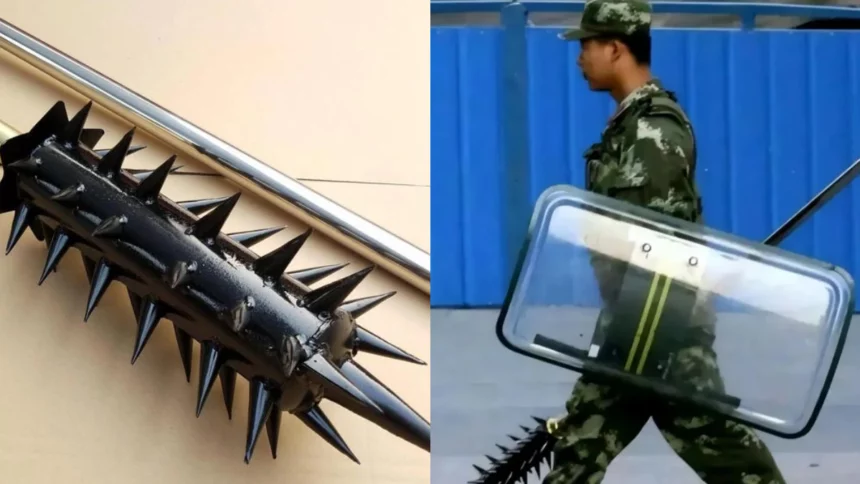
The debate over the 2020 Galwan Valley clash between India and China has resurfaced in global discourse after a startling claim by US Senator Bill Hagerty, who alleged that Beijing deployed electromagnetic weapons against Indian soldiers during the violent confrontation. The remark, delivered during a policy discussion in Washington, has added a new layer of intrigue to the already sensitive history of the border conflict and comes just weeks after Prime Minister Narendra Modi’s recent meeting with Chinese President Xi Jinping at the Shanghai Cooperation Organisation (SCO) Summit in Tianjin. Though unverified and dismissed by several experts as bizarre, Senator Bill Hagerty’s assertion underscores how the Galwan clash continues to resonate far beyond the Himalayas, shaping narratives in international politics, US-China rivalry, and India’s positioning between competing global powers.
Senator Hagerty’s allegation and its political undertones
Senator Bill Hagerty, a Republican senator from Tennessee, surprised observers when he claimed that “China used an electromagnetic weapon to literally melt Indian soldiers” during a border confrontation with India nearly five years ago. While Senator Bill Hagerty did not explicitly name the Galwan Valley incident of June 2020, his remarks appeared to suggest that the clash, which claimed the lives of 20 Indian soldiers and an undisclosed number of Chinese troops, involved advanced and unconventional weaponry.
The statement has drawn attention not only because of its sensational nature but also because of its timing. Barely two weeks before Senator Bill Hagerty’s comments, Prime Minister Modi had met Chinese President Xi Jinping in Tianjin, a rare face-to-face engagement between the two leaders amid tense ties. Senator Bill Hagerty’s words appear to signal Washington’s continuing unease over China’s growing military experimentation and its confrontations with neighboring countries, especially India, whose strategic significance has become more pronounced in the backdrop of intensifying US-China rivalry.
By invoking the Galwan clash, Senator Bill Hagerty also highlighted the deep historical mistrust between India and China, noting that the two nations “have a long history of grievances and distrust.” His remarks seemed designed to emphasize that the global community cannot overlook Beijing’s aggressive behavior, even as India and China attempt to manage their disputes.
US President Donald Trump also entered the conversation with his own dramatic phrasing, claiming that America had “lost India to darkest China” before quickly softening his tone and reaffirming India’s role as an important US partner. This back-and-forth illustrates how the India-China conflict has become intertwined with Washington’s strategic messaging, where references to Galwan are often used to highlight China’s threat perception and justify closer ties with India.
Although Senator Bill Hagerty’s claim about electromagnetic weapons has not been corroborated by any credible military report or intelligence assessment, its rhetorical power lies in framing China as a player willing to use untested or extreme measures in pursuit of dominance. In the realm of politics, such assertions can reinforce narratives, even when the underlying facts remain elusive.
Galwan clash and its aftermath for India-China relations
The Galwan Valley confrontation of June 2020 marked a turning point in modern India-China relations. The clash erupted after months of military build-up along the Line of Actual Control (LAC) in Ladakh, where both sides accused each other of encroachment and violating agreements meant to preserve peace. On June 15, a brutal hand-to-hand battle lasting nearly seven hours led to the deaths of 20 Indian soldiers, including a commanding officer, in what became the first deadly encounter on the disputed border in 45 years.
The clash shocked the Indian public and sent bilateral ties into freefall. China, after initially downplaying the incident, eventually admitted to suffering casualties but refrained from releasing official numbers. Independent reports suggested that Chinese losses may have been significantly higher than India’s, possibly double. The opacity around Beijing’s acknowledgment only deepened suspicions and fueled anger in India.
For New Delhi, Galwan represented not just a tragic loss of lives but also a shattering of trust. The confrontation reinforced the perception that China was willing to violate long-standing border protocols and agreements. It prompted India to harden its military posture along the LAC, accelerate infrastructure building in border regions, and impose restrictions on Chinese investments and technology companies.
The episode also altered the diplomatic vocabulary between the two countries. High-level talks resumed, but relations have never returned to pre-Galwan levels. The physical disengagement of troops in certain flashpoints did little to erase the political and emotional scars left by the violence. Modi’s meeting with Xi at the SCO Summit this year was seen as a cautious step toward normalization, but Senator Bill Hagerty’s recent remarks highlight how external powers continue to view Galwan as a defining moment in Asian geopolitics.
The broader impact of Galwan has been felt beyond bilateral ties. For India, the episode underscored the need for strategic autonomy while deepening engagement with other powers wary of China’s rise. For the United States, Galwan became a reference point to justify closer defense and security cooperation with New Delhi, situating India as a critical partner in the Indo-Pacific strategy designed to counterbalance Beijing.
The shifting India-US dynamic amid trade friction
While Senator Bill Hagerty’s comments spotlighted the military dimension of the India-China dispute, the broader context involves evolving India-US relations. Over the past months, Washington and New Delhi have experienced strains linked to trade, particularly after President Donald Trump imposed sweeping tariffs on Indian goods. In a dramatic move last month, Donald Trump doubled tariffs to 50 percent on a wide range of Indian exports, citing India’s continued purchase of Russian oil as a justification. The decision sparked sharp responses in India, where concerns were raised about the impact on economic growth and trade flows.
Despite the tariff tensions, Donald Trump has sought to temper the fallout with conciliatory gestures. He recently assured that he would “always be friends” with Prime Minister Modi, a statement warmly acknowledged by the Indian leader. Both sides have since emphasized their commitment to dialogue, with Donald Trump announcing that his administration would continue negotiations to resolve trade disputes. He also signaled his intent to speak with Modi in the coming weeks, underscoring the importance of maintaining stability in what remains one of Washington’s most consequential partnerships.
Senator Bill Hagerty’s remarks, therefore, can also be viewed against this backdrop. By drawing attention to China’s actions against India, the senator indirectly reinforces the argument that Washington should not alienate New Delhi over trade issues at a time when India’s alignment is crucial in countering Beijing. The claim about electromagnetic weapons, while sensational, serves to dramatize the stakes of keeping India close to the United States.
For India, the balancing act between managing its disputes with China and maintaining a strong partnership with the US has become more delicate. Galwan demonstrated the risks of unchecked Chinese aggression, while Donald Trump’s tariffs highlighted the unpredictability of American economic policy. Navigating these dual pressures will define India’s foreign policy choices in the near future, especially as it seeks to preserve autonomy while leveraging partnerships for security and growth.
In this charged geopolitical environment, statements like Senator Bill Hagerty’s, though bizarre to many ears, resonate as reminders that Galwan remains a symbol of unresolved tensions. The incident continues to echo in debates on international security, trade alignments, and the fluid equations of global diplomacy.