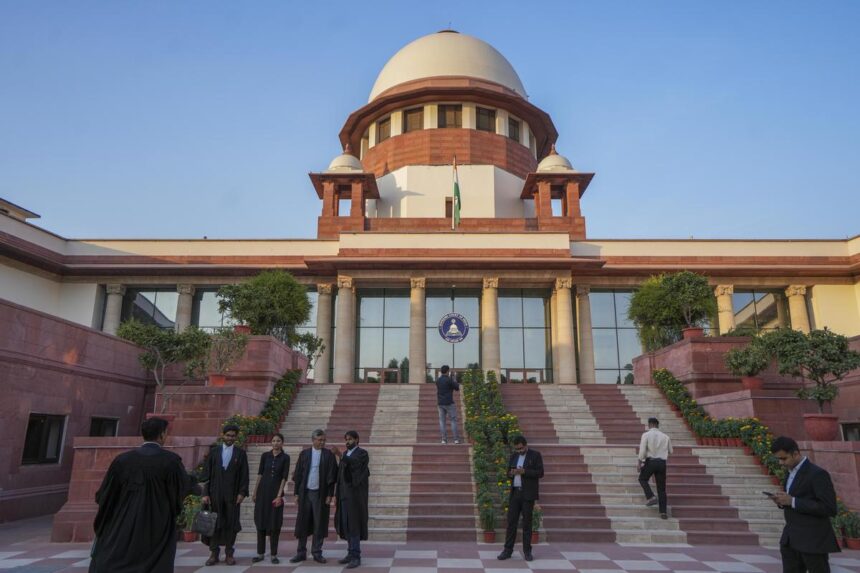
The issue of hate speech once again came under judicial scrutiny as the Supreme Court of India on Tuesday heard petitions raising concerns over divisive political rhetoric and its impact on social cohesion. The proceedings unfolded against a backdrop of increasing public anxiety over statements and visuals circulated by political actors, particularly those holding high constitutional offices. The court used the occasion not merely to address the legal aspects of the petitions before it, but to deliver a broader message on the ethical and constitutional duties of political leaders in a diverse democracy like India. Emphasising that freedom of expression cannot be divorced from responsibility, the bench underscored that the preservation of fraternity is a foundational obligation embedded in the Constitution itself.
Judicial Emphasis on Constitutional Morality and Leadership Responsibility
The bench, comprising Chief Justice of India Surya Kant, along with B. V. Nagarathna and Joymalya Bagchi, took a firm yet measured approach while addressing the concerns raised in the petitions. At the heart of the court’s observations was the idea that hate speech cannot be addressed solely through punitive mechanisms. Instead, the judges stressed the need for a deeper transformation in the mindset of those wielding political power.
During the hearing, the Chief Justice remarked that speech is often a reflection of underlying thought processes. According to the bench, meaningful efforts to curb hate speech must therefore begin with reforming the way leaders think about their political opponents and social groups. The court observed that words spoken by individuals in positions of authority carry disproportionate influence and can either strengthen social bonds or deepen existing divisions.
The bench appealed to political parties across the ideological spectrum to adhere to the principles of constitutional morality. It emphasised values such as mutual respect, self-restraint, and the dignity of opposing viewpoints as essential to the functioning of a healthy democracy. While acknowledging that political contestation is inevitable and even desirable in an electoral system, the court cautioned against allowing ideological competition to descend into personal or communal hostility.
The judges noted that when leaders themselves fail to model respectful behaviour, it becomes unrealistic to expect ordinary citizens to act with restraint. The court’s remarks suggested that leadership is not merely about winning elections or advancing policy agendas, but also about shaping public discourse in a manner consistent with constitutional ideals. In this context, the concept of fraternity—often overshadowed by discussions on liberty and equality—was highlighted as a vital pillar of India’s constitutional framework.
The bench also made it clear that while courts can intervene in specific cases, the larger responsibility for maintaining social harmony lies with political actors themselves. Judicial intervention, the judges implied, cannot substitute for ethical self-regulation by those in power. The appeal was thus as much moral as it was legal, aimed at reminding leaders that constitutional authority comes with an obligation to protect the social fabric of the nation.
Petitions, Political Controversy, and Broader Implications for Democratic Discourse
The immediate context for the court’s observations was a petition filed by nine individuals concerning recent speeches and a controversial video linked to Himanta Biswa Sarma, the Chief Minister of Assam. The petition alleged that the content in question targeted a specific community and sought the formulation of guidelines to regulate speech by individuals holding constitutional positions. The petitioners argued that unchecked rhetoric from powerful leaders risks legitimising prejudice and normalising hostility against vulnerable groups.
However, the court expressed reservations about the manner in which the petition was framed. The Chief Justice pointed out that the petition appeared to focus on a single individual at a sensitive political moment, which could create the impression of partisan targeting. The bench suggested that if the petitioners wished to pursue the matter further, they should withdraw the existing plea and file a more comprehensive petition encompassing all political parties and leaders, rather than singling out one figure.
This observation underscored the court’s attempt to maintain institutional neutrality while addressing a deeply political issue. The judges clarified that their concern was not with the legitimacy of the issue raised, but with the need to avoid perceptions of bias. By encouraging a broader, more inclusive petition, the court signalled that hate speech is a systemic concern rather than the failing of any one individual or party.
The controversy surrounding the petition gained further traction due to allegations raised by the Indian National Congress, which claimed that a video posted from the Assam unit of the Bharatiya Janata Party depicted the Chief Minister in a manner that appeared to promote violence against a particular community. According to the Congress, the video, which was later deleted, showed imagery that could be interpreted as endorsing targeted killings.
The issue was amplified when Congress spokesperson Supriya Shrinate shared the video on social media and criticised the ruling party’s leadership. In her remarks, she questioned the silence of institutions and directly held the political leadership accountable for what she described as an atmosphere of hatred and violence. The episode sparked intense debate on social media and in political circles, with supporters and critics offering sharply divergent interpretations of the video’s intent and impact.
Beyond the video controversy, the court was also mindful of a series of statements made by the Assam Chief Minister regarding the “Miya” Muslim community, a term widely regarded as derogatory when used to refer to Bengali-speaking Muslims. Critics have accused the Chief Minister of making repeated remarks that portray the community as outsiders or as competitors for resources, employment, and land. One particularly contentious statement involved comments about the potential removal of a large number of “Miya” voters from electoral rolls during a Special Intensive Revision process, raising concerns about disenfranchisement.
Additional remarks attributed to the Chief Minister, including suggestions that members of the community should be economically or socially pressured, further intensified the controversy. Such statements, critics argue, risk legitimising everyday discrimination and encouraging ordinary citizens to engage in acts of harassment. Supporters, however, have defended these remarks as expressions of concern over illegal immigration and resource allocation, highlighting the polarised interpretations that often accompany politically charged speech.
The Supreme Court’s intervention, though limited to procedural observations and broader ethical appeals, carries significant implications for India’s democratic discourse. By stressing the importance of fraternity and constitutional morality, the court positioned itself as a guardian not only of legal norms but also of democratic values. Its insistence that petitions addressing hate speech should be framed inclusively reflects an awareness of the need to rise above partisan battles while tackling issues that affect the entire polity.
At a time when political rhetoric increasingly shapes public attitudes and social relations, the court’s message serves as a reminder that democracy depends as much on the tone of debate as on the content of laws. The emphasis on leadership responsibility suggests that the battle against hate speech cannot be won through legal prohibitions alone, but requires a conscious commitment by those in power to uphold the spirit of the Constitution in both word and deed.