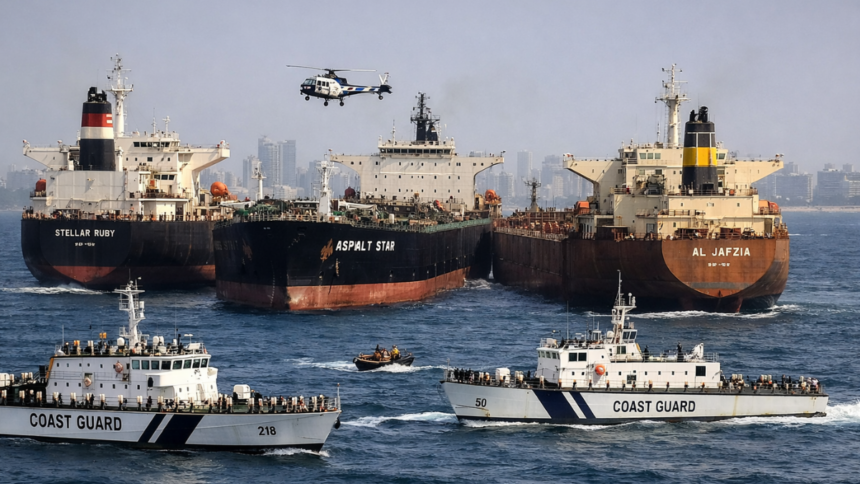
India has intensified its maritime enforcement posture following the seizure of three oil tankers linked to Iran and sanctioned by the United States, underscoring New Delhi’s growing resolve to prevent its territorial waters from being used for illicit energy trade. The vessels were intercepted roughly 100 nautical miles off the coast of Mumbai and escorted for investigation, highlighting a significant operational response by Indian authorities at a time of heightened geopolitical sensitivity surrounding global oil flows, sanctions compliance, and regional security.
The move has attracted international attention because it sits at the intersection of maritime law enforcement, global sanctions regimes, and India’s evolving strategic relationships. As energy markets remain volatile and geopolitical rivalries reshape trade routes, India’s actions indicate a willingness to assert control over its maritime zones while balancing complex diplomatic considerations involving Iran, the United States, and other major powers.
The seized vessels, identified as Stellar Ruby, Asphalt Star, and Al Jafzia, were reportedly operating under shifting identities and ownership structures, a tactic often used to obscure cargo origins and evade detection. Such practices have become increasingly common in the shadow economy of sanctioned oil trading, where intermediaries exploit regulatory gaps, jurisdictional ambiguities, and the vastness of the open sea to move discounted crude and fuel oil.
Indian authorities acted after detecting suspicious ship-to-ship activity, a method frequently employed to conceal the provenance of oil cargoes. These mid-sea transfers, often conducted at night or in poorly monitored waters, are designed to complicate tracking efforts by regulators and international watchdogs. By intervening decisively, India signalled that it does not intend to allow its maritime space to become a corridor for sanctions evasion, even as global demand for discounted energy creates strong financial incentives for such activity.
The seizures also come against the backdrop of closer engagement between New Delhi and Washington on trade and strategic issues. With the United States seeking stronger enforcement of sanctions related to Iran’s oil exports, India’s actions are being viewed as part of a broader alignment on maritime security and economic compliance, even as New Delhi continues to navigate its long-standing relationships across geopolitical divides.
Maritime Surveillance, Sanctions Evasion, and India’s Expanding Role in Policing Sea Lanes
India’s decision to intercept the tankers reflects a calculated expansion of its maritime surveillance and enforcement capabilities. Officials familiar with the operation indicated that monitoring across India’s maritime zones has been significantly stepped up, with dozens of ships and multiple aircraft engaged in continuous patrols. This heightened vigilance aims to detect unusual vessel movements, irregular transponder activity, and ship-to-ship transfers that could indicate illicit trade.
The Indian Coast Guard, supported by other maritime agencies, has played a central role in this expanded surveillance framework. By deploying assets across key shipping corridors, authorities are seeking to close loopholes that have historically been exploited by operators involved in sanctioned oil trade. The focus is not only on interception but also on deterrence, signalling to shipping companies, insurers, and intermediaries that India is prepared to act against violations within its jurisdiction.
The three seized vessels reportedly employed tactics commonly associated with sanctions evasion. These include frequent changes of vessel names, flags, and ownership records, as well as manipulation of Automatic Identification System signals to mask movements. Such practices complicate enforcement efforts and require advanced intelligence coordination to uncover patterns that link seemingly unrelated vessels to sanctioned entities or cargoes.
International shipping databases have previously flagged vessels with similar characteristics, often revealing overlapping International Maritime Organisation numbers that point to attempts at rebranding rather than genuinely distinct ships. In this case, vessels with matching identifiers had already appeared on sanctions lists maintained by the US Office of Foreign Assets Control, raising red flags for enforcement agencies monitoring maritime traffic in the Indian Ocean region.
India’s actions also reflect its growing confidence as a regional maritime power. With one of the world’s longest coastlines and some of the busiest shipping lanes passing near its shores, India has a strong interest in maintaining order and transparency at sea. Energy shipments, in particular, are critical to the global economy, and disruptions or illicit flows can have far-reaching consequences for market stability and regional security.
At the same time, New Delhi is aware of the diplomatic sensitivities involved. Iranian state media has cited the National Iranian Oil Company as denying any links between the seized vessels and the company or its cargoes. Such denials are not uncommon in cases involving sanctioned trade, where ownership and chartering arrangements are often deliberately opaque. Indian authorities, however, have focused on the operational behaviour of the vessels rather than solely on declared affiliations, emphasising compliance with maritime regulations and sanctions enforcement.
The emphasis on preventing ship-to-ship transfers within Indian waters is particularly significant. These transfers are a key mechanism through which sanctioned oil enters global supply chains, often blending with other cargoes or being re-exported under different documentation. By targeting this practice, India is addressing one of the most challenging aspects of maritime enforcement, where legal ambiguity and technical complexity can hinder accountability.
Geopolitical Context, Energy Trade Dynamics, and Implications for India’s Strategic Positioning
The seizure of the tankers cannot be viewed in isolation from the broader geopolitical environment shaping global energy trade. Sanctioned oil, particularly from Iran, is often sold at steep discounts, attracting buyers willing to assume legal and reputational risks. Intermediaries facilitate these transactions through layered ownership structures, offshore shell companies, and falsified paperwork, creating a complex web that obscures responsibility.
India’s intervention comes at a moment when its external relationships are undergoing recalibration. Recent developments in trade discussions with the United States, including adjustments to tariff regimes, have underscored a period of closer economic engagement. While India has historically maintained a pragmatic approach to energy sourcing, balancing affordability with diplomatic considerations, the current climate has increased scrutiny on compliance with international sanctions frameworks.
By acting against vessels linked to sanctioned trade, India reinforces its image as a responsible stakeholder in the global order, capable of enforcing rules within its jurisdiction. This stance may bolster its credibility in international forums focused on maritime security, non-proliferation, and financial transparency. It also aligns with India’s broader ambition to play a more prominent role in shaping norms in the Indo-Pacific region.
At the same time, the situation illustrates the delicate balancing act New Delhi must perform. Iran has been an important regional partner for India, particularly in the context of connectivity projects and regional stability. Actions perceived as aligning too closely with US sanctions enforcement could complicate diplomatic engagement. Indian policymakers, therefore, frame such operations primarily as enforcement of domestic maritime law and prevention of illegal activity, rather than as political statements against any particular country.
The involvement of international media outlets such as Reuters in reporting the seizures has amplified global attention, adding another layer of scrutiny to India’s actions. Transparency and adherence to due process become especially important in such high-profile cases, where enforcement decisions can have diplomatic and commercial repercussions.
Energy security remains a central concern for India, one of the world’s largest oil importers. While discounted sanctioned oil can appear economically attractive, the risks associated with legal penalties, insurance complications, and diplomatic fallout are significant. By tightening enforcement, India may be signalling a preference for stability and compliance over short-term economic gains from grey-market energy trade.
The case also highlights the evolving nature of maritime enforcement in an era of advanced tracking technologies and data analytics. As authorities become better equipped to identify suspicious patterns, the operational space for sanctions evasion narrows. However, those involved in illicit trade continue to adapt, exploiting new routes, flags, and financial channels. This dynamic creates an ongoing challenge for coastal states like India, requiring sustained investment in surveillance, intelligence sharing, and international cooperation.
In intercepting the three tankers near Mumbai, India has demonstrated both capability and intent. The operation reflects a broader strategic calculus that blends maritime security, economic diplomacy, and global governance. As global trade pressures shift and sanctions regimes continue to shape energy flows, India’s approach to policing its waters will remain a key indicator of how it positions itself within an increasingly complex international system.