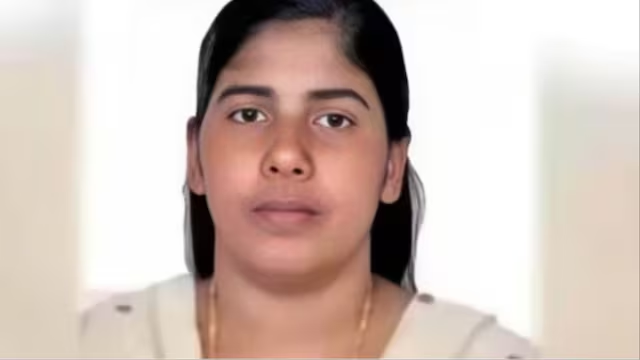
Just two days before her scheduled execution, the Supreme Court of India will hear an urgent plea seeking government intervention to save Nimisha Priya, a nurse from Kerala facing the death penalty in Yemen for the alleged murder of her Yemeni business partner. The plea, filed to explore the option of paying blood money under Yemen’s Sharia law to secure her release, has come as her family and supporters make a last-minute attempt to halt her execution scheduled for July 16.
Nimisha Priya, a 38-year-old nurse from Kerala’s Palakkad district, travelled to Yemen in 2011 seeking better opportunities to support her family back home. While her husband and daughter returned to India in 2014 due to escalating civil unrest, Nimisha Priya stayed back to continue working. Yemen’s laws require foreign medical professionals to partner with a local to run a clinic, leading her to partner with Yemeni national Talal Abdo Mahdi.
The Case Against Nimisha Priya
According to reports, Mahdi allegedly misused this partnership to claim he was married to Nimisha Priya , withheld her passport, and subjected her to prolonged physical abuse and financial exploitation. In 2017, in a desperate attempt to retrieve her passport and leave Yemen, Nimisha Priya tried to sedate Mahdi, but the dose proved lethal. She was later accused of dismembering his body in an attempt to dispose of it.
In 2020, Nimisha Priya was sentenced to death, a verdict upheld by the Houthis’ Supreme Judicial Council in 2023. She is currently imprisoned in Sana’a, Yemen’s capital, which is under the control of the Houthi administration. This situation complicates diplomatic intervention since India has no formal ties with the Houthis.
Plea for Blood Money to Save Her Life
The plea before the Supreme Court, filed by advocate Subhash Chandran KR, urges the Indian government to use diplomatic channels to negotiate with Yemeni authorities and the victim’s family, allowing the payment of ‘blood money’ to secure a pardon for Nimisha Priya . Under Yemen’s Sharia law, this provision enables the victim’s family to pardon the accused in exchange for financial compensation.
Nimisha Priya ’s family has reportedly offered $1 million (approximately ₹8.6 crore) as blood money in hopes of persuading Mahdi’s family to grant her a pardon. The petition argues that this option could be the last legal remedy to save Nimisha Priya ’s life, urging the Indian government to actively facilitate this process through available diplomatic or humanitarian channels.
The plea has been listed for an urgent hearing before a bench of Justices Vikram Nath and Sandeep Mehta, who are expected to take up the matter, highlighting the urgency and sensitivity surrounding the case. The family, human rights groups, and supporters hope that the Indian government’s intervention at this critical juncture could provide a lifeline for Nimisha Priya , whose life hangs in balance as the execution date nears.
Indian officials have been making efforts to secure Nimisha Priya ’s release, but the lack of formal diplomatic relations with the Houthi-controlled administration in Yemen has posed significant challenges. As the legal and humanitarian push continues in India, Nimisha Priya ’s case underscores the complexities faced by Indian nationals caught in legal and diplomatic crises abroad, especially in conflict zones where India’s reach remains limited.
The hearing at the Supreme Court marks a critical moment in the ongoing efforts to save Nimisha Priya, reflecting both the desperation of her family and the larger challenges of navigating international legal complexities to protect Indian citizens abroad.