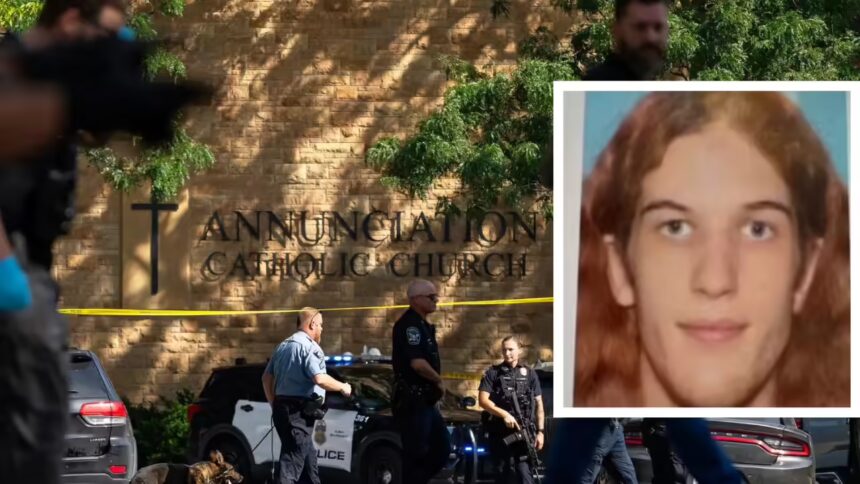
The tragic Minneapolis school shooting has taken a disturbing turn as new viral videos allegedly released by the shooter, Robin Westman, surfaced online showing his ammunition and weapons scrawled with hateful, violent, and racially charged messages. The chilling inscriptions, which include phrases like “Nuke India,” “Kill Donald Trump,” “Israel must fall,” and tributes to notorious mass shooters, have sparked outrage and intensified scrutiny into Westman’s motives, ideological leanings, and the broader culture of glorification of mass violence. The revelations have also drawn international attention, particularly due to the disturbing mention of India, alongside antisemitic and anti-American rhetoric.
Chilling videos reveal shooter’s disturbing ideology and weapon inscriptions
In the hours leading up to the horrifying attack at Annunciation Catholic School in Minneapolis, Robin Westman reportedly released a series of videos showcasing his cache of weapons, ammunition, and a written manifesto. These recordings, which circulated widely on X and other social platforms, depict not only his arsenal of firearms — including a semi-automatic rifle, shotgun, and handgun — but also chilling handwritten messages scrawled on his magazines. Some of the visible inscriptions included, “For the children,” “Kill Donald Trump,” “Where is your God?” and “Nuke India.”
Investigators are still working to verify the authenticity of the videos, but screenshots and clips shared across social media paint a haunting picture of a shooter deeply immersed in extremist ideas and fascinated with mass killings. In one of the clips, Westman flips through a journal filled with disturbing entries, including references to past attackers and violent fantasies. In another recording, the names of infamous mass shooters — including Adam Lanza, who carried out the 2012 Sandy Hook Elementary School massacre — are written on his magazines.
The invocation of Lanza is particularly alarming, as Westman’s own notes reportedly admitted an obsession with him. According to the New York Post, Westman wrote, “I have deep fascination with one man in particular: Adam Lanza.” The admiration for one of the deadliest school shooters in American history highlights not only his warped sense of identity but also the potential radicalizing effect of past atrocities on individuals predisposed to violence.
The videos did not stop at glorifying other shooters. They also revealed an unsettling amount of racial, political, and religious hatred. In addition to “Nuke India,” Westman’s weapons reportedly carried messages such as “Burn Israel,” “Israel must fall,” and antisemitic slurs directed at Jewish communities. One particularly disturbing excerpt from his writings suggested that if he were to carry out a racially motivated attack, it would most likely be against what he described as “filthy Zionist Jews.”
These details, combined with anti-Trump slogans such as “Kill Donald Trump,” reveal a chaotic ideology that fused antisemitism, political violence, and admiration for mass murderers. While investigators are still piecing together whether his motivations were rooted more in ideology, mental illness, or a dangerous combination of both, the breadth of his hateful writings has left authorities scrambling to understand what drove him to attack children during a religious service.
When the shooting unfolded inside the school during a Mass celebration, the impact was catastrophic. Two children lost their lives and seventeen others were injured. Armed with multiple weapons, Westman unleashed indiscriminate fire before turning the gun on himself, dying from a self-inflicted wound at the scene. His death leaves many questions unanswered, but the content of the videos and manifesto provide troubling insights into his state of mind before the rampage.
A manifesto of hate: obsession with mass killers and fantasies of violence
At the heart of the investigation into Robin Westman’s attack lies a manifesto that he allegedly posted online alongside the videos. The document, described as a disturbing blend of diary entries and schematic diagrams of firearms, offers a window into a deeply disturbed psyche consumed by fantasies of mass murder. Portions of the writings were reportedly in both English and Russian, raising questions about his influences and possible online communities that may have shaped his thinking.
Within these writings, Westman repeatedly returned to the theme of killing children, describing fantasies of murdering what he called “powerless children.” The deliberate targeting of a school during a religious gathering suggests he wanted to bring maximum shock value, echoing the strategies of shooters he idolized. His notes also included technical sketches of guns, diagrams of ammunition, and calculations that hinted at a meticulous approach to planning his rampage.
But perhaps most chilling is the way Westman integrated the legacies of past shooters into his self-identity. By invoking Adam Lanza and inscribing his name on a magazine, he appeared to see himself as part of a lineage of mass murderers. This fetishization of mass shooters has been a recurring theme in several recent attacks in the United States, where perpetrators have drawn inspiration from their predecessors, hoping to surpass them in infamy.
Westman’s manifesto also exposed his deep antisemitism. He repeatedly referred to Jewish people in derogatory terms, writing, “If I carry out a racially motivated attack, it would be most likely against filthy Zionist Jews.” Another phrase scrawled on his equipment read, “Psycho killer,” further reinforcing his embrace of violent identities. The targeting of Israel in his slogans — such as “Israel must fall” — underscores how his hatred stretched beyond America’s borders, embracing a worldview steeped in conspiracy theories and extremist rhetoric.
The presence of the phrase “Nuke India” among these slogans has alarmed many in South Asia and beyond. Though investigators have not yet established why Westman chose to single out India, experts speculate it may have been part of a generalized outpouring of hate rather than a specific political grievance. Nevertheless, its inclusion in his messages highlights the random and global scope of his rage, suggesting that he viewed his violence not merely in local terms but as part of a broader assault on nations, leaders, and communities he vilified.
Alongside antisemitism and anti-India rhetoric, Westman’s disdain for American politics was also evident. His weapons bore inscriptions like “Kill Donald Trump,” suggesting he harbored hostility toward the former U.S. president. The mix of anti-establishment messages, antisemitism, and references to foreign nations indicates an incoherent but deeply violent worldview. Analysts have noted that such amalgamations of hate are increasingly common among mass shooters, who often draw from multiple radical ideologies without adhering strictly to any single doctrine.
The sheer quantity of hateful inscriptions raises another troubling question: how was Westman able to acquire, prepare, and modify his weapons without drawing attention? Authorities are now investigating his online footprint, possible affiliations with extremist forums, and whether he was inspired or encouraged by online networks that celebrate mass violence.
As details emerge, the picture of Robin Westman becomes that of an isolated but deeply radicalized individual, intoxicated by the legacies of killers like Adam Lanza, immersed in fantasies of mass murder, and determined to inscribe his hate — literally — onto the weapons he would use to devastate innocent lives. The symbolism of writing his ideology directly on the magazines underscores how central these messages were to his identity and how much he wanted them to be part of the narrative of his attack.