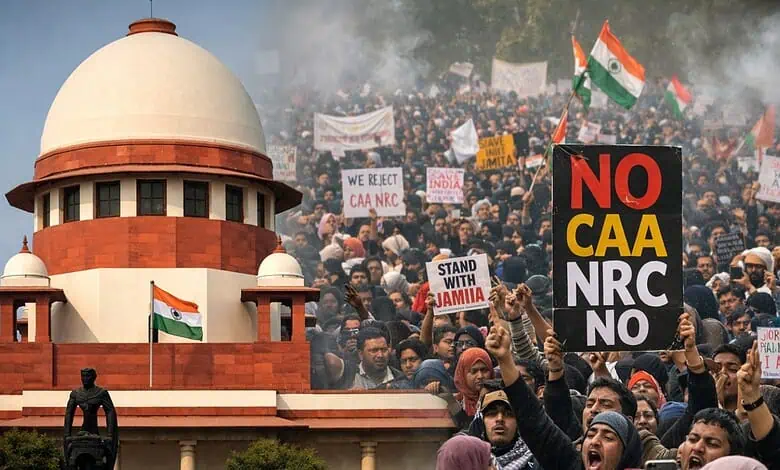
The Supreme Court will begin the final hearing on petitions challenging the Citizenship Amendment Act from May 5, 2026, in one of India’s most significant constitutional cases involving citizenship, secularism, and equality before law.
The constitutional challenge to the Citizenship Amendment Act has entered a decisive phase after the Supreme Court announced that final hearings on more than 250 petitions against the law will begin on May 5, 2026. The matter, which has remained one of the most politically and legally sensitive issues in recent years, is expected to witness extensive arguments concerning citizenship rights, constitutional morality, secularism, equality, and the federal structure of India.
A Bench headed by Chief Justice of India Surya Kant fixed May 5, May 6, May 7, and May 12 for the final hearing of the petitions challenging the constitutional validity of the Citizenship Amendment Act, 2019 and its accompanying rules. The court indicated that the proceedings would conclude with rejoinder submissions on May 12, setting the stage for one of the most consequential constitutional verdicts in modern Indian legal history.
The Citizenship Amendment Act, commonly referred to as the CAA, was passed by Parliament in December 2019 and immediately triggered intense political controversy and nationwide protests. The law amended India’s citizenship framework to provide a fast-track route to Indian citizenship for undocumented migrants belonging to Hindu, Sikh, Buddhist, Jain, Parsi, and Christian communities from Pakistan, Afghanistan, and Bangladesh who entered India before a specified cut-off date.
The law’s exclusion of Muslims from its ambit became the central point of constitutional challenge. Petitioners argued that the legislation violates the secular character of the Constitution and discriminates on the basis of religion, thereby infringing Articles 14, 15, and 21 of the Constitution. Opponents of the law have consistently maintained that citizenship cannot be selectively granted using religious identity as the basis for classification in a secular democracy.
The Supreme Court’s upcoming hearing is therefore expected to address questions extending far beyond citizenship administration. Legal experts believe the proceedings may shape the future interpretation of secularism, equality before law, and constitutional morality in India for decades to come.
During the latest hearing, senior advocates including Indira Jaising and Siddharth Luthra informed the Bench that written submissions had already been filed and requested that the matter proceed for final arguments. The court subsequently scheduled an intensive hearing calendar spanning multiple days.
One major aspect discussed before the court involved whether petitions specifically relating to Assam and Tripura should be heard separately from the broader constitutional challenge. Senior advocate Indira Jaising opposed separating the matters completely, arguing that the Assam-related issues overlap substantially with the broader constitutional concerns raised against the law itself.
The Chief Justice observed that the court may first hear the broader constitutional challenges before proceeding to state-specific concerns arising from Assam and Tripura, regions where demographic and migration-related anxieties have historically remained politically sensitive.
The petitions before the Supreme Court represent an extraordinarily broad coalition of political parties, civil society organisations, lawyers’ groups, activists, and individual citizens from across India. Among the prominent petitioners are leaders such as Jairam Ramesh, Mahua Moitra, and Asaduddin Owaisi. Political organisations including the Indian Union Muslim League, Assam Gana Parishad affiliates, and various regional groups have also challenged the law.
One of the central legal arguments advanced by petitioners concerns the alleged discriminatory classification created by the law. Petitioners contend that the Act selectively protects migrants belonging to six specified religious communities while excluding Muslims who may also face persecution in neighbouring countries. Critics argue that persecuted Muslim minorities such as Ahmadis in Pakistan or Rohingyas from Myanmar do not receive similar protection under the framework.
The petitioners further argue that the Act undermines the constitutional principle of secularism, which has repeatedly been recognised by the Supreme Court as part of the Constitution’s basic structure. According to the challengers, the state cannot create citizenship classifications based solely on religion without violating the equal protection guarantee enshrined in Article 14.
Another important issue likely to dominate the hearings is the alleged connection between the CAA and the National Register of Citizens process. Petitioners have argued that while the NRC may identify undocumented individuals, the CAA creates a selective protective mechanism for non-Muslim undocumented migrants while excluding Muslims from similar relief. Critics claim this creates unequal treatment based entirely on religious identity.
Senior advocate Kapil Sibal, appearing for the Indian Union Muslim League in earlier proceedings, had argued before the court that once citizenship is granted under the Act, the process becomes irreversible. He had pointed out that although the law was passed in 2019, the government delayed notification of the rules for nearly five years before implementation began.
The Union government, represented by Solicitor General Tushar Mehta, has strongly defended the legislation. The Centre has argued that Parliament possesses sovereign authority to determine citizenship policy and classification standards. The government maintains that the law merely provides humanitarian relief to persecuted minorities from neighbouring Islamic republics and does not take away citizenship rights from any existing Indian citizen.
According to the Centre, the classification under the Act is based on historical and geopolitical realities rather than religious discrimination. Government representatives have repeatedly argued that minorities in the three specified neighbouring countries face institutional persecution because those nations have Islam as their state religion. Therefore, the government contends that the classification is reasonable and constitutionally permissible.
Another dimension of the legal challenge concerns procedural and administrative changes introduced through the Citizenship Rules notified by the government. Critics argue that the revised framework reduces the role of state governments and local scrutiny mechanisms in the citizenship verification process. Earlier citizenship procedures under the Citizenship Rules of 2009 required consultation with state governments before citizenship grants were processed.
Legal experts say the final hearings are likely to involve extensive constitutional interpretation, including scrutiny of previous Supreme Court judgments dealing with equality, reasonable classification, religious freedom, and secular governance. The hearings may also examine whether Parliament’s powers over citizenship policy remain subject to constitutional limitations arising from the basic structure doctrine.
The political implications of the case remain enormous. Since its passage in 2019, the Citizenship Amendment Act has remained one of the most polarising legislative measures in India. Massive protests erupted across several states following the law’s enactment, with universities, student organisations, political groups, and civil society movements participating in demonstrations. Several protests eventually became flashpoints for broader debates surrounding identity, constitutionalism, and civil liberties.
The law also triggered significant concerns in northeastern states, particularly Assam, where anxieties over migration and demographic change have historically shaped regional politics. In Assam, many organisations opposed the Act not necessarily because of its religious classification but because they believed it legitimised undocumented migration regardless of religion, potentially affecting local demographic balances.
The Supreme Court’s verdict will therefore have implications extending beyond constitutional law into national politics, federal relations, migration policy, and social cohesion. The outcome may define the contours of India’s citizenship framework for future generations.
The case also arrives during a period of heightened global debate surrounding citizenship, migration, refugee protection, and identity politics. Many democracies worldwide are confronting difficult questions about balancing national security, humanitarian obligations, demographic concerns, and constitutional values. India’s handling of the CAA challenge is therefore being closely watched internationally as well.
Observers believe the final hearing may become one of the longest and most detailed constitutional proceedings in recent years due to the sheer number of petitions, legal issues, and intervenors involved. Constitutional scholars expect arguments to cover legislative intent, constitutional morality, international refugee principles, comparative citizenship frameworks, and the evolving interpretation of secularism within Indian jurisprudence.
As May 5 approaches, the country’s legal and political establishment is preparing for a courtroom battle that could ultimately redefine the relationship between citizenship policy and constitutional equality in India. Whatever the final verdict, the Supreme Court’s judgment on the Citizenship Amendment Act is expected to become one of the defining constitutional decisions of the decade.