The Supreme Court has formally entered a politically charged and constitutionally significant debate after West Bengal Chief Minister Mamata Banerjee challenged the ongoing Special Intensive Revision of electoral rolls in the state, prompting the apex court to issue notice to the Election Commission and list the matter for further hearing on Monday amid allegations of selective targeting and large-scale voter disenfranchisement.
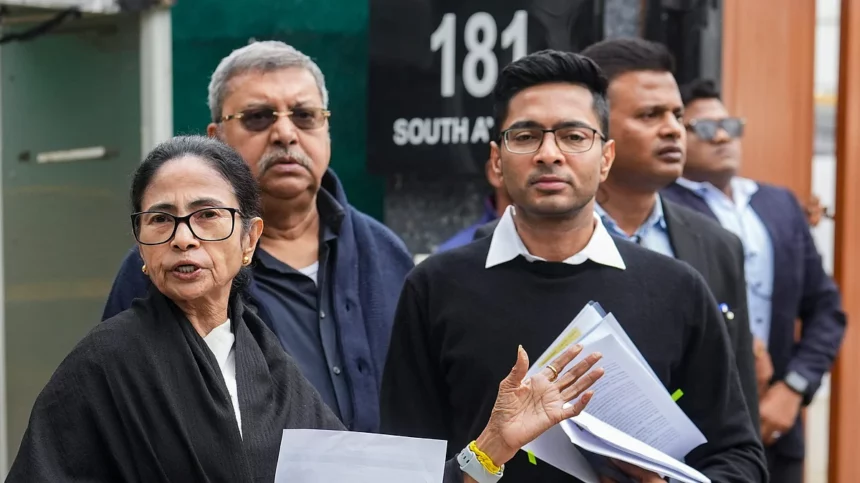
The hearing, held in New Delhi, saw Mamata Banerjee personally appear before the Supreme Court of India, an unusual step for a sitting chief minister. Her writ petition questions both the legality and the manner of implementation of the Special Intensive Revision, commonly referred to as SIR, being carried out by the Election Commission of India in West Bengal. The court, after hearing preliminary submissions, directed the poll panel to respond and indicated that additional time may be granted for detailed arguments.
Mamata Banerjee alleges selective targeting and mass voter deletions in Bengal
Arguing through Trinamool Congress MP and advocate Kalyan Banerjee, and also making submissions herself, Mamata Banerjee told the court that the SIR exercise in West Bengal has deviated from its intended purpose. She contended that the revision process has focused overwhelmingly on the deletion of names from the electoral rolls, while no meaningful inclusion exercise has been carried out for the past several months.
One of the central questions raised by the Chief Minister was the alleged selective application of SIR. She asked why a large-scale, time-bound revision was being undertaken in West Bengal while similar exercises had not commenced in Assam, a state heading into elections and governed by the Bharatiya Janata Party. According to Banerjee, this disparity raised serious concerns about neutrality and uniformity in the functioning of the Election Commission.
The Chief Minister further alleged that the process was being rushed in constituencies where non-BJP candidates were in contention, while comparable scrutiny was absent in BJP-ruled states. She described this as arbitrary and discriminatory, arguing that electoral roll revision must follow a consistent national standard rather than selective enforcement.
Banerjee also strongly objected to the appointment and role of micro-observers and roll observers deployed during the SIR process. She pointed out that many of these observers were not of sub-divisional magistrate rank and had been drawn from public sector undertakings and institutions such as Coal India and the Reserve Bank of India. According to her submissions, these officials were exercising disproportionate influence over the process, often overriding Electoral Registration Officers and deleting names without adequate field verification.
She alleged that a large number of micro-observers had been brought in from BJP-ruled states, further fuelling concerns about bias. In one of her most serious claims, Banerjee told the court that Electoral Registration Officers in West Bengal had effectively been stripped of their statutory powers, with decisions being taken by observers sitting in offices rather than through on-ground verification.
The Chief Minister also highlighted the human impact of the exercise, claiming that lakhs of genuine voters had been harassed or wrongly excluded. She cited cases where living individuals were marked as dead, women were flagged due to surname changes after marriage, and migrant workers were deleted after shifting residences for employment. According to her, such cases were being branded as “logical discrepancies” despite being routine life changes that should not disqualify citizens from voting.
Banerjee described the exercise as anti-poor and anti-women, arguing that economically weaker sections and female voters were disproportionately affected. She told the court that despite earlier Supreme Court directions emphasising transparency and voter convenience, the ground reality in West Bengal reflected widespread confusion, fear and administrative overreach.
Supreme Court issues notice, seeks balance between electoral integrity and voter rights
The three-judge bench comprising Chief Justice Surya Kant, Justice Joymalya Bagchi and Justice Vipul M. Pancholi took note of the submissions and issued notice to the Election Commission, seeking its response to the allegations raised. The court observed that only a few days remained in the current hearing schedule and orally indicated that additional time could be granted to ensure a full and fair hearing.
During the proceedings, the Election Commission defended its actions, raising concerns about the availability of senior officers such as sub-divisional magistrates in West Bengal to conduct the revision. In response, the court explored whether Grade II officers could be deployed to assist in the process, a suggestion to which Mamata Banerjee agreed, signalling her willingness to cooperate provided voter rights were protected.
The bench also made important oral observations underscoring the need for sensitivity in electoral administration. The judges noted that linguistic and regional variations often lead to differences in name spellings, and such discrepancies should not automatically trigger deletion. Justice Joymalya Bagchi observed that pronunciation differences in Bengali frequently alter spellings, while the Chief Justice remarked that such issues are common across the country and require a practical, humane approach.
The court reiterated that while the Election Commission has constitutional authority to revise electoral rolls, the exercise must not result in inconvenience or disenfranchisement of genuine voters. It recalled its earlier directions that discrepancy lists be displayed transparently and that affected individuals be clearly informed of the reasons their names were flagged.
Senior advocates appearing for the petitioners argued that notices had been issued to over a crore people, many of whom were not clearly informed why their names were questioned. They urged the court to direct the Election Commission to withdraw notices issued solely on the basis of minor name mismatches. The Chief Justice acknowledged that voters have a right to know the specific reasons affecting their electoral status and indicated that the court shared this concern.
Politically, the proceedings were welcomed by the ruling Trinamool Congress, which described the issuance of notice as a significant relief. The party framed the court’s intervention as a step toward safeguarding democratic rights in the state. At the same time, the case has intensified the confrontation between the West Bengal government and the Election Commission, with the Chief Minister portraying her legal battle as one fought in the larger public interest rather than for partisan gain.
The matter has now been listed for further hearing on Monday, along with connected petitions, including those filed by other Trinamool Congress leaders. The Election Commission is expected to file a detailed response, explaining the rationale, scope and safeguards of the SIR process.
As the case moves forward, its implications are likely to extend beyond West Bengal. The Supreme Court’s eventual directions could shape how Special Intensive Revisions are conducted nationwide, particularly in politically sensitive periods. At its core, the dispute raises a fundamental question about Indian democracy: how to balance the need for accurate electoral rolls with the equally vital obligation to ensure that no eligible citizen is denied the right to vote through procedural excess or administrative haste.