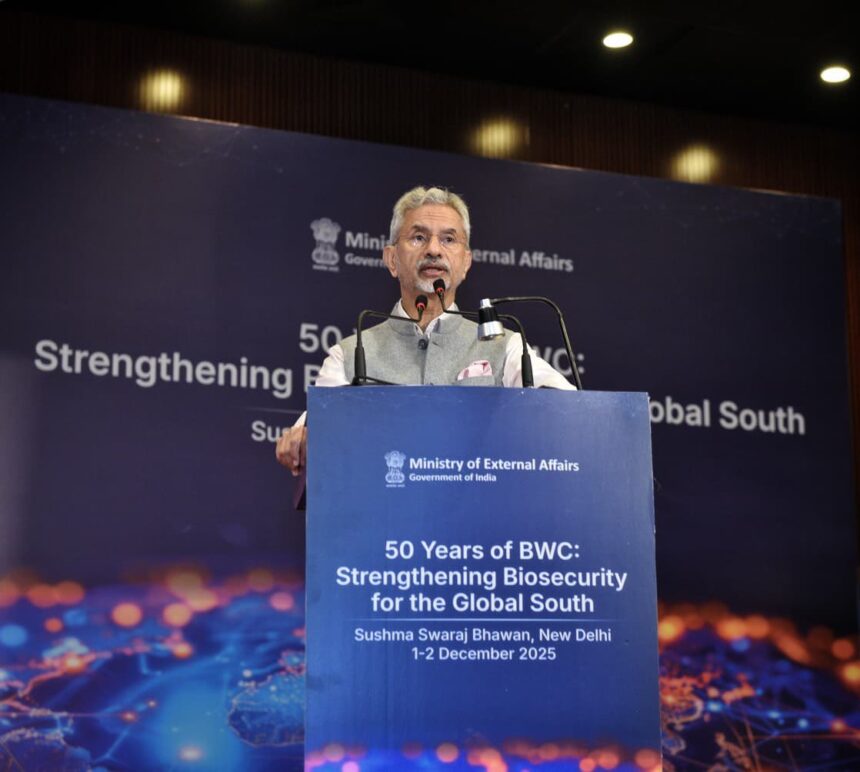
Marking a historic milestone in the global effort to prevent biological weapons and strengthen international security, India hosted a major two-day international conference at Sushma Swaraj Bhawan in New Delhi to commemorate the fiftieth anniversary of the Biological Weapons Convention (BWC). As one of the 189 states parties to this landmark treaty, with the majority being developing nations, India convened scientific experts, diplomats, policy leaders and representatives of international organisations to assess the convention’s long-term impact, examine emerging biosecurity challenges and review the implications of rapid technological progress in the life sciences. The conference also served as a critical platform to reflect on pandemic-era lessons and the need to reinforce global cooperation, particularly within the Global South.
Revisiting Five Decades of the BWC: Global Security, Public Health Governance and Multilateral Cooperation
The Biological Weapons Convention has long been regarded as a cornerstone of international peace and security. Since its entry into force fifty years ago, it has provided a foundational framework that prohibits the development, production and stockpiling of biological weapons. India’s longstanding commitment to disarmament and non-proliferation is reflected in its active engagement with the BWC and its global governance structures. Commemorating fifty years of the treaty’s existence is an opportunity for nations to collectively evaluate how far the world has come in countering biological threats, and how much more is needed in an era of rapidly evolving sciences.
The conference brought together specialists from diverse fields to discuss the convention’s contribution to global stability and public health governance, especially in the aftermath of the COVID-19 pandemic. The international health crisis exposed how vulnerable countries remain to biological threats, natural or deliberate, and how swiftly such crises can overwhelm systems, disrupt global supply chains and strain international relations. Against this backdrop, the BWC’s role has become even more vital, reinforcing the need for transparency, early warning cooperation and mechanisms that can respond to complex biological events.
Experts examined how the pandemic reshaped global health governance and the systems for outbreak detection, surveillance and preparedness. It became evident that biological threats cannot be managed by any nation alone; cooperation, information sharing and coordinated policy frameworks are essential. Participants reviewed how the BWC often complements other export control regimes, such as the Australia Group, which regulate sensitive biological materials and technologies. These frameworks work collectively to prevent proliferation and restrict access to equipment that can be misused for harmful purposes.
Discussions highlighted that while the BWC is a robust treaty, it lacks formal verification mechanisms, which leaves gaps in monitoring compliance. The need for stronger global standards, more transparent biosurveillance networks, and comprehensive reporting mechanisms emerged as common themes. Delegates emphasised that future strengthening of the BWC will have to integrate scientific advancements, multi-stakeholder engagement and capacity building to ensure that the treaty continues to remain effective in a rapidly changing world.
Public health specialists in attendance also examined the evolving nature of biosecurity challenges, arguing that the boundaries between natural outbreaks, accidental laboratory events, and deliberate biological misuse are becoming increasingly blurred. In a world where biological research has become faster, cheaper and more accessible, both intentional and unintentional risks have grown. The BWC, therefore, must remain dynamic and adaptable, not static.
Additionally, diplomats highlighted the political dimensions of biological threats. They emphasised that, increasingly, misinformation, geopolitical tensions and competing narratives complicate global biological security dialogues. To bridge these divides, the BWC framework must prioritise trust-building, scientific openness and shared responsibilities among member states. Over five decades, the BWC has succeeded in shaping norms against the use of biological weapons, yet implementation challenges persist in regions with weaker institutions and limited technical expertise.
Thus, revisiting the treaty at its fiftieth anniversary was not merely a ceremonial gesture but a deeper attempt to integrate decades of experience, lessons from global crises and insights into the future of biological safety.
Biosecurity Challenges in the Global South and the Urgent Need for Responsible Technological Oversight
One of the central themes of the conference was the disproportionate impact of biological and biosafety challenges on the Global South. Developing countries often face structural inequalities—limited laboratory infrastructure, inadequate biosurveillance systems, weaker public health networks and insufficient access to cutting-edge technologies. These factors heighten vulnerability to outbreaks and limit the ability to respond quickly and effectively to biological events.
Panels highlighted how regional disparities create pockets of heightened risk. In several developing countries, infectious diseases continue to be prevalent, while biosafety practices do not always meet global standards. Experts pointed out that unregulated laboratories, poor waste-handling mechanisms, inadequate training and supply chain constraints make such regions more prone to accidental or deliberate biosecurity breaches.
The conference emphasised that these challenges are compounded by a lack of integrated policy frameworks. Many countries have health, environment and veterinary systems that function in isolation, making disease detection and response fragmented. International specialists stressed the importance of the ‘One Health’ approach, which integrates human, animal and environmental health into a unified framework. This concept has become especially relevant after COVID-19, which illustrated how zoonotic diseases can spread rapidly when ecological and public health systems are disrupted.
The discussions further acknowledged that combating new biological risks requires not only local governance reforms but also strong international cooperation. Capacity-building initiatives—such as improving laboratory systems, training biosafety professionals and supporting national surveillance networks—are essential to strengthening global security. Delegates suggested expanding international funding mechanisms, establishing cross-border early-warning systems and improving access to advanced diagnostic technologies across the Global South.
In addition to current challenges, the conference placed significant focus on the implications of emerging technologies. Artificial intelligence, synthetic biology, gene editing frameworks such as CRISPR and advanced bioengineering tools have revolutionised life sciences. These technologies hold immense promise in disease detection, vaccine development, precision medicine and rapid response systems for public health emergencies.
However, with this progress comes a heightened risk of misuse. Experts warned that simplified gene editing tools and digital biological design platforms can be exploited by non-state actors, extremist groups or individuals with malicious intent. The concern is not theoretical; open-source AI tools can increasingly model biological sequences, generate synthetic constructs or optimise harmful pathogens. These risks, combined with insufficient global oversight, pose significant threats.
Scientists and policymakers discussed measures for responsible technological governance. They emphasised the need for global norms, ethical guardrails and transparent monitoring mechanisms to prevent misuse. The rapid pace of innovation requires that regulations keep up with technological advances; otherwise, the world risks falling behind the threats that these technologies might unintentionally unleash.
Delegates also called for deeper cooperation between governments, academia, private biotechnology companies and international organisations. They argued that the future of biosecurity will depend on sustained collaboration, standardised biosafety frameworks and interoperable regulations that function across borders.
The anniversary, therefore, became a platform not only to celebrate fifty years of the BWC but also to look forward—to imagine what global biosecurity should look like in the decades to come. The discussions illuminated a shared understanding that while scientific advancements offer transformative benefits, they must be matched with ethical responsibility, risk assessments and strict safeguards, especially in regions with limited resources.
The Global South, with its demographic diversity and vast ecosystems, remains central to this global conversation. Its security is intertwined with global security, and strengthening its capacities is essential for international peace and stability. As biosecurity challenges continue to evolve, the world must ensure that developing nations are not left behind, and that scientific progress is used solely for peaceful purposes.