Saif al-Islam Gaddafi, the son of former Libyan ruler Muammar Gaddafi and once considered the heir apparent to his father’s regime, was killed on Tuesday in Libya, according to multiple Libyan and international reports. His death marks a violent end to one of the most polarising figures to emerge from Libya’s post-2011 turmoil, at a time when the country remains deeply fractured by years of conflict, competing authorities and stalled political transitions.
Libyan television channel Fawasel reported that armed gunmen stormed Saif al-Islam’s residence in the western Libyan city of Zintan, where he was shot dead. His lawyer, Khaled al-Zaidi, and political adviser, Abdullah Othman, confirmed his death in separate social media posts, though neither disclosed details regarding the attackers or their motives.
Soon after the reports emerged, conflicting accounts added to the uncertainty surrounding the incident. The BBC, citing Libyan television sources, suggested that Saif al-Islam may have been killed near the Libya–Algeria border, raising the possibility that he was either travelling or in hiding at the time. Libyan authorities have yet to issue a clear and unified official statement, leaving the precise circumstances of his death unresolved.
Saif al-Islam was 53 years old and had, in recent years, been attempting to re-enter Libya’s fractured political arena, positioning himself as a potential leader in a country still struggling to stabilise more than a decade after the fall of his father’s rule.
From reformist figure to symbol of a fallen authoritarian order
Born on June 25, 1972, in Tripoli, Saif al-Islam Gaddafi was the second son of Muammar Gaddafi, who ruled Libya for over forty years. Among the Gaddafi children, Saif al-Islam stood out as the most educated and internationally visible, cultivating an image that appeared markedly different from his father’s revolutionary rhetoric and authoritarian governance.
Educated abroad, he earned a degree from the London School of Economics, where he developed connections with Western academics, policymakers and political figures. During the early 2000s, as Libya sought to normalise relations with Western governments after years of sanctions and diplomatic isolation, Saif al-Islam emerged as a key intermediary between Tripoli and foreign capitals.
He spoke publicly about economic liberalisation, engagement with the international community and limited political reform. Western media and governments frequently portrayed him as the modern and pragmatic face of the Gaddafi regime. Although he never held an official government post, he was widely believed to be his father’s preferred successor.
Behind the scenes, Saif al-Islam exercised significant influence, playing a role in negotiations that led to Libya abandoning its weapons of mass destruction programme and rejoining the global diplomatic system. For a period, he symbolised cautious optimism that Libya might gradually evolve toward a less confrontational political order.
Arab spring, imprisonment and controversial political return
That image collapsed during the Arab Spring uprisings of 2011. As protests spread across the Middle East and North Africa, Libya descended into rebellion against Muammar Gaddafi’s decades-long rule. Rather than distancing himself from the regime, Saif al-Islam became one of its most vocal defenders.
In a widely broadcast televised address, he warned protesters that the government would fight “until the last bullet,” described opponents as “rats,” and made clear that the regime would not surrender. His remarks permanently altered perceptions of him, recasting him as a central figure in the violent repression that followed.
After Muammar Gaddafi was captured and killed in October 2011, Saif al-Islam attempted to flee Libya but was captured the following month by a militia from Zintan. In 2015, a Libyan court sentenced him to death in absentia as part of a mass trial of former regime officials, a process criticised by human rights groups for failing to meet due process standards.
The International Criminal Court also issued an arrest warrant, accusing him of war crimes and crimes against humanity linked to the suppression of civilian protests. Nevertheless, he remained beyond the reach of both Tripoli-based authorities and international prosecutors, underscoring Libya’s fragmented post-revolution power structure.
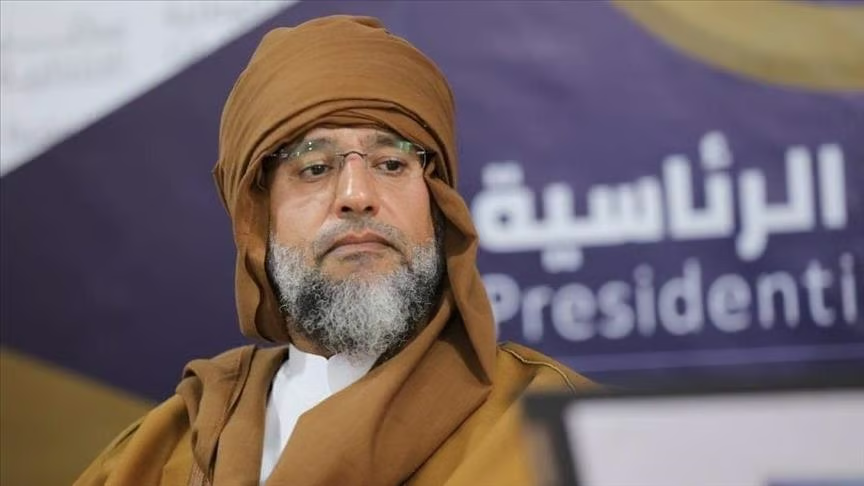
Released in 2017 under a general amnesty law, Saif al-Islam later sought a return to politics. In 2021, he declared his candidacy for Libya’s postponed presidential election, igniting controversy and polarising public opinion. Although a court reinstated his candidacy after it was initially rejected, the election was ultimately delayed, leaving Libya without a clear political roadmap.
His reported killing now adds a new and volatile chapter to Libya’s unresolved post-2011 crisis, reinforcing how deeply the legacy of the Gaddafi era continues to shape the country’s uncertain future.