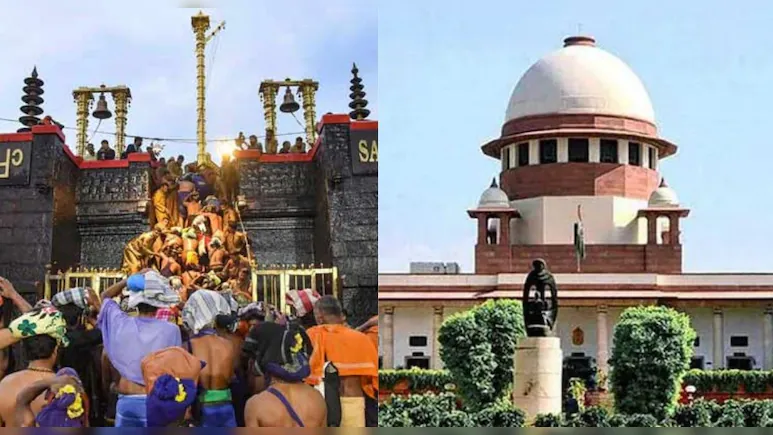
The Supreme Court of India on Wednesday observed that courts cannot become instruments for reforming religion during the ongoing review proceedings in the politically and socially sensitive Sabarimala Temple entry case. The remarks came during hearings before a nine-judge Constitution Bench examining broader constitutional questions arising out of the landmark 2018 verdict that permitted entry of women of menstruating age into the Kerala temple.
The observations were made by a Bench headed by Chief Justice of India Surya Kant while hearing arguments from parties supporting the original 2018 judgment. The court’s comments reignited debate over the constitutional limits of judicial intervention in matters of faith, religious customs and social reform.
Senior advocate Indira Jaising, appearing for two women who had entered the Sabarimala temple following the 2018 ruling, argued before the Bench that religion must evolve and reform itself to remain relevant in a modern constitutional society. She submitted that religious practices should harmonise with constitutional values, gender equality and social reform.
The Sabarimala case remains one of the most significant constitutional and religious disputes in contemporary India because it involves a complex intersection of fundamental rights, gender equality, freedom of religion and judicial review. The matter has continued to generate intense political, social and legal debate since the Supreme Court’s historic verdict in September 2018.
In the 2018 judgment, a five-judge Constitution Bench of the Supreme Court had ruled by a majority that the centuries-old restriction preventing women aged between 10 and 50 from entering the Sabarimala temple was unconstitutional. The verdict held that the practice violated constitutional guarantees of equality, dignity and freedom of worship.
The decision triggered widespread protests across Kerala and several parts of the country, with devotees and religious groups arguing that the restriction formed an essential part of the temple’s unique religious traditions associated with Lord Ayyappa’s celibate character.
Following the verdict, multiple review petitions were filed before the Supreme Court challenging the judgment and questioning the scope of judicial intervention in religious practices. The court later referred broader constitutional questions involving essential religious practices and religious freedoms to a larger nine-judge Bench.
Supreme Court Examines Limits of Judicial Intervention in Religious Practices
During Wednesday’s proceedings, the Bench observed that courts cannot directly undertake the task of reforming religion through judicial orders. The remarks reflected the court’s continuing effort to define the constitutional boundaries between faith-based practices and judicial scrutiny.
The issue before the nine-judge Bench extends beyond Sabarimala itself and includes larger constitutional questions regarding how courts should determine whether a religious practice qualifies as an “essential religious practice” protected under the Constitution.
The Bench is also examining whether constitutional principles such as equality and dignity can override long-standing religious customs and denominational practices. These questions are expected to have implications for several religious disputes across India involving entry rights, gender restrictions and denominational autonomy.
Indira Jaising argued that religion cannot remain insulated from constitutional morality and evolving social realities. She submitted that practices inconsistent with gender justice and equality require reconsideration within a constitutional democracy.
According to submissions made during the hearing, religious practices must adapt over time if faith traditions are to remain socially relevant and constitutionally compatible. Jaising also stressed that constitutional rights cannot be denied solely on the basis of biological characteristics such as menstruation.
The respondents supporting the 2018 verdict maintain that exclusion of women based on menstruation amounts to discrimination prohibited under the Constitution. They argue that women devotees possess an equal right to worship and access religious spaces regardless of age or gender.
Opponents of the verdict, however, continue to assert that the Sabarimala temple represents a distinct religious denomination with unique customs protected under Articles 25 and 26 of the Constitution. They contend that the restriction is not rooted in gender discrimination but in the specific religious character of Lord Ayyappa as a celibate deity.
The legal debate has therefore evolved into a broader constitutional examination of how courts should balance individual rights against collective religious freedoms and denominational autonomy.
Sabarimala Verdict Triggered Nationwide Political and Religious Debate
The original 2018 judgment permitting women’s entry into the Sabarimala temple became one of the most debated judicial rulings in India’s recent constitutional history. The verdict immediately sparked political mobilisation, public demonstrations and legal challenges across Kerala.
Several devotees, religious organisations and political groups opposed the ruling, arguing that the Supreme Court had interfered with deeply rooted temple traditions and matters of faith. Large-scale protests erupted across Kerala during the annual pilgrimage season following the judgment.
Attempts by women activists and devotees to enter the temple after the verdict often faced resistance from protesters and local groups opposing implementation of the judgment. The issue quickly transformed into a major political controversy within Kerala and beyond.
The two women represented by Indira Jaising became the first to successfully enter the temple following the Supreme Court ruling, triggering intense reactions across the state. Their entry was viewed by supporters as a historic assertion of women’s constitutional rights, while opponents regarded it as a violation of sacred temple traditions.
The Kerala government at the time supported implementation of the Supreme Court judgment and deployed security personnel to facilitate women devotees seeking entry into the shrine. Opposition parties and several Hindu organisations criticised the state government’s approach and accused it of hurting religious sentiments.
The controversy surrounding Sabarimala also reignited broader debates about the judiciary’s role in religious reform and constitutional interpretation. Legal scholars, activists and religious leaders expressed differing views on whether courts should intervene in matters involving longstanding religious customs.
Some constitutional experts argued that the judiciary has a duty to strike down discriminatory practices inconsistent with fundamental rights, while others warned against excessive judicial involvement in faith-based traditions.
Nine-Judge Bench Hearing Could Shape Future Religious Rights Cases
The ongoing proceedings before the nine-judge Constitution Bench are expected to have far-reaching consequences beyond the Sabarimala dispute itself. The court’s eventual interpretation of constitutional principles related to religion and essential religious practices may influence future cases involving religious customs across different faiths.
Legal observers note that the Bench’s findings could establish important judicial standards regarding the extent to which courts may examine or invalidate religious practices claimed to be essential by denominations or communities.
The case also touches upon the doctrine of constitutional morality, which was heavily relied upon in the 2018 majority verdict. Supporters of the original judgment argue that constitutional morality requires protection of equality and dignity even in religious contexts.
Critics, however, caution that allowing courts to define acceptable religious practices could undermine pluralism and religious autonomy guaranteed under the Constitution.
The nine-judge Bench is additionally examining whether courts should rely upon theological interpretation while deciding disputes involving essential religious practices. The question remains legally sensitive because judges are often required to assess whether a particular custom constitutes an integral part of a religion.
During Wednesday’s hearing, the Bench’s observation that courts cannot reform religion suggested judicial caution regarding direct involvement in reshaping faith traditions. However, the court has not yet indicated its final position on the broader constitutional issues under examination.
The hearings are expected to continue over the coming weeks with submissions from multiple parties, religious organisations and constitutional experts. The final outcome may redefine the legal framework governing the relationship between constitutional rights and religious practices in India.
For now, the Sabarimala review proceedings continue to remain at the centre of a national conversation about gender equality, religious freedom and the constitutional role of courts in balancing faith with social reform.