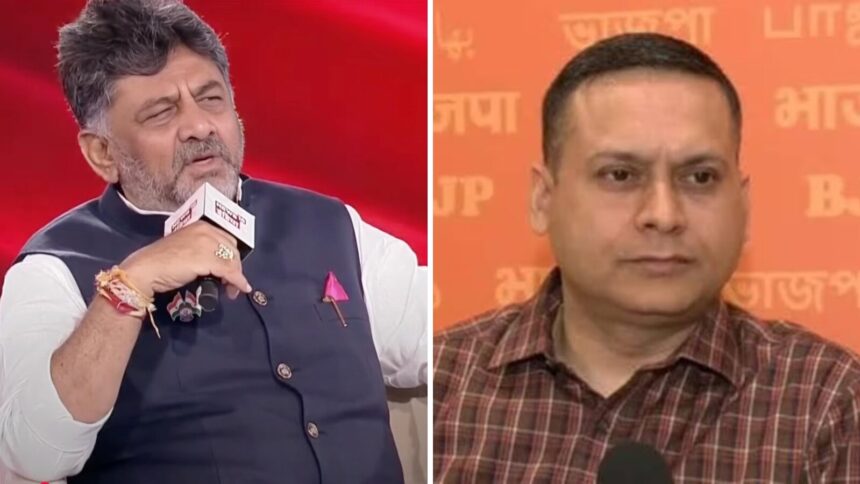
Karnataka Deputy Chief Minister DK Shivakumar’s remark on constitutional changes has sparked a major political storm, with the BJP accusing Congress of appeasement politics. Speaking at a public event, DK Shivakumar hinted that the Constitution could change over time, citing past legal rulings. The BJP seized on his statement, claiming it exposed Congress’s intent to alter the Constitution for Muslim reservations. Leaders like Amit Malviya and Shehzad Poonawalla launched sharp attacks, calling it a betrayal of national interest. With the Karnataka government recently passing a bill granting 4% Muslim quota in contracts, the controversy has further fueled the political debate.
A political controversy erupted after Karnataka Deputy Chief Minister DK Shivakumar’s statement regarding constitutional changes, triggering sharp reactions from the Bharatiya Janata Party (BJP). Speaking at the News18 India Diamond States Summit 2025, DK Shivakumar, while discussing the recently passed bill granting a 4% quota to Muslims in government contracts, remarked that the “Constitution will be changing.” His statement drew immediate criticism, with the BJP accusing the Congress of engaging in appeasement politics and undermining the country’s constitutional framework.
During his speech, DK Shivakumar defended the decision, stating that societal progress required inclusive policies to uplift marginalized communities. He acknowledged that legal challenges could arise but expressed confidence that necessary changes would be made over time. Referring to past judicial verdicts, he emphasized that several rulings had modified constitutional interpretations in the past. “There is a big debate on this issue. Many BJP leaders have claimed that Muslims are repairing bike punctures. It is our responsibility to uplift every section of society and ensure participation in development. We have initiated something, and we are aware that legal proceedings will follow. Many judgments have altered the Constitution over time,” he stated.
The BJP was quick to seize on DK Shivakumar’s remarks, interpreting them as an admission that Congress sought to amend the Constitution to facilitate Muslim reservations. Amit Malviya, head of BJP’s IT cell, took to social media, questioning Congress leader Rahul Gandhi’s silence on the matter. “Karnataka Deputy Chief Minister and senior Congress leader DK Shivakumar openly declares that the Congress will amend the Constitution to grant reservations to Muslims. Where is Rahul Gandhi now? Congress has always prioritized appeasement over national interest. They didn’t hesitate to partition the country along religious lines and have continued such policies. There could be no greater betrayal,” Malviya posted on X.
BJP leader Shehzad Poonawalla also launched an attack, accusing the Congress of being “anti-Constitution, anti-reservation, and anti-Ambedkar.” He claimed that the Congress was willing to alter the constitutional framework to facilitate religious-based reservations. “The cat is out of the bag. Congress has admitted they want to change the Constitution to grant illegal Muslim reservations. DK Shivakumar confirms that Congress is the biggest threat to the Constitution,” he stated.
Poonawalla further alleged that the Congress was contradicting its own stance, as Rahul Gandhi had previously accused other parties of attempting to alter the Constitution. “Karnataka’s Deputy CM has admitted that granting 4% reservation to Muslims in government contracts is unconstitutional, yet Congress wants to change the Constitution to justify it. Rahul Gandhi must answer—who is the real enemy of the Constitution? Congress’s vote bank and appeasement politics pose the biggest threat to India’s constitutional integrity,” he added.
The controversy intensified as the Karnataka Assembly recently passed a bill granting a 4% reservation for Muslims in contracts awarded by the Congress-led state government. The move has further polarized political discourse, with the BJP vowing to challenge what it calls “blatant appeasement politics” aimed at securing vote banks. With legal battles likely to ensue, the debate over constitutional changes and religious-based reservations is set to remain a contentious issue in the political landscape.