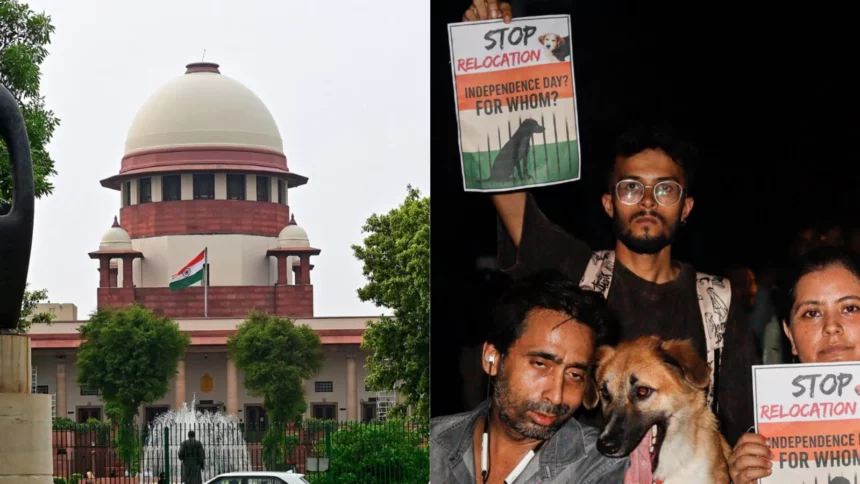
The Supreme Court has reserved its order on petitions challenging its recent directive to relocate all stray dogs in Delhi-NCR to shelters within eight weeks. The controversial order, issued on August 11, has sparked intense debate between supporters who see it as a necessary public safety measure and opponents — including prominent animal rights organisations — who warn it could cause chaos, suffering, and an escalation in human–dog conflict. The case has now been taken up by a new bench, with senior lawyers and government representatives presenting sharply different perspectives.
Shift in Bench and Legal Proceedings
On Monday, August 11, a two-judge bench of the Supreme Court ordered the immediate relocation of stray dogs from Delhi and the National Capital Region to designated shelters or pounds. The court further directed the creation of such facilities within eight weeks and sought a report on the progress of the infrastructure. The order was issued in a suo motu case, with the intent of addressing the growing stray dog population and related incidents in the region.
However, the matter took a significant turn mid-week. On Wednesday, Chief Justice of India (CJI) Bhushan R. Gavai withdrew the suo motu case from the bench of Justices J.B. Pardiwala and R. Mahadevan. The case was subsequently reassigned to a new three-judge bench led by Justice Vikram Nath. On Thursday, the newly constituted bench heard petitions seeking a stay on the August 11 directive and reserved its order on the matter.
During Thursday’s hearing, Solicitor General Tushar Mehta appeared for the government, pointing to a perceived hypocrisy among certain individuals claiming to be animal lovers. “I have seen people posting videos of eating meat and then claiming to be animal lovers,” Mehta remarked. His comment came in response to concerns raised by NGOs and individuals opposing the relocation order.
Senior advocate Kapil Sibal, representing an NGO that works extensively for the welfare of stray dogs, urged the court to grant a stay on parts of the August 11 order. Sibal described the situation as “very serious” and stressed the need for an in-depth legal examination before implementing such sweeping measures. He cautioned that the directive could have severe consequences both for the animals and for the communities they inhabit.
The court engaged with the issue of legal compliance, questioning local authorities about their implementation of the Animal Birth Control (ABC) Rules. The bench noted that while Parliament has framed laws and rules for controlling the stray dog population through sterilisation and vaccination, they have not been effectively enforced. “The whole problem is because of inaction by authorities in implementing the rules,” the court observed, indicating that better adherence to existing laws could have prevented the current crisis.
Public and Organisational Response to the Directive
The Supreme Court’s relocation order has sharply divided public opinion. Some residents of Delhi-NCR view it as a welcome relief from the increasing number of dog-bite incidents and street safety concerns. For these supporters, the creation of dedicated shelters represents a long-overdue step towards addressing a persistent civic challenge.
However, the directive has also attracted strong criticism from animal welfare organisations, legal experts, and sections of the public who view stray dogs as an integral part of community life. PETA India, the Indian arm of the US-based animal rights organisation People for the Ethical Treatment of Animals, issued a strongly worded statement condemning the August 11 order.
PETA India described the forced removal of community dogs as “impractical, illogical, and illegal,” arguing that it contravenes the ABC Rules and established principles of humane animal management. The organisation warned that mass relocation could lead to widespread suffering among animals due to inadequate shelter facilities, insufficient care, and the potential spread of disease in overcrowded enclosures.
Moreover, PETA cautioned that removing established dog populations from their home territories could backfire, potentially creating a vacuum that allows unsterilised dogs from surrounding areas to move in. This, they argued, could result in even higher stray dog numbers in the long term, undermining the very goal of the relocation order.
Local animal welfare activists echoed these concerns, emphasising that community dogs often play a role in guarding neighbourhoods and deterring theft. Their sudden removal, activists say, could disrupt community dynamics and lead to resentment among residents who care for them.
The issue has therefore become not only a legal matter but also a socio-cultural debate over urban coexistence, public safety, and ethical animal management. While the government has not formally detailed how it intends to carry out the relocation, critics fear that inadequate planning and funding could make the implementation of the Supreme Court’s directive highly problematic.