The Supreme Court has directed the Centre to file its response within eight weeks to petitions seeking the restoration of statehood to Jammu and Kashmir. The court, while hearing the matter on Thursday, emphasised that the decision must account for on-ground realities, including recent incidents in the region. Chief Justice of India (CJI) Bhushan R. Gavai underscored the need to consider events like those in Pahalgam before taking a call on restoring statehood. The Centre, through Solicitor General Tushar Mehta, reiterated its assurance that statehood would be granted after elections, citing the “peculiar situation” in Jammu and Kashmir.
Court’s Observations and Reference to Pahalgam Incident
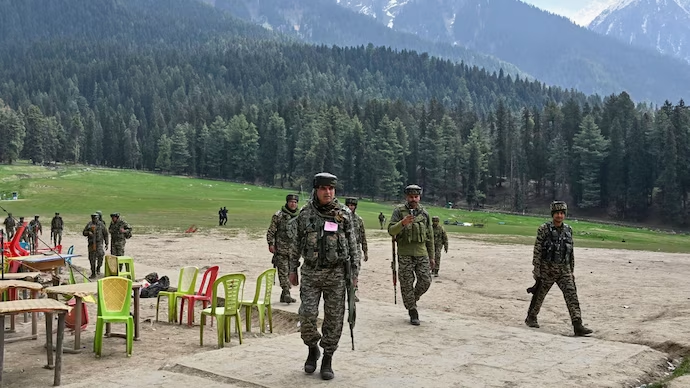
During Thursday’s proceedings, the Supreme Court bench, led by CJI Bhushan R. Gavai, took note of recent security concerns in Jammu and Kashmir. The Chief Justice remarked that while considering statehood restoration, “ground realities” must be a key factor. In a pointed observation, he said, “You cannot ignore what happened in Pahalgam,” referring to a recent incident in the tourist town that reportedly raised security alarms and underscored lingering challenges in the Union Territory. The remark signalled that the apex court is aware of the complex security environment in Jammu and Kashmir and intends to weigh these concerns in its deliberations. Although the court did not elaborate on the specifics of the Pahalgam episode during the hearing, the reference indicated that recent developments could influence the timeline and conditions for statehood restoration. The petitions before the court challenge the delay in restoring the erstwhile state’s status, which was downgraded to a Union Territory following the abrogation of Article 370 in August 2019. Petitioners argue that prolonged Union Territory status undermines democratic governance, local representation, and the constitutional
promise of eventual statehood.
Centre’s Stand and Request for Time
Appearing for the Centre, Solicitor General Tushar Mehta reiterated that the government has already assured the restoration of statehood to Jammu and Kashmir. He said that this commitment stands, but it would be implemented after elections are held in the Union Territory. Mehta emphasised that the region faces a “peculiar situation” that requires careful handling before any political status change can be made. Seeking additional time, the Solicitor General requested an eight-week period to obtain instructions from the government and file a detailed affidavit in response to the pleas. He suggested that factors such as security stability, administrative readiness, and electoral processes are central to the Centre’s approach. The Centre’s position reflects a balancing act between its political commitment to restore statehood and its assessment of security conditions in the sensitive border region. The government has previously stated in Parliament that statehood would be restored at an “appropriate time,” but has not provided a specific timeline. The Supreme Court agreed to grant the Centre eight weeks, making it clear that the response must address the concerns raised in the petitions. The court’s directive sets a clear deadline, signalling that the issue will remain under active judicial consideration and that further delays will be scrutinised.