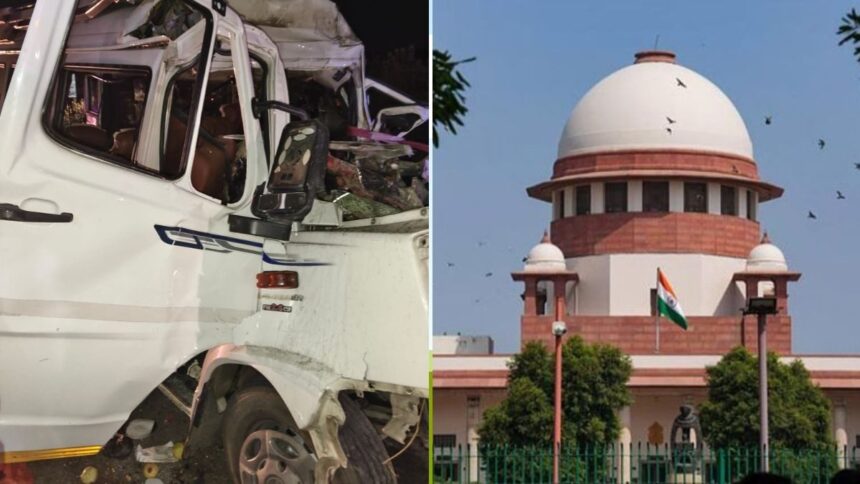
The Supreme Court has flagged the unchecked spread of illegal roadside dhabas and small hotels along expressways and national highways as a serious public safety hazard, observing that such encroachments are emerging as a major cause of fatal road accidents and demand urgent, coordinated action by authorities.
Taking note of recurring accidents linked to unauthorised roadside structures, the top court said it was considering framing nationwide guidelines to address regulatory gaps and ensure uniform safety standards on highways and expressways. The court’s observations came while examining a case that highlighted how poorly regulated roadside activity, combined with weak enforcement, continues to cost lives despite existing laws and agencies tasked with highway management.
The bench underscored that road safety cannot be treated as a fragmented administrative issue, with responsibility passed between authorities, and stressed the need for clarity on who is legally bound to prevent illegal constructions along high-speed corridors meant exclusively for uninterrupted vehicular movement.
Court questions responsibility after fatal Rajasthan accident
The Supreme Court’s concern was sharpened by reference to a tragic accident that occurred on November 2 in Phalodi, Rajasthan, where a tempo traveller rammed into a stationary trailer parked near an illegal roadside establishment. The collision claimed 15 lives, including 10 women and four children, drawing attention to how unauthorised stopping points and eateries along highways create dangerous conditions for motorists, especially at night.
A bench comprising Justices J K Maheshwari and Vijay Bishnoi examined the circumstances surrounding such accidents and questioned why illegal dhabas continue to operate openly despite posing obvious risks. The judges observed that expressways and national highways are designed for high-speed traffic and any unauthorised access, parking, or commercial activity along their edges drastically increases the chances of collisions.
During the hearing, the bench questioned Solicitor General Tushar Mehta, who was appearing on behalf of the National Highways Authority of India. The court sought details on the legal framework governing action against illegal dhabas and roadside hotels, and asked what concrete steps had been taken to prevent their mushrooming along highways.
In response, Mehta submitted that rules do exist for the removal of illegal structures from highway land, but enforcement often falls outside the direct control of the NHAI. He explained that district administrations and local police authorities usually bear the responsibility for taking action against such encroachments, leading to confusion, delays, and lack of accountability. This diffusion of responsibility, he suggested, allows illegal establishments to continue operating despite repeated accidents and safety concerns.
The bench expressed dissatisfaction with this explanation, pointing out that the existence of rules is meaningless if no single authority can be held accountable for enforcing them. The judges questioned how lives could be protected if agencies continue to shift responsibility instead of acting decisively.
Justice Bishnoi noted that even on highways where service roads exist, accidents frequently occur near unauthorised dhabas and roadside hotels. Vehicles slow down abruptly, park haphazardly, or enter and exit highways at unsafe points, creating unpredictable traffic movements that often lead to deadly crashes.
The court also took note of submissions made by senior advocate A N S Nadkarni, who has been appointed as amicus curiae in the matter. Nadkarni placed before the court several images sourced from widely available mapping platforms, showing rampant encroachments along highways across different states. These visuals, the court observed, illustrated that the problem is neither isolated nor occasional, but widespread and systemic.
Nationwide problem prompts move toward uniform guidelines
The Supreme Court made it clear that the issue of illegal roadside dhabas is not confined to a particular state or region, but is a nationwide problem affecting expressways and national highways across India. The bench observed that not all highways are equipped with service roads, and even where they exist, unauthorised eateries often come up at random intervals, forcing vehicles to stop or slow down abruptly on high-speed lanes.
Such conditions, the court said, are inherently dangerous and defeat the very purpose of controlled-access highways. The judges remarked that highways are engineered with specific safety assumptions, including limited entry and exit points, and unauthorised constructions violate these assumptions, exposing road users to unacceptable risks.
Acknowledging the scale of the problem, the Supreme Court indicated that it would consider formulating comprehensive national guidelines to regulate roadside activity along highways and expressways. These guidelines, the court suggested, could help close existing legal loopholes and ensure that all authorities operate under a clear, uniform framework.
The bench stressed that any effective solution must clearly define the roles and responsibilities of various agencies, including the NHAI, state governments, district administrations, and police authorities. Without such clarity, the court warned, enforcement will remain weak and reactive, with action taken only after major accidents rather than as a preventive measure.
The court also questioned the effectiveness of current monitoring mechanisms and asked how illegal structures are allowed to come up and remain operational for long periods without intervention. It noted that while post-accident inquiries often result in blame being assigned to contractors or local officials, this does little to prevent future tragedies if systemic failures are not addressed.
Justice Maheshwari observed that road safety is a shared responsibility, but shared responsibility cannot mean diluted responsibility. He emphasised that when multiple agencies are involved, the law must clearly state who has the final authority and obligation to act, particularly in matters involving public safety.
The Supreme Court’s discussion highlighted broader concerns about infrastructure governance and regulatory enforcement in India. Despite significant investments in building modern expressways and highways, the benefits of such infrastructure, the court noted, are undermined if safety norms are not strictly enforced on the ground.
The bench’s intention to frame guidelines reflects a growing judicial focus on preventive safety measures rather than post-facto accountability. By addressing the root causes of accidents linked to illegal roadside activity, the court aims to reduce fatalities and ensure that highways function as intended.
As proceedings continue, the court is expected to seek further inputs from stakeholders, including highway authorities and state administrations, before finalising any directions. The emphasis, however, remains firmly on accountability, clarity of law, and the urgent need to protect lives on India’s increasingly busy road networks.