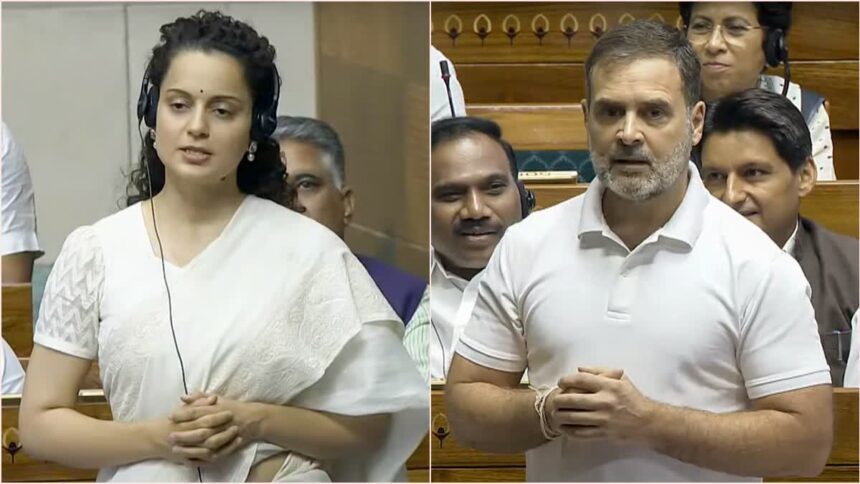
In a development that has stirred both political and public reactions, the Supreme Court’s recent questioning of Rahul Gandhi’s remarks regarding the Indian Army has drawn strong criticism from Bharatiya Janata Party (BJP) MP Kangana Ranaut. The actor-turned-politician condemned the Congress leader for his past statements on the India-China border conflict and accused him of repeatedly echoing narratives that, according to her, align with enemy nations. The incident has reignited discussions around responsible political commentary, national security, and the boundaries of public discourse.
Kangana, while praising the Supreme Court’s stance, asserted that such judicial interventions should act as a caution for others who might consider making remarks that undermine the nation’s honour. The Supreme Court’s pointed queries regarding the credibility and appropriateness of Rahul Gandhi’s statements, particularly on social media, have added to the controversy surrounding the Congress leader’s earlier comments.
Kangana Welcomes Supreme Court’s Rebuke
Kangana Ranaut, known for her strong nationalistic views and fiery political statements, welcomed the Supreme Court’s firm tone. Speaking to reporters, she said, “This is a welcome move by the Supreme Court; they pulled him up. In the future, others should be mindful that they do not hurt India’s honour, integrity, and morale.” She reiterated her claim that Rahul Gandhi possesses what she described as an “anti-India mindset,” a term she has frequently used against various political opponents.
The BJP MP further emphasized that the judiciary’s intervention should not be seen in isolation but rather as a signal to all public figures, especially elected representatives, that national dignity must remain above political rhetoric. According to her, Rahul Gandhi’s comments often tend to support external narratives that discredit India’s sovereignty and armed forces. Her remarks add a new dimension to the ongoing debate over freedom of expression versus national interest.
Supreme Court Grills Rahul Gandhi Over Army Remarks
The Supreme Court’s remarks came during a hearing where a bench comprising Justices Dipankar Datta and Augustine George Masih questioned Rahul Gandhi’s past statements concerning Chinese aggression on the Indian border. The bench expressed concern over the credibility of Rahul Gandhi’s assertion that China had captured 2,000 square kilometres of Indian territory, a claim he made during the Congress’s Bharat Jodo Yatra in December 2022.
Justice Datta asked, “How do you get to know that 2000 square kilometres of Indian territory was occupied by China? What is the credible material?” He further added that such claims, particularly in times of border conflict, do not align with the conduct expected from a “true Indian.”
The bench did not merely question the content of Rahul Gandhi’s statements but also the platform on which they were made. “Whatever you have to say, why don’t you say it in the Parliament? Why do you have to say this in social media posts?” asked Justice Datta, raising concerns about the tendency of public figures to bypass institutional platforms in favour of viral communication methods.
Rahul Gandhi’s comments, made during a press interaction in the midst of his Bharat Jodo Yatra, had drawn both public attention and political backlash. He had claimed that while the media focused on internal party issues, they failed to question the government about significant national concerns like the loss of territory to China and the deaths of Indian soldiers in border skirmishes. His remarks have been repeatedly used by BJP leaders to portray him as insensitive to national interests.
Ongoing Political Fallout and Media Reaction
Following the Supreme Court’s observations, the BJP intensified its criticism, branding Rahul Gandhi as a “certified anti-national” and accusing him of demoralizing the armed forces with irresponsible statements. The party’s communication channels quickly disseminated clips from the court proceedings and linked them to Rahul Gandhi’s broader political narrative.
Meanwhile, some opposition leaders have defended Rahul Gandhi, arguing that questioning government decisions and demanding accountability on issues like border security fall well within the democratic rights of an elected representative. However, the method, timing, and tone of Rahul Gandhi’s remarks have continued to be a contentious point.
While the court has not issued any legal penalty, its strong words serve as a reminder of the weight that public speech carries, particularly when it touches sensitive subjects like national defence. Legal experts suggest that such remarks from the judiciary, even if not legally binding, can influence political discourse by drawing attention to the responsibilities that accompany free speech.
Kangana’s comments reflect a broader sentiment within sections of the political right that view certain criticisms as crossing the line into anti-national territory. Her rise within the BJP and Parliament has been marked by a string of outspoken statements that blend cultural commentary with sharp political critique. In this instance, her remarks contribute to the intensifying scrutiny on the role of public figures in shaping national narratives.
As the political and judicial drama unfolds, the spotlight remains firmly on how political leaders choose to engage with sensitive national issues, and how institutions respond when those boundaries are perceived to be crossed. The evolving conversation around Rahul Gandhi’s statements continues to raise questions about patriotism, accountability, and the ethics of political speech in India’s democracy.