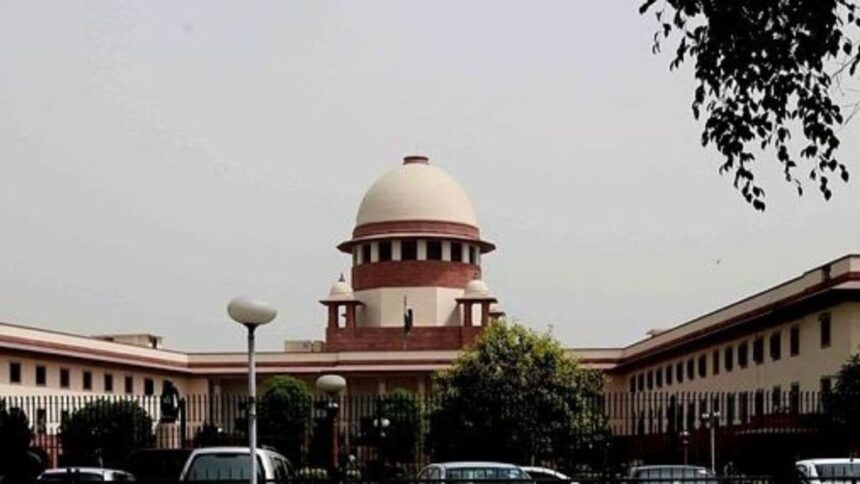
The supreme court on Friday stepped into a growing constitutional and administrative debate by issuing notice to the election commission of india on a petition filed by the kerala government seeking postponement of the special intensive revision of electoral rolls in the state, citing an unavoidable clash with the schedule for local self-government elections and warning of serious administrative disruption if both exercises continue simultaneously.
The matter was heard by a bench comprising Justice Surya Kant, Justice Joymalya Bagchi, and Justice SVN Bhatti, which also issued notices to the Election Commission of India on separate pleas filed by political parties and leaders challenging not just the timing but the very conduct of the revision exercise. The apex court has listed the next hearing in the matter for November 26, setting the stage for a significant examination of how electoral roll revisions interact with constitutionally mandated election schedules.
The petitions before the court reflect mounting concern among the state government and opposition parties that the special intensive revision, commonly referred to as sir, could undermine the smooth conduct of grassroots democratic processes in kerala. At the heart of the dispute lies the argument that the exercise, while legally permissible, has been initiated at a moment when the state’s administrative machinery is already stretched to its limits by the impending local body elections scheduled for December.
kerala government flags conflict between sir and local body election schedule
Appearing on behalf of the kerala government, senior advocate Kapil Sibal told the court that the sir schedule directly overlaps with preparations for the upcoming local self-government institution elections, creating a situation where the same pool of trained personnel would be expected to perform two large-scale, resource-intensive exercises at the same time. According to the state, this overlap is not merely inconvenient but constitutionally and administratively untenable.
The petition submitted by the kerala government emphasised that the ongoing sir is unsuitable in the context of the state’s current electoral timetable. Local self-government elections, which include polls to panchayats and municipalities, are constitutionally mandated and governed by strict statutory deadlines. The plea pointed out that under the constitution, as well as the kerala panchayat raj act and the kerala municipality act, the entire local election process must be completed before December 21, 2025.
To underline the immediacy of the issue, the state detailed the election commission’s own schedule for the local body polls. Polling has been fixed for December 9 and December 11, with counting scheduled to begin on December 13. The entire electoral process is expected to conclude by December 18. In contrast, the sir timeline requires enumeration to be completed by December 4, submission of data by December 9, and publication of the final revised electoral rolls only on February 7, 2026. According to the state, this creates a direct and unavoidable overlap during the most critical phase of election preparation and execution.
The petition argued that conducting both exercises concurrently would place an unsustainable burden on the administrative system. The state government informed the court that approximately 176,000 government and quasi-government staff are required to conduct the local body elections, along with around 68,000 police personnel to ensure security and law and order. The sir exercise, it said, would require an additional 25,668 staff members. The plea warned that there simply are not enough trained and experienced personnel to be deployed for both tasks simultaneously without compromising the integrity of one or both processes.
Beyond the numbers, the state stressed the qualitative aspect of election management. Electoral processes rely heavily on trained officials who understand procedures, legal requirements, and contingency handling. Diverting or overburdening these officials, the petition argued, risks errors, delays, and disputes that could undermine public confidence in the democratic process. The kerala government cautioned that insisting on the sir at this juncture could effectively bring administrative functioning to a standstill during a crucial democratic exercise.
The plea also questioned the urgency of conducting the special intensive revision at this point in time. It noted that the 2024 lok sabha elections have already concluded and that the next kerala legislative assembly elections are not due until May 2026. In this context, the state argued, there is no pressing constitutional or electoral necessity to complete the sir immediately, particularly when doing so threatens to disrupt local body elections that are imminent and legally time-bound.
political parties challenge revision as court reviews wider national context
In addition to the kerala government’s petition, the supreme court issued notices on pleas filed by the Communist Party of India (Marxist), the Communist Party of India, and PK Kunhalikutty. These petitions go a step further by challenging the special intensive revision of electoral rolls itself, raising concerns about its scope, timing, and potential impact on voters.
The challenges mounted by these political parties reflect apprehensions that large-scale revisions carried out close to election periods can lead to confusion, exclusion of eligible voters, or administrative lapses. While the details of their arguments are to be examined in subsequent hearings, the fact that the apex court has clubbed these matters together suggests that it intends to take a comprehensive view of the issue rather than addressing the kerala government’s plea in isolation.
The court’s intervention in the kerala matter also comes against the backdrop of similar challenges raised in other states. The supreme court is already seized of petitions concerning the sir exercise in Bihar, Tamil Nadu, and West Bengal. In Bihar, the matter has been heard multiple times, and elections in the state have already been completed. This has limited the scope of immediate relief, although broader questions about the conduct of the revision remain under judicial consideration.
In contrast, Tamil Nadu and West Bengal have not yet begun the sir process. In those cases, the court has sought responses from the election commission to challenges raised by petitioners, signalling that it is closely examining whether the timing and manner of the revision exercise align with constitutional principles and practical realities across different states.
The kerala case, however, presents a particularly sharp conflict between two parallel democratic exercises. On one hand is the election commission’s mandate to maintain accurate and up-to-date electoral rolls through mechanisms such as special intensive revisions. On the other is the constitutional obligation to conduct local self-government elections within prescribed timelines, ensuring continuity in grassroots democratic institutions.
Legal observers note that the court’s decision to issue notice does not amount to a stay on the sir exercise at this stage, but it does indicate that the bench considers the concerns raised to be serious enough to warrant detailed examination. The November 26 hearing is expected to focus on whether the election commission can justify proceeding with the sir in kerala despite the state’s objections, and whether alternative timelines or safeguards can be considered to avoid administrative overload.
The outcome of this case could have implications beyond kerala. If the court accepts the argument that large-scale electoral roll revisions should not overlap with major elections requiring the same administrative machinery, it may prompt the election commission to recalibrate its scheduling practices nationwide. Conversely, if the commission successfully defends its timeline, states may be required to find ways to manage overlapping electoral responsibilities, even at the cost of significant logistical strain.
As matters stand, the supreme court’s notice has brought temporary clarity but no immediate resolution. The competing imperatives of electoral roll accuracy and timely conduct of elections remain in tension, and the kerala case is poised to become a key reference point in defining how these priorities are balanced within India’s constitutional framework.