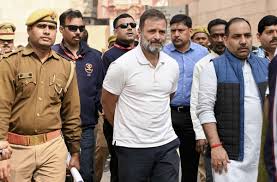
The defamation case against Congress leader Rahul Gandhi witnessed a significant procedural development as the plaintiff was cross examined before a local court in Sultanpur, marking an important stage in a legal battle that has drawn sustained political and public attention across the country.
The case, rooted in allegations that Gandhi made defamatory remarks during a political address, has been progressing steadily through the trial stage. The cross examination of the complainant signals a deeper judicial scrutiny of the claims and counterclaims, as both sides attempt to establish the credibility of their arguments and the context in which the disputed statements were made. For Gandhi, who has faced multiple legal challenges linked to political speeches, the Sultanpur proceedings represent another test of how criminal defamation law is being applied in politically charged circumstances.
plaintiff questioned as court examines basis of defamation claim
During the hearing in the Sultanpur court, the plaintiff, who had filed the defamation complaint against Rahul Gandhi, was subjected to detailed cross examination by the defence. The questioning focused on the circumstances under which the allegedly defamatory remarks were made, the plaintiff’s interpretation of those remarks, and the extent to which they were perceived as damaging to reputation.
Legal sources indicated that the defence sought to highlight inconsistencies in the complainant’s account and to establish whether the statements attributed to Gandhi were taken out of their broader political context. The line of questioning also aimed to determine whether the remarks were directed specifically at the plaintiff or were part of a more general political critique, a distinction that is often central to defamation cases involving public speeches.
The court proceedings unfolded in a routine but closely watched manner, with both sides adhering to procedural requirements. Observers noted that cross examination is a crucial phase in such trials, as it allows the defence to challenge the factual foundation of the complaint and test the reliability of the plaintiff’s testimony under oath.
The Sultanpur court has been hearing the case after it was transferred and consolidated through earlier judicial orders. The matter has seen multiple hearings, with Rahul Gandhi previously appearing through legal counsel and complying with court directions. While the Congress leader has consistently denied the allegations, maintaining that his remarks fall within the bounds of political speech, the complainant has argued that the statements caused personal and reputational harm, warranting criminal action.
The court did not pass any substantive order on the day of cross examination, as the hearing was limited to recording testimony and responses. The proceedings are expected to continue, with further examination of witnesses and arguments to follow in subsequent dates.
political and legal context surrounding the sultanpur case
The defamation case in Sultanpur forms part of a broader pattern of legal challenges faced by Rahul Gandhi in recent years, many of them linked to speeches made during election campaigns or public rallies. Supporters of Gandhi have argued that such cases reflect an increasing use of criminal defamation laws against opposition leaders, while critics maintain that public figures must be held accountable for their words, particularly when they allegedly target individuals or groups.
From a legal standpoint, the case raises familiar questions about the balance between freedom of speech and the right to reputation. Indian courts have repeatedly held that while political speech enjoys a degree of protection, it is not absolute, and statements that cross into personal vilification can attract criminal liability. At the same time, courts have also cautioned against using defamation law to stifle legitimate political criticism.
The Sultanpur proceedings have therefore attracted attention not only because of the high profile of the accused but also because of their potential implications for political discourse. Legal experts point out that the outcome will depend heavily on how the court interprets the intent and impact of the disputed remarks, as well as the evidence presented by both sides.
For Rahul Gandhi, the case adds to an already complex legal landscape. In the past, he has faced convictions, stays, and appeals in defamation matters arising from political comments, turning such cases into flashpoints in the national debate on free speech. Each new development is closely followed by political observers, as judicial outcomes can carry consequences beyond the courtroom, influencing electoral narratives and public perception.
The plaintiff’s cross examination represents a procedural milestone rather than a final determination. It indicates that the trial court is moving methodically through the evidentiary stage, allowing both sides adequate opportunity to present their case. As the proceedings continue, the court is expected to examine additional witnesses and documents before moving towards final arguments.
For now, the Sultanpur court’s focus remains on assessing the factual and legal merits of the complaint, separate from the political noise surrounding the case. The pace and direction of the trial will determine whether the allegations against Rahul Gandhi withstand judicial scrutiny or whether the defence succeeds in demonstrating that the remarks in question do not meet the legal threshold for criminal defamation.