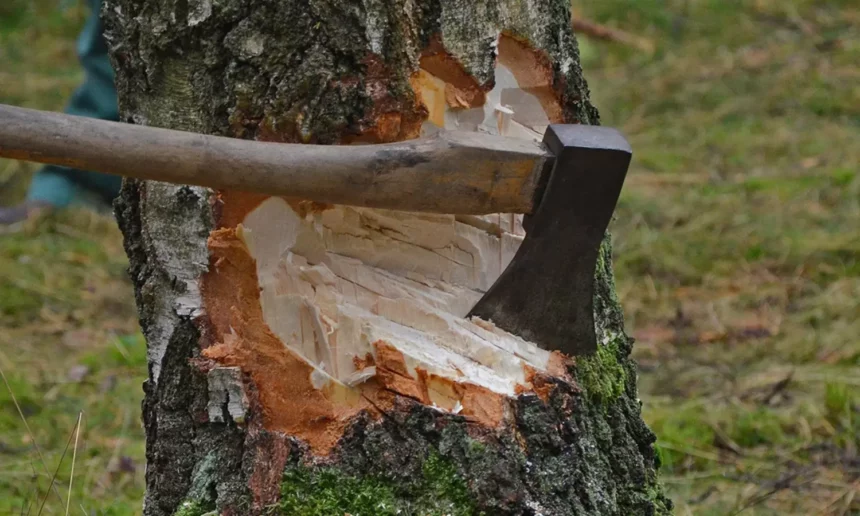
The Supreme Court has strongly condemned the large-scale felling of trees, stating that cutting a significant number of trees is worse than killing human beings. The court made this observation while imposing a hefty fine of Rs 1 lakh per illegally cut tree on a man who had chopped down 454 trees in the protected Taj Trapezium Zone.
A bench comprising Justices Abhay S Oka and Ujjal Bhuyan dismissed the plea of the accused, Shiv Shankar Agarwal, who had sought relief after being penalized for cutting the trees without permission. The court emphasized that environmental violations must not be taken lightly and declared that such actions have severe consequences. “There should be no mercy in environmental cases. Felling a large number of trees is worse than killing a human,” the bench remarked.
The court highlighted the long-term damage caused by the illegal act, stating that it would take at least 100 years to regenerate the green cover lost due to the destruction of 454 trees. The court upheld the findings of the Central Empowered Committee (CEC), which had recommended a fine of Rs 1 lakh per tree, noting that the violation took place in Dalmia Farms, located in Mathura-Vrindavan.
Senior advocate Mukul Rohatgi, representing Agarwal, acknowledged the wrongdoing but requested a reduction in the penalty. However, the court refused to entertain the plea, insisting that the fine must be paid in full. Additionally, the court directed that Agarwal should undertake plantation efforts at a nearby site as part of the remedial measures. It further clarified that the contempt plea against him would only be disposed of after ensuring compliance with the directives.
In a significant move, the Supreme Court also revoked its 2019 order, which had removed the requirement of obtaining prior permission for cutting trees on non-forest and private lands within the Taj Trapezium Zone. The court’s latest ruling reinstates stricter environmental regulations, reinforcing the importance of preserving greenery in ecologically sensitive areas.
This verdict underscores the judiciary’s firm stance on environmental protection, highlighting the irreversible damage caused by deforestation and the urgent need for stricter compliance with ecological norms.