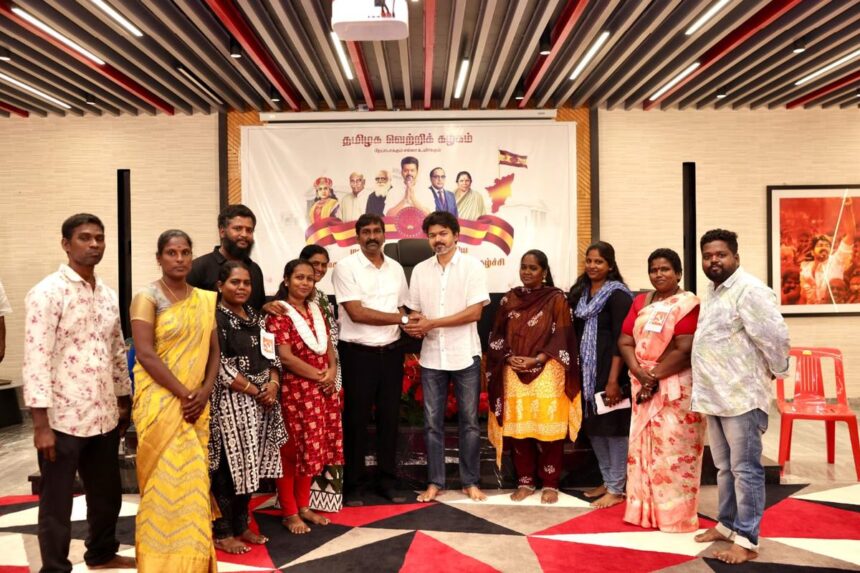
Tamil superstar Vijay has strongly criticised the DMK government for midnight arrests of sanitation workers protesting peacefully in Chennai. In a major political flashpoint in Tamil Nadu, acclaimed Tamil actor and Tamilaga Vettri Kazhagam (TVK) party leader Vijay has launched a scathing attack on the DMK government, accusing it of acting in an “inhumane and anarchic” manner by arresting hundreds of sanitation workers in the middle of the night. The incident, which took place outside Chennai’s historic Ripon Building — headquarters of the Greater Chennai Corporation — has triggered outrage among labour groups, opposition parties, and civil rights activists. The arrests followed an order from the Madras High Court directing the state administration to clear the protest site, where sanitation workers had been staging a peaceful sit-in for 13 days. The workers were demanding permanent jobs, salary security, and a rollback of the civic body’s plan to outsource conservancy operations in Zones V and VI. Police detained nearly 900 protesters in the early hours of the morning, sparking allegations of excessive force, including violence against women workers. Vijay, who has recently entered active politics through his newly formed party, condemned the arrests, calling them an act of tyranny and a direct assault on democratic rights. “Condemnation to the fascist DMK government for arresting sanitation workers, who have been peacefully fighting for their rights, in an inhumane and anarchic manner in the dead of night,” Vijay said in a strongly worded statement.
Midnight Arrests and Allegations of Violence Against Women
According to Vijay, the police action in the dead of night was not only unnecessary but also cruel in its execution. He alleged that during the crackdown, several women workers fainted, while others sustained injuries as they were forcibly dragged away from the protest site. “Witnessing this midnight arrest operation, it is evident that violence has been unleashed on women to an extent that no one with a conscience can bear,” Vijay remarked, adding that immediate medical assistance should be provided to the injured workers. In addition to the physical harm, Vijay alleged that detainees were taken to multiple undisclosed locations, making it difficult for them to communicate with their families. He sharply questioned the state government’s morality and democratic values: “To detain them in a way that prevents even communication with their families — are sanitation workers anti-national elements? Does the ruling government have even a shred of conscience? Looking at this cruel action, it becomes crystal clear that what is happening in Tamil Nadu is not democracy but tyranny,” he said. The actor-politician also pointed out the apparent hypocrisy of the ruling DMK, accusing it of failing to fulfil promises made to sanitation workers before the election. He demanded the immediate release of all detained workers and called for a transparent explanation from the government regarding the midnight operation.
Court Order, Government Defence, and Protesters’ Demands
The confrontation between sanitation workers and the civic administration has been building for nearly two weeks. On the 13th day of the protest, the Madras High Court issued a directive to clear the protest site, stating that occupying public footpaths was impermissible. A bench comprising Chief Justice Manindra Mohan Shrivastava and Justice Sunder Mohan instructed the police to act with restraint while implementing the order, emphasising that protesters should be allowed to continue their agitation at designated venues after obtaining necessary permissions. The sanitation workers’ protest is primarily against the Greater Chennai Corporation’s plan to privatise waste management services in Zones V and VI. Protesters fear that outsourcing these operations to private contractors will strip them of job security, reduce wages, and undermine hard-earned employment benefits. Many workers also suspect that privatisation will open the door to exploitative work conditions and weaken union protections.
The demands of the workers include:
- Granting permanent employment status to contract workers.
- Ensuring fixed and secure salaries.
- Halting the proposed privatisation of conservancy operations.
- Improving working conditions and providing necessary safety equipment.
The government and the civic body, however, have defended the outsourcing plan, arguing that it would improve operational efficiency, ensure better waste collection and disposal, and address chronic manpower shortages. Officials point to similar models already implemented in other zones, claiming they have led to cleaner streets and better waste segregation without large-scale job losses. Political Fallout and Continued Resistance Vijay’s intervention in the matter marks one of his most outspoken political statements since launching Tamilaga Vettri Kazhagam, and it underscores his positioning as a champion for workers’ rights and social justice. His remarks have resonated widely among supporters, particularly in urban working-class communities who view the sanitation workers’ cause as emblematic of broader labour struggles. Left parties have also criticised the Madras High Court order, noting that the court has yet to hear and decide the core petitions regarding the workers’ employment rights. These parties argue that clearing the protest site before resolving the legal dispute undermines the workers’ ability to collectively press for their demands. Despite the arrests and removal from the protest site, worker representatives have vowed to continue their agitation in permitted venues, insisting that privatisation is a direct threat to their livelihoods. They have also warned of intensifying the protest if their demands are not met, signalling the possibility of a prolonged confrontation with the state government.