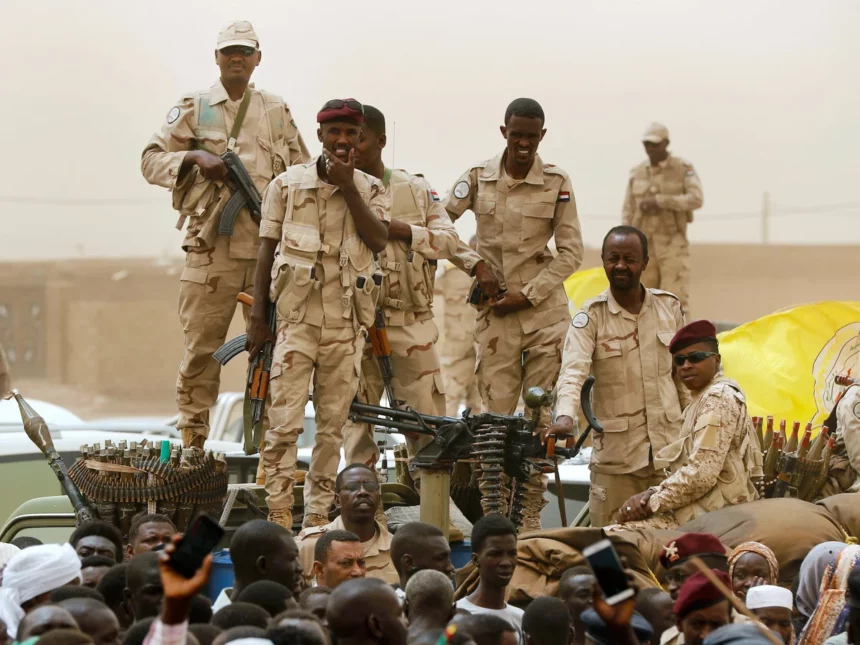
Sudan’s paramilitary group, the Rapid Support Forces (RSF), has announced the formation of a rival government, marking two years since the country descended into a brutal civil war. The war, which has already led to tens of thousands of deaths, is now being described by the United Nations as the world’s worst humanitarian crisis. With the conflict still raging, the RSF, led by Mohamed Hamdan Dagalo, also known as Hemedti, declared the establishment of the “Government of Peace and Unity” in areas under its control, challenging the army-led administration headed by General Abdel Fattah al-Burhan.
New Government and Rival Authority
On Tuesday, Dagalo proclaimed the formation of the new government, claiming it as a broad coalition representing the true face of Sudan. The RSF and its allies had already laid the groundwork for this move with a charter signed in Nairobi earlier this year, which set out their intent to create an alternative governing authority. In his announcement, Dagalo also highlighted the endorsement of a transitional constitution, which he described as a “roadmap for a new Sudan.” The proposed constitution suggests the creation of a 15-member presidential council, designed to represent all regions of Sudan.
The declaration of a rival government comes as Sudan remains in the grips of war. Experts fear the ongoing conflict could result in the permanent fragmentation of the country. Sharath Srinivasan, a Sudan specialist at the University of Cambridge, warned that the RSF’s growing influence in the Darfur region might lead to “de facto separation.” This marks a significant step in Sudan’s internal strife, which shows no sign of easing.
International Reactions and Humanitarian Crisis
As the RSF solidifies its control in western Sudan, international scrutiny has intensified, especially regarding its actions in Darfur. The United States condemned the RSF for its recent attacks on civilian camps in North Darfur, which resulted in at least 300 deaths. The attacks on the Zamzam and Abu Shouk camps, home to thousands of displaced people, have drawn widespread condemnation. The U.S. State Department voiced deep concerns about the RSF’s targeting of civilians and humanitarian workers, calling for accountability and respect for international humanitarian laws.
Meanwhile, Sudan’s escalating humanitarian crisis has prompted global efforts to increase aid. The United Kingdom hosted a donor conference in London, where international partners pledged financial support to help alleviate the suffering. The European Union pledged over $592 million, and the UK committed an additional $158 million. However, Sudan’s military-aligned government criticized the conference, noting the exclusion of both warring factions from the talks.
The international community remains divided on the way forward, with continued calls for an immediate ceasefire and a transition to civilian rule. The future of Sudan remains uncertain as the conflict continues to ravage the country, with no political solution in sight.