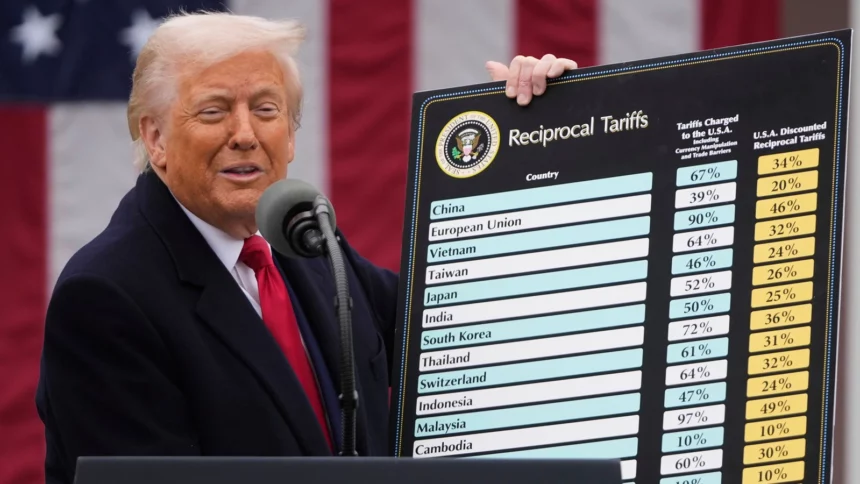
The Indian stock market saw a sharp decline on Thursday, April 3, following a major announcement by US President Donald Trump, who imposed a 26% reciprocal tariff on India. This unexpected move sent shockwaves through financial markets, triggering significant losses across various sectors, particularly IT, telecom, and real estate stocks. Investors expressed concerns over the potential economic impact of the new tariffs, leading to widespread market instability.
Stock Market Reaction: Sensex and Nifty Fall
At the opening bell, BSE Sensex dropped by 499.45 points (0.65%), settling at 76,117.99, while the NSE Nifty slipped by 125.25 points (0.54%), closing at 23,207.10. The market reaction was primarily driven by fears of escalating trade tensions between India and the US, which could lead to significant disruptions in key sectors, especially in IT and telecom.
Among the 30 Sensex stocks, Tata Motors took the hardest hit, declining by 2.34%, trading at ₹656.05. Other major losses included Kotak Mahindra Bank (-2.25% to ₹2,106.05) and Adani Ports & Special Economic Zone (-2.22% to ₹1,170). Only three stocks managed to stay in the green, highlighting the broader market’s struggle under increased selling pressure.
Sector-Wise Decline: IT, Telecom, and Realty Sectors Struggle
The Nifty Midsmall IT & Telecom Index was hit the hardest, falling by 1.94% to 9,055.90, followed closely by the Nifty IT Index, which dropped 1.67% to 35,676.45. The Nifty Realty Index also saw a 1.47% decline, settling at 842.10. These declines marked a stark contrast to the previous session, where these same indices had seen gains. The market’s nervousness surrounding the tariff announcement overshadowed the positive momentum from the earlier days.
The impact of the new reciprocal tariffs from the US is expected to continue to affect investor sentiment in the coming days. According to Akshay Chinchalkar, Head of Research at Axis Securities, “Asia is a sea of red due to last night’s tariff announcements, and the Nifty is expected to open weak.” He also highlighted that key support levels between 23,090-23,141 and the critical 22,800-23,000 zone will be closely monitored to gauge future market movements.
Investor sentiment was further dampened by the foreign institutional investors (FIIs) turning net sellers, offloading equities worth ₹1,538.88 crore. In contrast, domestic institutional investors (DIIs) stepped in as net buyers, purchasing stocks worth ₹2,808.83 crore. This mix of institutional activity reflects the market’s cautious response to the uncertainty created by Trump’s tariff policy.
As the market adapts to these new tariff developments, the closing trend of the day will provide crucial insights into investor confidence and the long-term impact on India’s economy and stock market stability.