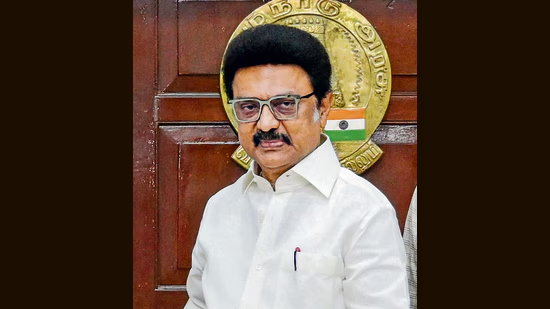
Tamil Nadu Chief Minister and DMK president MK Stalin has voiced deep concerns regarding the ongoing Special Intensive Revision (SIR) of electoral rolls in the state. He warned that multiple procedural flaws in the current process could jeopardize the voting rights of citizens ahead of the 2026 assembly elections. Stalin emphasized that the effectiveness of the revision largely depends on the proper functioning of booth-level officers (BLOs), and he criticized the Election Commission for failing to ensure smooth coordination between the BLOs and booth-level agents (BLAs) of political parties. Ahead of the planned protests on November 11, he insisted that all eligible voters must be included in the revised lists and that no ineligible names should be added.
Procedural Flaws and DMK’s Objections to SIR
MK Stalin pointed out that the SIR process, which involves revising and verifying voter lists, has been marred by several procedural irregularities. According to him, the Election Commission had promised seamless coordination between BLOs and BLAs to ensure that political parties could actively monitor the revision. However, this promise has not been fulfilled. Stalin stated that while DMK’s BLAs are prepared to participate in the verification process, BLOs are frequently absent, which undermines the accuracy and transparency of the exercise. He stressed that the integrity of the SIR depends on the active participation of BLOs and that their absence poses a serious threat to democratic processes.
The Chief Minister clarified that the DMK is not opposed to revising electoral rolls in principle. He acknowledged that electoral rolls do require periodic updates to remove ineligible voters and include new voters. However, Stalin argued that the current SIR is being conducted in a rushed manner, without sufficient time or proper planning, at a point when only a few months remain before the 2026 assembly elections. He described this hurried approach as anti-democratic and potentially harmful to the rights of voters. Stalin expressed fears that many legitimate voters might be omitted from the lists while some ineligible voters could be included, undermining the fundamental principle of fair and transparent elections.
Stalin also highlighted that the DMK had moved the Supreme Court against the current process, emphasizing that it posed a threat to the voting rights of all citizens in Tamil Nadu. He said that his party had consistently voiced concerns that the SIR could result in large-scale deletion of eligible voters from electoral rolls, confirming suspicions that the revision could be misused for political gains. To mitigate the potential impact, the DMK has established a helpline for citizens affected by the SIR, providing guidance and clarifying doubts to ensure voters’ rights are protected.
The Chief Minister further reiterated that the DMK would act as an ally for citizens in defending their electoral rights. He urged the public to remain vigilant, warning that the danger of losing the right to vote was imminent and that citizens must collectively protect democracy in the state. Stalin’s emphasis on public participation and awareness reflects the party’s strategy to mobilize voters and safeguard their rights against what it views as a flawed and politically motivated exercise.