
• English
  • Hindi
  • Punjabi
  • Marathi
  • German
  • Gujarati
  • Urdu
  • Telugu
  • Bengali
  • Kannada
  • Odia
  • Assamese
  • Nepali
  • Spanish
  • French
  • Japanese
  • Arabic
  • Home
  • Noida
  • National
    • BulletsIn
    • cliQ Explainer
    • Government Policy
    • New India
  • International
    • Middle East
    • Foreign
  • Entertainment
  • Business
    • Tender News
  • Sports
    • IPL2025
  • Services
    • Lifestyle
    • How To
    • Spiritual
      • Festival and Culture
    • Tech
Notification
  • Home
  • Noida
  • National
    • BulletsIn
    • cliQ Explainer
    • Government Policy
    • New India
  • International
    • Middle East
    • Foreign
  • Entertainment
  • Business
    • Tender News
  • Sports
    • IPL2025
  • Services
    • Lifestyle
    • How To
    • Spiritual
      • Festival and Culture
    • Tech
  • Home
  • Noida
  • National
    • BulletsIn
    • cliQ Explainer
    • Government Policy
    • New India
  • International
    • Middle East
    • Foreign
  • Entertainment
  • Business
    • Tender News
  • Sports
    • IPL2025
  • Services
    • Lifestyle
    • How To
    • Spiritual
      • Festival and Culture
    • Tech
  • Noida
  • National
  • International
  • Entertainment
  • Business
  • Sports
CliQ INDIA > National > Mohan Bhagwat Reaffirms RSS’s Legal Recognition, Respect for the Tricolour, and Inclusive National Vision | cliQ Latest
National

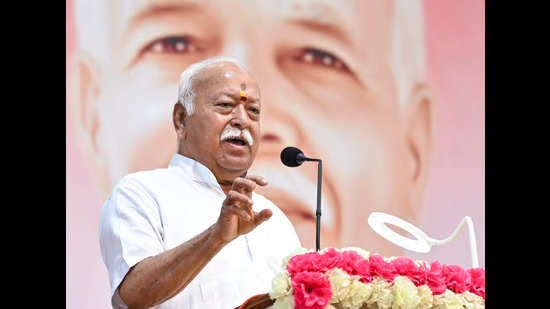
Mohan Bhagwat Reaffirms RSS’s Legal Recognition, Respect for the Tricolour, and Inclusive National Vision | cliQ Latest

vak Sangh (RSS) chief Mohan Bhagwat has reiterated that the organization has always respected India’s national flag, the Tricolour, and that it holds full legal recognition as a

cliQ India
cliQ India
Share
11 Min Read
SHARE
Highlights
  • Mohan Bhagwat Reaffirms RSS’s Legal Recognition, Respect for the Tricolour, and Inclusive National Vision
  • Mohan Bhagwat Reaffirms RSS’s Legal Recognition, Respect for the Tricolour, and Inclusive National Vision Introduction: Rashtriya Swayamsevak Sangh (RSS) chief Mohan Bhagwat has reiterated that the organization has always respected India’s national flag, the Tricolour, and that it holds full legal recognition as a lawful “association of persons,” despite not being formally registered. His remarks came amid political debate in Karnataka, where state minister Priyank Kharge questioned the RSS’s registration status and demanded restrictions on its use of public spaces for events. Addressing the issue, Bhagwat clarified that the RSS, founded in 1925, was never required to be registered under the laws of the time, as its identity as a voluntary social organization was already acknowledged by successive governments over decades. Legal Recognition, Organizational Nature, and the Question of Registration Mohan Bhagwat stated that the RSS has always been recognized as a lawful collective of individuals under Indian law, enjoying legitimacy through its structure and the recognition of government authorities. He pointed out that the organization had been banned three times in India’s history, which in itself proved that it has always existed as a legally recognized entity. “If we were not legally recognized, how could any government have banned us?” he asked, emphasizing that even the Income Tax Department acknowledges the RSS’s status by granting tax exemptions to its operations. Bhagwat criticized those who question the organization’s legitimacy, particularly opposition leaders, calling their arguments politically motivated. He explained that the RSS’s legal recognition predates Indian independence and that the concept of registration under the Societies Act or other laws was not necessary for its functioning in 1925. The RSS, he said, was founded with the vision of national service and moral upliftment rather than political ambition. Over the decades, it has remained a lawful, voluntary, and cultural body devoted to nation-building. He clarified that the RSS is not affiliated with any political party. “We do not have a party of our own, but all Indian parties belong to us,” Bhagwat remarked, underscoring that the organization supports Rashtraniti (national policy) rather than Rajniti (party politics). He emphasized that the RSS supports any effort that promotes national unity and strength, regardless of the political party undertaking it. The organization, he explained, does not impose restrictions on who may participate in its activities. “We never ask about anyone’s religion, caste, or creed in our daily shakhas,” he said. “Muslims, Christians, Hindus, and people of all backgrounds attend. We consider all of them the sons and daughters of Bharat Mata.” This assertion was intended to dispel long-standing allegations that the RSS discriminates based on religion or caste. Bhagwat maintained that the organization’s ideology is rooted in inclusivity and cultural nationalism, not sectarianism. “Our goal is not political dominance but national integration,” he said, adding that the RSS seeks to guide India’s future along a moral and culturally grounded path. He further highlighted that the RSS’s contributions have been consistently recognized by governments of different political orientations. “Every time the organization was banned, it was eventually reinstated because truth and national service prevailed,” he said, referring to the post-independence bans following the assassination of Mahatma Gandhi and the Emergency period. Bhagwat’s argument was that the state’s repeated legal acknowledgment of the RSS following such bans is evidence of its constitutional legitimacy. Bhagwat also addressed criticism from Congress and left-wing leaders, saying that their objections stem from ideological bias rather than factual understanding. “Our recognition is legal, our existence historical, and our service to the nation undeniable,” he affirmed. “The RSS is not an underground or secretive organization. We have open branches, transparent operations, and a mission rooted in India’s unity.” The Tricolour, the Saffron Flag, and National Identity In his address, Bhagwat elaborated on the RSS’s relationship with the Indian national flag and its historical association with the saffron flag, or Bhagwa Dhwaj. He noted that the organization adopted the saffron flag in 1925, symbolizing renunciation, purity, and sacrifice—values that the RSS considers central to India’s cultural ethos. The national Tricolour, he explained, was adopted later in 1933 after deliberations by the National Flag Committee. The committee had initially recommended saffron as the dominant colour, but after Mahatma Gandhi’s intervention, the Tricolour with three bands was finalized to represent all communities. Bhagwat stressed that the RSS has always respected and revered the national flag. “We have always saluted the Tricolour, protected it, and honoured it,” he said, countering allegations that the organization had previously refused to hoist it at certain events. He emphasized that the RSS’s reverence for the flag is inseparable from its devotion to the nation itself. “The saffron flag represents the spirit of sacrifice, while the Tricolour represents the unity of our diverse nation. Both are sacred to us,” he said. To illustrate his point, Bhagwat drew parallels with other political movements. “The Communist Party has its red flag, the Congress has its tricolour with the spinning wheel, and the Republican Party has its blue flag. We have the saffron,” he said. “But that does not diminish our respect for the national flag.” His comments were intended to highlight that different organizations may have their symbols, yet all must respect the symbols that unite the nation as a whole. Addressing India’s relationship with Pakistan, Bhagwat remarked that peace between the two countries can only be achieved if Pakistan ceases its hostile activities against India. “Peace will prevail only when Pakistan stops its attempts to harm us,” he said. “As long as it takes satisfaction in causing us trouble, there can be no peace. And if this continues, it will one day have to face the consequences.” He referenced the 1971 war and the creation of Bangladesh as a reminder of India’s resolve and strength. In the context of the RSS’s centenary year, Bhagwat said the organization was evolving to engage with younger generations more effectively. “We have changed many methods of our work, but our fundamentals remain the same,” he said. Recognizing the importance of technology, he acknowledged that today’s youth are deeply connected to social media and artificial intelligence. “If the youth are active in these spaces, we must go there too,” he stated. “We must reach them with the message of national service and patriotism.” Bhagwat also underscored that the RSS’s guiding principles transcend political boundaries. The organization, he said, focuses on national welfare rather than political power. “We do not interfere in elections or pressure our volunteers to support any party. All political parties are equal to us, and we support only those policies that strengthen the nation,” he explained. His remarks came in response to criticisms from opposition leaders who accuse the RSS of functioning as the ideological arm of the ruling party. Bhagwat dismissed such allegations, reiterating that the organization’s primary goal is to foster unity, discipline, and service among citizens. “We serve Bharat Mata, not any political organization,” he declared. Following Bhagwat’s comments, reactions poured in from political leaders and social commentators. Communist Party of India (CPI) General Secretary D. Raja criticized the RSS, calling Bhagwat’s remarks a repetition of the organization’s long-standing defensive strategy. Raja argued that while the CPI, also founded in 1925, is a registered and constitutionally transparent entity, the RSS continues to operate in secrecy. He accused the RSS of maintaining an opaque structure while seeking to influence public institutions indirectly. In response, Bhagwat reiterated that transparency within the RSS is reflected in its public presence and community activities. He maintained that all its events, from daily shakhas to public outreach programs, are open to participation from people of all backgrounds. “Our branches are open to all Indians. We do not ask who you are, what religion you follow, or what caste you belong to,” he said. “In our eyes, all are equal participants in the service of the nation.” Bhagwat’s speech also reflected a vision for the organization’s future, emphasizing inclusivity, modernization, and a focus on social cohesion. He called upon volunteers to embrace new methods of outreach, particularly digital engagement, to connect with the country’s youth and spread the message of national pride, discipline, and unity. The RSS’s willingness to adapt while maintaining its ideological foundation, he said, would ensure its continued relevance in India’s evolving social landscape. Through his remarks, Bhagwat sought to reaffirm the RSS’s place in India’s democratic and cultural fabric—legally recognized, socially inclusive, and unwaveringly committed to the nation’s unity. His defense of the organization’s history, legal legitimacy, and reverence for national symbols marked a comprehensive response to its critics while emphasizing its continuing mission of nation-building and civic engagement.

Rashtriya Swayamsevak Sangh (RSS) chief Mohan Bhagwat has reiterated that the organization has always respected India’s national flag, the Tricolour, and that it holds full legal recognition as a lawful “association of persons,” despite not being formally registered. His remarks came amid political debate in Karnataka, where state minister Priyank Kharge questioned the RSS’s registration status and demanded restrictions on its use of public spaces for events. Addressing the issue, Bhagwat clarified that the RSS, founded in 1925, was never required to be registered under the laws of the time, as its identity as a voluntary social organization was already acknowledged by successive governments over decades.

Contents
Legal Recognition, Organizational Nature, and the Question of RegistrationThe Tricolour, the Saffron Flag, and National Identity

Legal Recognition, Organizational Nature, and the Question of Registration

Mohan Bhagwat stated that the RSS has always been recognized as a lawful collective of individuals under Indian law, enjoying legitimacy through its structure and the recognition of government authorities. He pointed out that the organization had been banned three times in India’s history, which in itself proved that it has always existed as a legally recognized entity. “If we were not legally recognized, how could any government have banned us?” he asked, emphasizing that even the Income Tax Department acknowledges the RSS’s status by granting tax exemptions to its operations.

Bhagwat criticized those who question the organization’s legitimacy, particularly opposition leaders, calling their arguments politically motivated. He explained that the RSS’s legal recognition predates Indian independence and that the concept of registration under the Societies Act or other laws was not necessary for its functioning in 1925. The RSS, he said, was founded with the vision of national service and moral upliftment rather than political ambition. Over the decades, it has remained a lawful, voluntary, and cultural body devoted to nation-building.

He clarified that the RSS is not affiliated with any political party. “We do not have a party of our own, but all Indian parties belong to us,” Bhagwat remarked, underscoring that the organization supports Rashtraniti (national policy) rather than Rajniti (party politics). He emphasized that the RSS supports any effort that promotes national unity and strength, regardless of the political party undertaking it. The organization, he explained, does not impose restrictions on who may participate in its activities. “We never ask about anyone’s religion, caste, or creed in our daily shakhas,” he said. “Muslims, Christians, Hindus, and people of all backgrounds attend. We consider all of them the sons and daughters of Bharat Mata.”

This assertion was intended to dispel long-standing allegations that the RSS discriminates based on religion or caste. Bhagwat maintained that the organization’s ideology is rooted in inclusivity and cultural nationalism, not sectarianism. “Our goal is not political dominance but national integration,” he said, adding that the RSS seeks to guide India’s future along a moral and culturally grounded path.

He further highlighted that the RSS’s contributions have been consistently recognized by governments of different political orientations. “Every time the organization was banned, it was eventually reinstated because truth and national service prevailed,” he said, referring to the post-independence bans following the assassination of Mahatma Gandhi and the Emergency period. Bhagwat’s argument was that the state’s repeated legal acknowledgment of the RSS following such bans is evidence of its constitutional legitimacy.

Bhagwat also addressed criticism from Congress and left-wing leaders, saying that their objections stem from ideological bias rather than factual understanding. “Our recognition is legal, our existence historical, and our service to the nation undeniable,” he affirmed. “The RSS is not an underground or secretive organization. We have open branches, transparent operations, and a mission rooted in India’s unity.”

The Tricolour, the Saffron Flag, and National Identity

In his address, Bhagwat elaborated on the RSS’s relationship with the Indian national flag and its historical association with the saffron flag, or Bhagwa Dhwaj. He noted that the organization adopted the saffron flag in 1925, symbolizing renunciation, purity, and sacrifice—values that the RSS considers central to India’s cultural ethos. The national Tricolour, he explained, was adopted later in 1933 after deliberations by the National Flag Committee. The committee had initially recommended saffron as the dominant colour, but after Mahatma Gandhi’s intervention, the Tricolour with three bands was finalized to represent all communities.

Bhagwat stressed that the RSS has always respected and revered the national flag. “We have always saluted the Tricolour, protected it, and honoured it,” he said, countering allegations that the organization had previously refused to hoist it at certain events. He emphasized that the RSS’s reverence for the flag is inseparable from its devotion to the nation itself. “The saffron flag represents the spirit of sacrifice, while the Tricolour represents the unity of our diverse nation. Both are sacred to us,” he said.

To illustrate his point, Bhagwat drew parallels with other political movements. “The Communist Party has its red flag, the Congress has its tricolour with the spinning wheel, and the Republican Party has its blue flag. We have the saffron,” he said. “But that does not diminish our respect for the national flag.” His comments were intended to highlight that different organizations may have their symbols, yet all must respect the symbols that unite the nation as a whole.

Addressing India’s relationship with Pakistan, Bhagwat remarked that peace between the two countries can only be achieved if Pakistan ceases its hostile activities against India. “Peace will prevail only when Pakistan stops its attempts to harm us,” he said. “As long as it takes satisfaction in causing us trouble, there can be no peace. And if this continues, it will one day have to face the consequences.” He referenced the 1971 war and the creation of Bangladesh as a reminder of India’s resolve and strength.

In the context of the RSS’s centenary year, Bhagwat said the organization was evolving to engage with younger generations more effectively. “We have changed many methods of our work, but our fundamentals remain the same,” he said. Recognizing the importance of technology, he acknowledged that today’s youth are deeply connected to social media and artificial intelligence. “If the youth are active in these spaces, we must go there too,” he stated. “We must reach them with the message of national service and patriotism.”

Bhagwat also underscored that the RSS’s guiding principles transcend political boundaries. The organization, he said, focuses on national welfare rather than political power. “We do not interfere in elections or pressure our volunteers to support any party. All political parties are equal to us, and we support only those policies that strengthen the nation,” he explained.

His remarks came in response to criticisms from opposition leaders who accuse the RSS of functioning as the ideological arm of the ruling party. Bhagwat dismissed such allegations, reiterating that the organization’s primary goal is to foster unity, discipline, and service among citizens. “We serve Bharat Mata, not any political organization,” he declared.

Following Bhagwat’s comments, reactions poured in from political leaders and social commentators. Communist Party of India (CPI) General Secretary D. Raja criticized the RSS, calling Bhagwat’s remarks a repetition of the organization’s long-standing defensive strategy. Raja argued that while the CPI, also founded in 1925, is a registered and constitutionally transparent entity, the RSS continues to operate in secrecy. He accused the RSS of maintaining an opaque structure while seeking to influence public institutions indirectly.

In response, Bhagwat reiterated that transparency within the RSS is reflected in its public presence and community activities. He maintained that all its events, from daily shakhas to public outreach programs, are open to participation from people of all backgrounds. “Our branches are open to all Indians. We do not ask who you are, what religion you follow, or what caste you belong to,” he said. “In our eyes, all are equal participants in the service of the nation.”

Bhagwat’s speech also reflected a vision for the organization’s future, emphasizing inclusivity, modernization, and a focus on social cohesion. He called upon volunteers to embrace new methods of outreach, particularly digital engagement, to connect with the country’s youth and spread the message of national pride, discipline, and unity. The RSS’s willingness to adapt while maintaining its ideological foundation, he said, would ensure its continued relevance in India’s evolving social landscape.

Through his remarks, Bhagwat sought to reaffirm the RSS’s place in India’s democratic and cultural fabric—legally recognized, socially inclusive, and unwaveringly committed to the nation’s unity. His defense of the organization’s history, legal legitimacy, and reverence for national symbols marked a comprehensive response to its critics while emphasizing its continuing mission of nation-building and civic engagement.

You Might Also Like

We’re Screwed,’ Warns Trump as Supreme Court Tariff Ruling Threatens Massive Refund Crisis and Economic Uncertainty | cliQ Latest
Navigating New Horizons: The Agalega Island Development Project
"My life is dedicated to country whether….": Arrested Delhi CM Kejriwal
Union Minister HD Kumaraswamy congratulates PM Modi for "showcasing India to world through yoga"
"Joined in journey to make Viksit Bharat": Scindia as Congress candidate from Indore withdraws nomination
TAGGED:cliQ LatestMohanBhagwatSpeechRSSLeadership

Sign Up For Daily Newsletter

Be keep up! Get the latest breaking news delivered straight to your inbox.
By signing up, you agree to our Terms of Use and acknowledge the data practices in our Privacy Policy. You may unsubscribe at any time.
Share This Article
Facebook Whatsapp Whatsapp Telegram Copy Link Print
Share
What do you think?
Love0
Sad0
Happy0
Angry0
Wink0
Previous Article Stalin Raises Serious Concerns Over Tamil Nadu’s Special Intensive Revision, Citing Procedural Flaws Threatening Voting Rights Before Protests | cliQ Latest
Next Article India and Australia Take a Major Step Towards Comprehensive Economic Cooperation Agreement for Stronger Bilateral Ties

Stay Connected

FacebookLike
XFollow
InstagramFollow
YoutubeSubscribe
TelegramFollow
- Advertisement -
Ad imageAd image

Latest News

Bengal Falta Repoll 2026: Massive Security Deployment After Election Controversy | Cliq Latest
National
May 21, 2026
Peddi Promotion Event In Bhopal: Ram Charan And AR Rahman Ready For Mega Show | Cliq Latest
Entertainment
May 21, 2026
Junior NTR Dragon Teaser Out: NTR Stuns Fans With Intense Assassin Avatar | Cliq Latest
Entertainment
May 21, 2026
KKR Vs MI IPL 2026: Manish Pandey And Bowlers Revive Kolkata Playoff Dream | Cliq Latest
Sports
May 21, 2026

//

We are rapidly growing digital news startup that is dedicated to providing reliable, unbiased, and real-time news to our audience.

We are rapidly growing digital news startup that is dedicated to providing reliable, unbiased, and real-time news to our audience.

Sign Up for Our Newsletter

Sign Up for Our Newsletter

Subscribe to our newsletter to get our newest articles instantly!

Follow US

Follow US

© 2026 cliQ India. All Rights Reserved.

CliQ INDIA
  • English – अंग्रेज़ी
  • Hindi – हिंदी
  • Punjabi – ਪੰਜਾਬੀ
  • Marathi – मराठी
  • German – Deutsch
  • Gujarati – ગુજરાતી
  • Urdu – اردو
  • Telugu – తెలుగు
  • Bengali – বাংলা
  • Kannada – ಕನ್ನಡ
  • Odia – ଓଡିଆ
  • Assamese – অসমীয়া
  • Nepali – नेपाली
  • Spanish – Española
  • French – Français
  • Japanese – フランス語
  • Arabic – فرنسي
Welcome Back!

Sign in to your account

Username or Email Address
Password

Lost your password?


