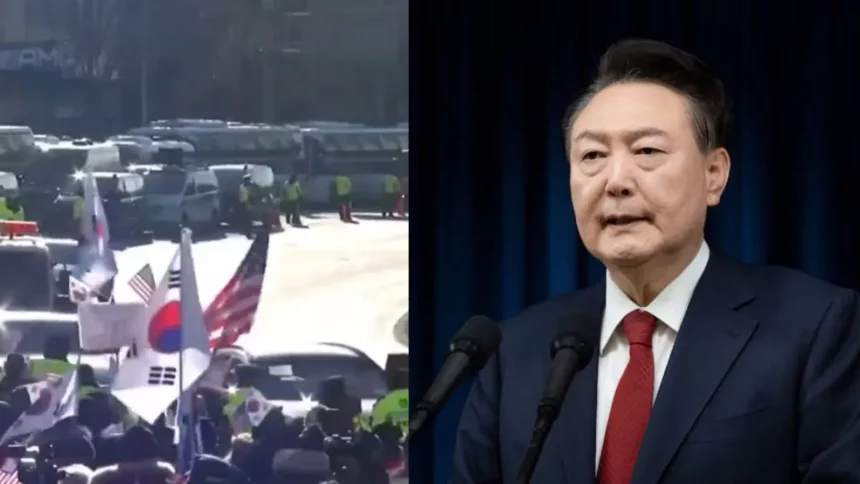
South Korean investigators are locked in a tense standoff with security forces as they attempt to arrest impeached President Yoon Suk Yeol at his residence on Friday. The arrest is in connection with his failed attempt to declare martial law, an action that shook the nation’s democratic foundations. According to local media reports, security forces were blocking the investigators’ attempts to carry out the arrest warrant. Yoon Suk Yeol, who was suspended from duty by lawmakers, could become the first sitting president in South Korea’s history to be arrested if the warrant is executed.
The failed martial law declaration, made by Yoon Suk Yeol on December 3, caused widespread concern in the country, briefly plunging the vibrant East Asian democracy back into the turmoil of military rule. Yoon Suk Yeol faces the possibility of imprisonment or, in the worst-case scenario, the death penalty for his actions.
The Corruption Investigation Office (CIO) confirmed that the execution of the arrest warrant for Yoon Suk Yeol had begun. Investigators, including senior prosecutor Lee Dae-hwan, managed to breach heavy security barriers around the president’s residence in an attempt to detain Yoon Suk Yeol. However, they were blocked by a military unit stationed inside the compound, according to reports from Yonhap news agency. Despite the initial obstruction, the investigators eventually maneuvered past the unit to confront members of the Presidential Security Service, who were also present.
The situation remains unclear, particularly regarding whether the Presidential Security Service, which continues to protect Yoon Suk Yeol as the sitting head of state, would cooperate with the investigators. In the past, members of the president’s security team have thwarted attempts by police to raid the residence. It is still not known which specific units were involved in blocking the investigators on Friday.
Yoon Suk Yeol’s legal team strongly condemned the attempt to arrest him, asserting that the warrant was illegal and invalid. “The execution of a warrant that is illegal and invalid is indeed not lawful,” said Yoon Suk Yeol ‘s lawyer, Yoon Kap-keun.
To prevent further escalation, South Korean authorities have deployed dozens of police buses and hundreds of uniformed officers to the area around the presidential compound in central Seoul. Yonhap news agency reported that approximately 2,700 police officers and 135 police buses were stationed to maintain order, particularly after Yoon Suk Yeol ‘s supporters clashed with anti-Yoon demonstrators on Thursday.
Since a court approved the arrest warrant earlier this week, Yoon Suk Yeol has remained inside the presidential residence, vowing to “fight” the authorities seeking to question him about his failed martial law bid. South Korean media reports suggest that CIO officials intend to arrest Yoon Suk Yeol and transport him to their office in Gwacheon, near Seoul, for questioning. Under the existing warrant, Yoon Suk Yeol can be held for up to 48 hours. To keep him in custody for longer, investigators would need to apply for an additional warrant.
On Thursday night, Yoon Suk Yeol ’s most ardent supporters, including far-right YouTube personalities and evangelical Christian preachers, gathered outside his compound. They staged protests and held all-night prayer sessions in support of the embattled president. Chants of “Illegal warrant is invalid” filled the air as they rallied for Yoon Suk Yeol’s survival. One supporter, Rhee Kang-san, told AFP that many were “rooting for the president” to withstand the arrest attempt. Another supporter, Lee Hye-sook, claimed that protesters were working to prevent opposition figures from “transforming our country into a socialist state, similar to North Korea.”
Yoon Suk Yeol has continued to accuse the opposition of colluding with South Korea’s communist enemies, fueling further tensions in the political landscape.
Yoon Suk Yeol’s legal team confirmed that the impeached president remained inside the presidential compound on Thursday, despite mounting pressure to comply with the arrest warrant. The team has already filed an injunction with the constitutional court to block the warrant, calling the order “an unlawful and invalid act.” They have also lodged an objection with the Seoul court that issued the arrest order.
Meanwhile, CIO head Oh Dong-woon has warned that anyone attempting to obstruct the arrest could face prosecution themselves. In addition to the arrest warrant, a search warrant was also issued for Yoon Suk Yeol’s official residence and other locations.
This marks the latest chapter in a turbulent political saga in South Korea, as authorities struggle to execute similar arrest warrants for lawmakers in the past, thwarted by party members and supporters who blocked police during the warrant’s validity period. As tensions continue to mount, the country watches closely to see how this unprecedented political crisis will unfold.