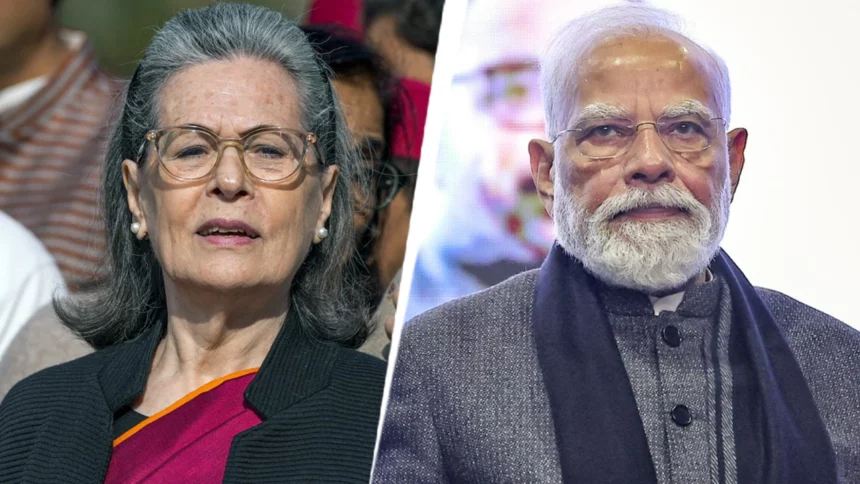
Congress Parliamentary Party president *Sonia Gandhi* has launched a sharp attack on the Narendra Modi-led government, warning that the replacement of the Mahatma Gandhi National Rural Employment Guarantee Act will push crores of rural labourers into unemployment and deepen economic distress in India’s villages. In a strongly worded intervention, she argued that the decision reflects a deliberate withdrawal of the state from its constitutional responsibility to guarantee the right to work, and accused the government of undermining one of independent India’s most important social protection laws.
Her remarks come in the wake of President *Droupadi Murmu* giving assent to the Viksit Bharat–Employment and Livelihood Mission (Rural) Bill, also known as VB-G-RAM-G, which will formally replace the two-decade-old MGNREGA framework. Sonia Gandhi laid out her critique in a column titled The Bulldozer Demolition of MGNREGA, in which she described the move as a collective failure and urged political parties, civil society, and citizens to unite in opposition to what she sees as the erosion of a hard-won constitutional guarantee.
Allegations of dismantling MGNREGA and weakening rural workers’ rights
In her column, Sonia Gandhi argued that MGNREGA was not merely a welfare programme but a rights-based law rooted in Mahatma Gandhi’s philosophy of Sarvodaya, or welfare for all. She wrote that the Act strengthened the right to work for rural households, provided a safety net during periods of agrarian distress, and helped stabilise village economies by ensuring predictable employment. According to her, the Modi government has effectively dismantled this framework without adequate debate, consultation, or adherence to parliamentary norms.
She alleged that removing Mahatma Gandhi’s name from the scheme was only the first symbolic step, and that the deeper objective was to hollow out the law itself. Sonia Gandhi pointed out that MGNREGA drew inspiration from Article 41 of the Constitution, which directs the state to secure the right to work. In her view, replacing it with a new mission-based framework represents a retreat from this constitutional promise.
A central concern raised by Sonia Gandhi is the shift from a legally guaranteed programme to what she described as a bureaucratically controlled scheme. Under MGNREGA, there was no fixed national cap on expenditure, allowing states to respond flexibly to demand for work. She argued that the new law introduces a capped budget, effectively limiting the number of workdays that states can provide and ending the guarantee of employment on demand. This change, she said, undermines the very principle that made MGNREGA transformative.
Sonia Gandhi also accused the government of deliberately weakening the bargaining power of rural labourers. She said one of MGNREGA’s most significant achievements was that it empowered landless workers and marginal farmers by raising rural wage levels and giving workers an alternative to exploitative employment. According to her, the new framework risks reversing these gains at a time when agricultural employment has reportedly increased for the first time since Independence. She claimed the government is reluctant to allow wages to rise, even as rural labour becomes more central to the economy.
Questioning the government’s claim that the new law guarantees 125 days of employment, Sonia Gandhi described this assurance as misleading. She argued that the financial burden placed on states makes it unrealistic for them to actually deliver the promised number of workdays. With state finances already under strain, she warned that the situation could worsen, leading to fewer days of employment in practice. She also recalled that over the past decade, MGNREGA had already been weakened through budget cuts, technical hurdles, and chronic delays in wage payments, further eroding trust among workers.
VB-G-RAM-G law, parliamentary passage, and broader constitutional concerns
The Viksit Bharat–Employment and Livelihood Mission (Rural) Guarantee, or VB-G-RAM-G, formally replaces MGNREGA after nearly 20 years of its existence. The bill was introduced in Parliament by *Shivraj Singh Chouhan* during the winter session, amid strong opposition protests. The Lok Sabha passed the bill on December 16, followed by the Rajya Sabha on December 18, after around 14 hours of debate. Opposition parties staged demonstrations within the Parliament complex, with more than 50 MPs participating, while Trinamool Congress members held an overnight protest demanding the bill’s withdrawal.
Sonia Gandhi framed the passage of the new law as part of a broader pattern of what she described as an assault on constitutional rights. In her column, she argued that ending the statutory right to work is not an isolated move, but fits into a wider weakening of democratic and social guarantees. She cited what she sees as the dilution of the Right to Information, the Right to Education, forest rights protections, and land acquisition safeguards. She also accused the government of undermining farmers’ rights to a minimum support price through earlier farm laws, and warned that even the National Food Security Act could be at risk.
By linking the replacement of MGNREGA to these wider trends, Sonia Gandhi sought to position the issue beyond partisan politics, framing it instead as a fundamental question about the direction of the Indian state. She argued that programmes like MGNREGA were designed not only to provide employment, but to uphold dignity, reduce inequality, and strengthen democracy at the grassroots. Removing the legal guarantee of work, she warned, risks pushing millions of rural families back into insecurity at a time when inflation, climate stress, and job uncertainty are already high.
Sonia Gandhi’s intervention has added fuel to an already heated political debate over rural employment and social protection. Supporters of the new law argue that it promises more days of work and a reoriented focus on livelihoods, while critics fear that the shift from a rights-based guarantee to a centrally controlled mission will weaken accountability and leave workers vulnerable. As the VB-G-RAM-G framework begins to replace MGNREGA on the ground, the real test, many observers note, will be whether rural workers actually see more employment, timely wages, and improved livelihoods, or whether the concerns raised by Sonia Gandhi about unemployment and declining incomes prove justified.