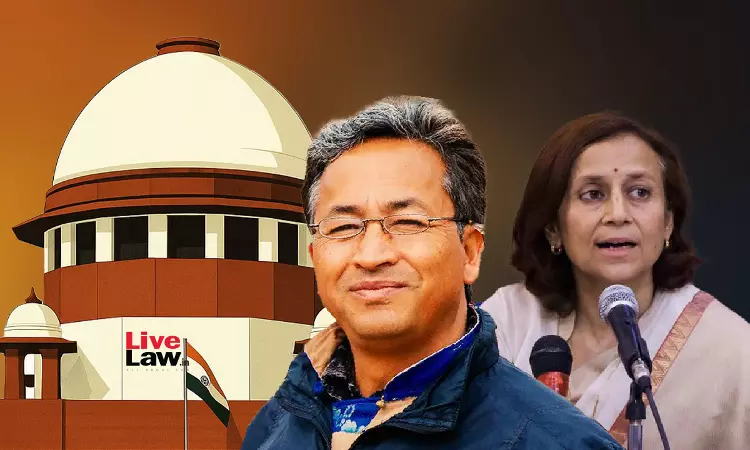
The detention of climate activist and education reformer Sonam Wangchuk has emerged as one of the most closely watched legal and political controversies in recent months, placing questions of preventive detention, constitutional safeguards, and democratic dissent under sharp public scrutiny. On December 15, 2025, the Supreme Court of India adjourned the hearing on a petition challenging Wangchuk’s detention under the National Security Act, deferring the matter to January 7, 2026. The plea was filed by his wife, Gitanjali J. Angmo, who has argued that the arrest represents an arbitrary and unlawful exercise of state power that violates fundamental rights guaranteed by the Constitution.
The adjournment, ordered by a bench comprising Justices Aravind Kumar and N. V. Anjaria, was attributed to a lack of time, but the pause has done little to slow the growing national debate surrounding the case. Wangchuk’s detention followed violent protests in Ladakh, where demonstrators were demanding statehood and Sixth Schedule status. The protests turned deadly, leaving four people dead and dozens injured, prompting authorities to invoke the stringent provisions of the National Security Act against the activist.
background of the detention and the government’s position
Wangchuk was taken into custody on September 26, 2025, two days after unrest broke out in parts of Ladakh. The government accused him of inciting violence and claimed his actions posed a threat to public order and national security. Preventive detention under the National Security Act allows authorities to detain individuals without formal charges if they are believed to be acting in a manner prejudicial to the security of the state or the defence of India. The law permits detention for up to 12 months, subject to review, and has long been criticised by civil liberties advocates for its sweeping powers and limited safeguards.
In court, the Centre and the Ladakh administration have defended the detention as a necessary response to an extraordinary situation, arguing that the scale of violence and loss of life required immediate and firm action. During an earlier hearing on November 24, the Solicitor General sought additional time to respond to Angmo’s rejoinder, leading to the matter being postponed. Prior to that, on October 29, the Supreme Court had asked the Union government and the Ladakh administration to file detailed responses to the amended plea challenging the legality of the detention.
The government’s stance has been that Wangchuk’s influence and public standing amplified the protests, contributing to instability in a strategically sensitive region. Officials have maintained that the preventive measure was aimed at averting further violence and preserving public order. These assertions, however, are strongly contested by the petitioner, who describes the detention as disproportionate, unjustified, and disconnected from any credible evidence of wrongdoing.
arguments raised in the plea and the broader constitutional debate
Angmo’s petition presents a detailed challenge to the detention order, contending that it is founded on vague allegations, outdated police reports, and speculative assumptions rather than concrete facts. According to the plea, the authorities relied on “stale FIRs” and imprecise imputations that lack any live or proximate connection to the alleged grounds of detention. Such an approach, the petition argues, undermines the constitutional requirement that preventive detention must be based on clear, compelling, and immediate necessity.
The plea further asserts that the detention violates Wangchuk’s fundamental rights, including his right to personal liberty and due process. It characterises the use of preventive detention powers in this instance as a gross abuse of authority, striking at the core of constitutional liberties. The argument emphasises that Wangchuk has spent more than three decades working peacefully in Ladakh and across India, earning national and international recognition for his contributions to education reform, grassroots innovation, and environmental conservation. Against this backdrop, the petition says, it is implausible to suggest that he would suddenly engage in or encourage violence.
A key element of the plea is the claim that Wangchuk explicitly condemned the violence that erupted during the protests. Through his social media platforms, he reportedly described the incidents as deeply distressing and reiterated his long-standing commitment to non-violent methods of advocacy. He is said to have warned that violence would undermine Ladakh’s peaceful struggle, referring to the movement as a “tapasya” that had been pursued non-violently for years. Angmo’s petition notes that September 24, the day of the violence, was described by Wangchuk as the saddest day of his life.
Beyond the individual case, the petition raises broader questions about the balance between national security and civil liberties in a democratic society. Preventive detention laws, while constitutionally permitted, are meant to be used sparingly and under strict scrutiny. Critics argue that their misuse can have a chilling effect on dissent and activism, particularly in regions with sensitive political or strategic contexts. Supporters of such laws, on the other hand, contend that they are essential tools for maintaining order in extraordinary circumstances.
The Supreme Court’s eventual decision is expected to have implications that extend beyond Wangchuk’s personal liberty. It will test the judiciary’s role as a guardian of fundamental rights in cases involving preventive detention and assess how rigorously the executive’s claims of necessity are examined. As the hearing approaches in January, legal observers, activists, and policymakers alike are watching closely, aware that the outcome may influence how similar cases are handled in the future.