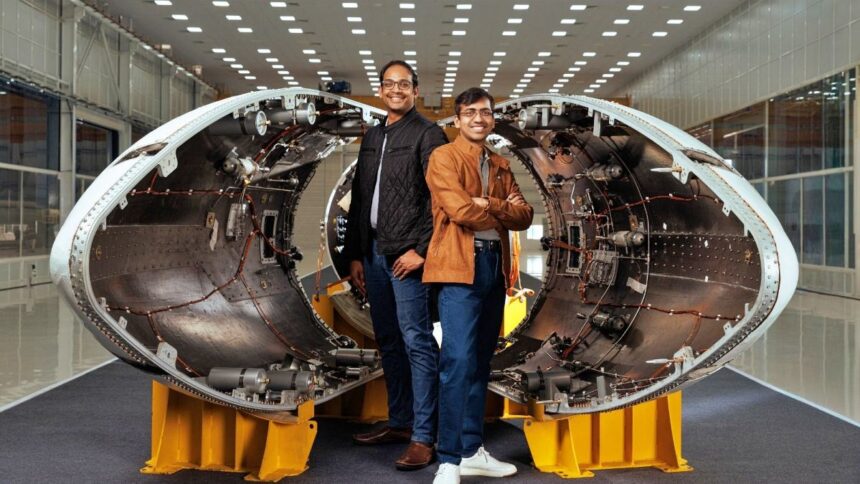
India’s private space sector has achieved a historic milestone after Skyroot Aerospace officially entered the unicorn club following a fresh funding round of 60 million dollars.
The Hyderabad-based startup has now crossed a valuation of 1.1 billion dollars, nearly ₹10000 crore, making it India’s first spacetech unicorn and one of the country’s most significant deep-tech startup success stories.
The achievement is being viewed as a major breakthrough for India’s rapidly expanding private aerospace industry, which has transformed dramatically following policy reforms and increased government support for private participation in space technology.
Over the last few years, India has emerged as a serious global player in satellite launches, low-cost mission capabilities and commercial space innovation. Skyroot Aerospace now stands at the centre of this transformation.
Major Global Investors Back Skyroot Aerospace
The latest funding round was led by global institutional investors Sherpalo Ventures and GIC.
Existing investors including GreenCo Group founders and Arkam Ventures also participated in the round alongside several prominent family offices and investment firms.
The strong investor participation reflects growing global confidence in India’s commercial space ambitions and the long-term potential of private aerospace companies emerging from the country.
One of the most notable developments following the funding round is the entry of Ram Shriram into the company’s board structure.
Shriram’s involvement is being viewed as a major strategic boost because of his extensive experience in backing high-growth technology businesses globally.
Industry experts believe his association could strengthen Skyroot’s international investor network and strategic expansion plans.
Funding to Support Vikram Rocket Expansion Plans
According to company leadership, the newly raised capital will be used primarily across three major areas.
The first priority is establishing regular commercial launches for the Vikram-1 rocket programme.
Skyroot Aerospace wants to move beyond demonstration missions and begin operational satellite deployment services for global customers.
Executives believe that consistent launch schedules can create stable revenue streams and improve the company’s credibility within the highly competitive international launch market.
The second major focus area involves manufacturing expansion.
The company plans to significantly increase rocket production capacity so multiple launch vehicles can be developed simultaneously.
Large-scale manufacturing is expected to reduce operational costs, improve efficiency and help Skyroot compete against established international private launch firms.
The third major priority is the development of the advanced Vikram-2 rocket.
The upcoming launch vehicle is expected to carry payloads of up to 1000 kilograms into orbit and will use sophisticated cryogenic stage technology.
Industry analysts believe heavier launch systems could place Skyroot in a much stronger position within the global commercial launch industry.
Vikram-1 Orbital Mission Preparations Underway
The funding comes at a crucial stage for the company because preparations are underway for the first orbital mission of the Vikram-1 rocket.
Critical launch vehicle components have already been transported from the company’s manufacturing facility in Hyderabad to Satish Dhawan Space Centre in Andhra Pradesh.
The launch is expected within the coming weeks and is being closely monitored by both Indian technology circles and international aerospace observers.
Skyroot Aerospace claims its launch services could become among the most affordable satellite deployment options globally.
The company is attempting to capitalise on rapidly increasing demand for small satellite launches driven by commercial communication systems, earth observation networks, climate monitoring projects and private satellite infrastructure.
India’s Space Sector Has Changed Rapidly After Reforms
India’s private space ecosystem has evolved dramatically since the government opened the sector to private participation.
Previously, Indian Space Research Organisation (ISRO) handled nearly all major launch and space research operations independently.
However, regulatory reforms and industry support encouraged startups to enter the sector, triggering rapid innovation and investment growth.
Skyroot Aerospace has played a pioneering role in this transformation.
The company was founded in 2018 by former ISRO scientists Pawan Kumar Chandana and Naga Bharath Daka.
Both founders possessed extensive experience in rocket engineering and space systems before leaving government service to establish a private launch company focused on affordable access to space.
Pawan Kumar Chandana studied Mechanical Engineering at Indian Institute of Technology Kharagpur before spending six years at ISRO.
It was during this period that he met co-founder Bharath Daka, who shared a similar vision regarding the future of India’s private space technology ecosystem.
Vikram-S Mission Changed India’s Private Space Industry
Skyroot Aerospace first attracted major national attention in 2022 after successfully launching Vikram-S, India’s first privately developed rocket.
The mission was considered historic because it demonstrated that Indian private companies could independently build and launch advanced aerospace systems.
The success of Vikram-S created strong confidence among investors, policymakers and international clients.
It also established Skyroot Aerospace as one of Asia’s leading private aerospace startups.
The upcoming Vikram-1 mission is expected to become an even larger milestone because it will attempt a complete orbital launch.
Successfully achieving orbit would place Skyroot among a small group of private companies globally capable of independently delivering payloads into space.
India’s Space Economy Expected to Grow Rapidly
Industry analysts believe India’s private space economy could generate billions of dollars in opportunities during the next decade.
Sectors such as satellite internet, defence applications, navigation systems, climate research and communication infrastructure are all increasing global demand for affordable launch services.
Competition within the international space industry has also intensified sharply.
Companies in the United States, China and Europe are aggressively investing in reusable rockets, satellite systems and commercial launch infrastructure.
Indian startups are attempting to compete by leveraging lower operational costs and highly efficient engineering capabilities.
Skyroot Aerospace believes India’s engineering talent and manufacturing advantages can help position the country as a preferred global launch destination.
The company’s strategy focuses on combining advanced aerospace innovation with affordable production and operational efficiency.
Deep-Tech Startups Reshaping India’s Innovation Identity
The rise of spacetech startups is also transforming global perceptions regarding India’s innovation ecosystem.
Earlier, Indian startups were largely associated with software services and digital applications.
Today, sectors such as aerospace, artificial intelligence, defence technology and deep-tech manufacturing are attracting major international investment.
Skyroot Aerospace’s unicorn milestone therefore represents more than a company success story.
Industry experts believe the achievement symbolises India’s changing technological ambitions and could encourage more engineers and scientists to pursue entrepreneurship in advanced scientific sectors.
The Indian government has also introduced multiple initiatives supporting private aerospace growth through regulatory reforms, infrastructure access and collaboration opportunities with ISRO.
Vikram-1 Launch Could Define Company’s Global Future
The coming months are expected to become critical for Skyroot Aerospace.
A successful Vikram-1 orbital launch could firmly establish the company as a serious global competitor within the commercial launch market.
Investors and aerospace analysts will closely monitor whether the startup can scale operations, maintain reliability and execute regular commercial launch schedules.
As India’s first spacetech unicorn enters its next growth phase, the country’s private aerospace sector appears poised for a transformative decade.
The rise of Skyroot Aerospace signals that India’s ambitions are no longer limited to government-led missions.
Private enterprise is now emerging as a powerful force shaping the future of India’s space technology ecosystem and commercial aerospace innovation.