Adani Group is preparing to make one of the largest private-sector commitments to india’s defence manufacturing ecosystem, with plans to invest nearly ₹1.8 lakh crore next year to expand indigenous military capabilities across unmanned systems, advanced guided weapons, and next-generation defence technologies, signalling a decisive shift toward self-reliance and rapid deployment in national security.
The proposed investment, according to people familiar with the company’s strategy, reflects how Adani Group has repositioned its defence arm from long gestation planning to execution-focused manufacturing, with several of its platforms already seeing operational use during operation sindoor in 2025. The move comes amid india’s broader push to reduce dependence on defence imports and build domestic industrial capacity aligned with future warfare needs.
focus on autonomous systems, guided weapons, and rapid deployment
The bulk of the planned investment will be channelled through Adani Defence & Aerospace, which has emerged as the country’s largest integrated private-sector defence player. Company sources said the focus areas for the coming year include unmanned and autonomous platforms, advanced guided weapons, sensors and electronics, artificial intelligence-enabled multi-domain operations, and a significant expansion of maintenance, repair and overhaul infrastructure.
A central pillar of the investment strategy is the scaling up of autonomous systems across air, sea and land domains. These platforms are designed to operate using advanced sensors, secure communication networks and software-driven decision-making, reducing the need for constant human intervention while extending operational reach. In modern military doctrine, such systems are increasingly viewed as force multipliers that enhance surveillance, precision strike capability and situational awareness while lowering risk to personnel.
In the air domain, unmanned aerial vehicles developed by the company are designed to perform intelligence, surveillance and reconnaissance missions, communications relay, and precision support over long endurance cycles. At sea, unmanned surface and underwater platforms are being developed to handle maritime surveillance, anti-submarine warfare roles and mine countermeasure operations across vast oceanic areas. On land, unmanned ground vehicles are intended to support logistics, reconnaissance, perimeter security and explosive ordnance disposal in high-risk environments.
Sources noted that the company’s shift from extended development cycles to rapid deployment became evident in 2025, when several platforms moved swiftly from trials to operational readiness. This transition aligns with the indian military’s evolving requirements, which increasingly emphasise speed, adaptability and technology-driven solutions over traditional procurement timelines.
operational milestones, military integration, and long-term ambitions
Adani Defence & Aerospace has already crossed several operational milestones that underscore its growing role in india’s defence ecosystem. In 2025, its drishti 10 unmanned aerial vehicles were inducted into the Indian Navy and the Indian Army for long-endurance intelligence, surveillance and reconnaissance missions. These inductions marked a significant step for a private-sector player in supplying mission-critical platforms to frontline forces.
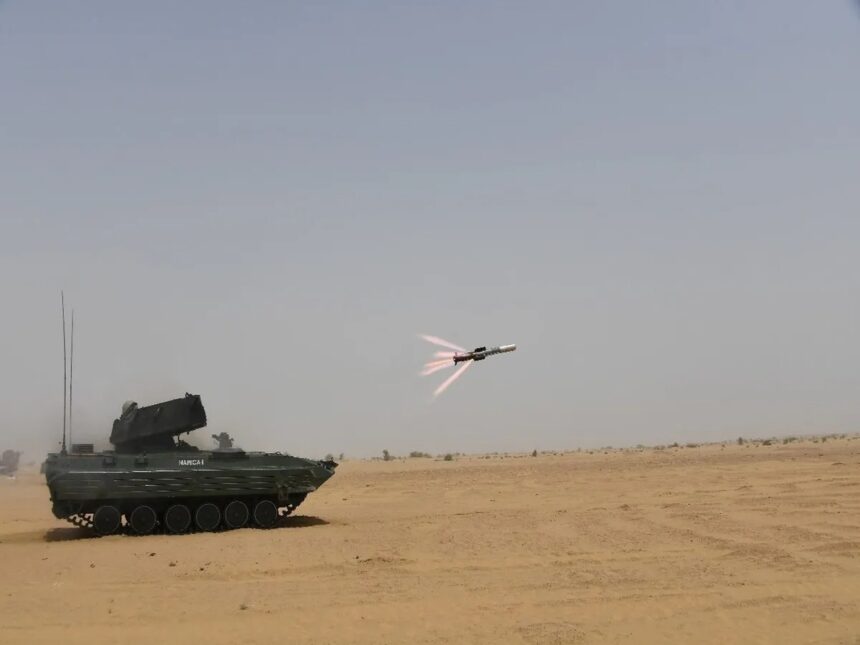
The company’s counter-drone systems have also cleared trials conducted by the Indian Air Force, the navy and the army, positioning them as viable solutions against emerging aerial threats. In parallel, agnikaa loitering munitions demonstrated high endurance and resilience against electronic warfare, while the arka manpads shoulder-fired missile system achieved tri-service deployment readiness within compressed timelines, reflecting the emphasis on accelerated development and testing.
Another notable development has been the company’s entry into airborne warning and control systems platforms, making it the sole private-sector player in this highly specialised segment. This move is seen as strategically significant, as such platforms are central to modern air combat and network-centric warfare.
Beyond frontline systems, adani defence has expanded into maintenance, repair and overhaul by integrating air works and indamer, creating a large defence-civil aviation mro platform. The acquisition of fstc has strengthened pilot and engineering training capabilities, enabling the company to offer end-to-end solutions that span manufacturing, lifecycle support and human capital development.
Sustainability and resilience have also been embedded into the company’s approach. Digital twins, predictive maintenance technologies and modular design principles are being used to improve efficiency and reduce lifecycle costs. Higher levels of indigenous sourcing have strengthened supply-chain resilience, a factor that has gained importance amid global disruptions and geopolitical uncertainties.
Looking ahead to 2026, company sources said the focus will be on scaling autonomous systems across all operational domains, expanding precision-strike capabilities, deepening the mro and training footprint, and advancing artificial intelligence-enabled multi-domain operational systems. These plans are aligned with india’s projected defence investment trajectory and the broader goal of positioning domestic industry as a cornerstone of national security.
The scale of the proposed ₹1.8 lakh crore investment underscores the growing role of private industry in india’s defence landscape. As the country seeks to modernise its armed forces and prepare for future conflict scenarios, the emphasis on indigenous manufacturing, rapid deployment and advanced technologies is expected to intensify. Adani’s planned spending reflects both confidence in policy support for domestic defence production and a strategic bet on the centrality of autonomous and ai-driven systems in future warfare.