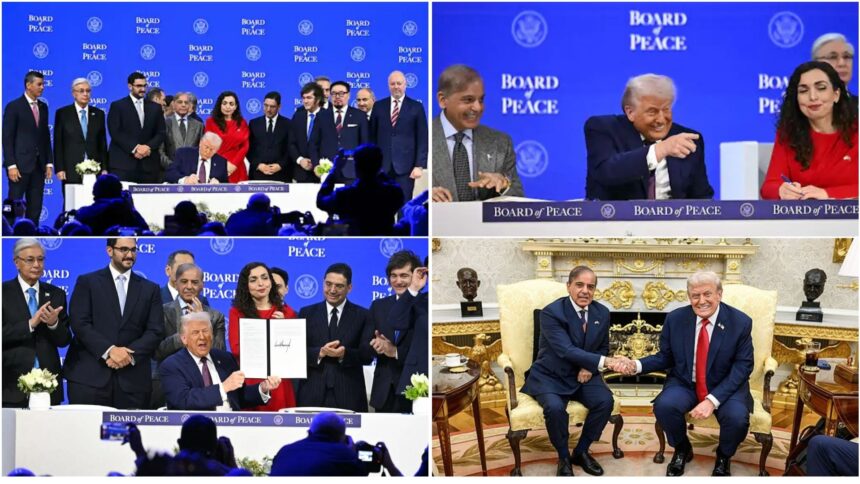
The decision by Shehbaz Sharif to join a peace initiative announced by Donald Trump has triggered a fierce political storm in Pakistan, reopening long-standing debates about foreign policy independence, democratic accountability, and the country’s traditional position on the Gaza conflict at a time of heightened regional and global sensitivity.
A diplomatic move that unsettled domestic political consensus
Shehbaz Sharif’s participation in trump’s newly announced peace board, unveiled on the sidelines of the World Economic Forum meeting, was presented by the government as a constructive diplomatic step aimed at supporting peace and humanitarian stability in Gaza. Officials described the move as an opportunity for Pakistan to remain engaged in international efforts seeking to reduce violence and facilitate reconstruction in one of the world’s most troubled regions.
However, the announcement quickly ignited criticism across Pakistan’s political spectrum. Opposition parties accused the prime minister of making a major foreign policy decision without consulting parliament or building national consensus. They argued that joining an initiative linked to trump, whose past policies on the Middle East were widely criticized in Pakistan, required thorough debate and legislative scrutiny rather than executive discretion.
Much of the backlash centered on perceived inconsistency. Political rivals pointed out that Sharif himself had earlier condemned trump-era peace proposals, describing them as unfair and dismissive of Palestinian rights. By associating with a new peace board under trump’s leadership, critics claimed, the prime minister appeared to reverse his own stated principles, raising questions about political credibility and moral consistency.
Opposition leaders framed the decision as a symbolic departure from Pakistan’s long-held pro-Palestinian stance. For decades, Pakistan has maintained vocal support for Palestinian self-determination and has refused to recognize Israel. Against this backdrop, Sharif’s move was interpreted by critics as a concession to western diplomatic pressure rather than a reflection of Pakistan’s traditional foreign policy values.
Public reaction mirrored political division. Supporters of the government defended the decision as pragmatic engagement, arguing that participation does not imply endorsement of all associated policies and could allow Pakistan to advocate for humanitarian concerns from within the process. Detractors, however, viewed the move as politically tone-deaf, especially amid widespread public sympathy for civilians affected by the Gaza crisis.
The controversy also revived broader concerns about governance. Legal analysts and opposition lawmakers questioned whether the executive had the authority to commit Pakistan to an international peace mechanism without parliamentary approval. For them, the issue extended beyond Gaza to the principles of democratic accountability and institutional balance within Pakistan’s political system.
Social media amplified the debate, with images of Sharif alongside trump circulating widely and becoming symbolic flashpoints. For many critics, the optics reinforced perceptions of political opportunism and raised doubts about whether Pakistan’s foreign policy decisions were being shaped more by external alignment than internal consensus.
International reactions and the broader geopolitical context
Beyond Pakistan’s borders, Sharif’s decision drew mixed reactions, reflecting the fragmented nature of contemporary Middle East diplomacy. Supporters of trump’s peace board argued that new frameworks are necessary to break longstanding diplomatic deadlocks and improve coordination of humanitarian assistance and post-conflict reconstruction in Gaza.
Others, however, questioned the legitimacy and effectiveness of the initiative. Analysts noted that peace mechanisms lacking broad regional representation risk being perceived as externally imposed rather than inclusive. Concerns were also raised about whether such a board could genuinely address the political roots of the Gaza conflict or would remain limited to managing symptoms rather than causes.
Pakistan’s inclusion in the initiative added another layer of complexity. Some international observers saw Islamabad’s participation as an attempt to remain diplomatically relevant amid shifting global alignments. By engaging with a us-backed initiative, Pakistan may be seeking to balance its traditional positions with strategic pragmatism in an increasingly multipolar world.
At the same time, the move exposed Pakistan to criticism from multiple directions. Certain regional actors expressed skepticism about Islamabad’s role in Gaza-related efforts, citing ideological differences and past positions. This underscored the difficulty of navigating peace diplomacy in a region marked by deep mistrust and competing narratives.
The controversy surrounding Sharif’s decision also highlighted the challenges faced by leaders operating under intense economic and diplomatic pressure. Pakistan’s government is currently balancing domestic economic concerns, international financial negotiations, and geopolitical recalibration. In this context, engagement with high-profile global initiatives can be seen both as opportunity and risk.
For critics, the primary concern remains principle. They argue that peace initiatives must align clearly with Pakistan’s stated values and historical commitments. Any ambiguity, they warn, risks eroding public trust and weakening the moral clarity of the country’s foreign policy.
Supporters counter that diplomacy often requires engagement with imperfect frameworks and controversial actors. From this perspective, participation does not necessarily equal endorsement but can provide a platform to influence outcomes and advocate humanitarian priorities.
As debate continues, Sharif’s decision has become a focal point for larger questions about Pakistan’s role in international diplomacy, the balance between pragmatism and principle, and the domestic legitimacy of foreign policy choices. The episode has revealed how a single diplomatic gesture can expose fault lines within political systems and reignite unresolved questions about identity, alignment, and responsibility on the global stage.