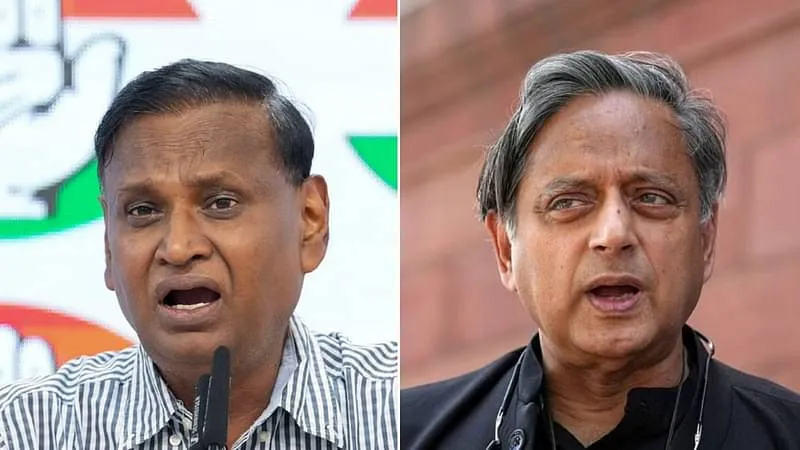
Congress leader Shashi Tharoor has strongly responded to his party colleague Udit Raj after the latter questioned his remarks on the recent terror attack in Pahalgam. In a sharp retort, Tharoor reminded Raj of his past affiliation with the BJP, asserting that it was Raj, not him, who was better placed to speak about the BJP’s position.
Udit Raj had criticized Tharoor’s stance on the Pahalgam attack, accusing him of aligning with the BJP. Raj went further, suggesting that Tharoor was attempting to become a “super-BJP man.” He questioned whether Tharoor, who is a senior leader of Congress, had shifted his loyalties and was now advocating for the BJP’s position. He also challenged Tharoor to ask the BJP about when the government would take action on Pakistan-occupied Kashmir (PoK).
In response, Tharoor made it clear that he was not a spokesperson for the BJP, emphasizing that he speaks for himself and not for any party. He pointed out that Udit Raj, who had once been a Member of Parliament with the BJP, was in a better position to comment on the BJP’s views. Tharoor’s reply was direct and pointed, underscoring the need for political maturity and civility even in the face of disagreement.
The controversy began after Tharoor made remarks about the intelligence failure regarding the Pahalgam attack, in which 26 people, mostly tourists, were killed by terrorists. Tharoor acknowledged that no intelligence system is foolproof, using Israel’s recent intelligence failure during the October 7 attack as an example. He suggested that just as Israel had waited until the end of the war to demand accountability, India should take a measured approach and assess the situation before making any demands for accountability from the government.
Tharoor’s measured response to the Pahalgam attack, which emphasized the unpredictability of terrorism and the limits of intelligence gathering, did not sit well with Udit Raj, who appeared to be critical of Tharoor’s caution. The attack, which targeted tourists near Jammu and Kashmir’s Pahalgam, has led to widespread outrage and calls for stronger action against those responsible.
In the aftermath of the attack, India has already taken retaliatory steps against Pakistan, including suspending the Indus Waters Treaty, reducing diplomatic staff, and halting visa services for Pakistani nationals. Prime Minister Narendra Modi has also vowed to ensure that those behind the attack are brought to justice.