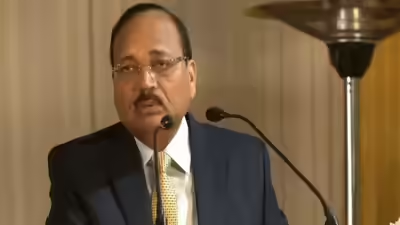
In a significant development, the Chief Justice of India, Surya Kant, has recused himself from hearing petitions challenging the Election Commission appointments law. The decision was taken during a hearing in the Supreme Court of India, where the bench was considering multiple pleas against the 2023 legislation that altered the process for appointing Election Commissioners. The Chief Justice stated that his participation could give rise to allegations of conflict of interest, making it appropriate for him to step aside in the interest of judicial propriety and transparency.
The bench, which also included Justices Joymalya Bagchi and Vipul M Pancholi, was hearing public interest litigations questioning the validity of the law. The Chief Justice emphasized that the matter should be heard by a bench comprising judges who are not in line to become the Chief Justice in the future. This suggestion reflects a broader concern about maintaining the integrity and impartiality of the judicial process, particularly in cases involving constitutional questions and institutional frameworks.
Background of the Election Commission Appointment Law
The controversy centers around the changes introduced by the 2023 law governing the appointment of the Chief Election Commissioner (CEC) and other Election Commissioners. Earlier, following a landmark judgment by the Supreme Court, the appointment process involved a committee comprising the Prime Minister, the Leader of the Opposition, and the Chief Justice of India. This structure was intended to ensure a balance of power and enhance the independence of the Election Commission.
However, the new law passed by Parliament in December 2023 replaced the Chief Justice with a Union Minister, thereby altering the composition of the selection committee. Under the revised framework, the committee now consists of the Prime Minister, a Union Minister nominated by the Prime Minister, and the Leader of the Opposition. This change has been a point of contention, with critics arguing that it reduces the role of the judiciary in the appointment process.
Petitions challenging the law have been filed by various individuals and organisations, including Congress leader Jaya Thakur and the Association for Democratic Reforms. The petitioners contend that the removal of the Chief Justice undermines the fairness and independence of the Election Commission, which is a key institution in India’s democratic framework.
Arguments from Petitioners and Government
During the hearing, senior advocate Prashant Bhushan, representing the petitioners, supported the Chief Justice’s decision to recuse himself. He argued that the case should be heard by a bench that does not include any judge who may become Chief Justice in the future, to avoid any perception of bias. This position aligns with the principle that justice must not only be done but also be seen to be done.
The petitioners have raised concerns that the exclusion of the Chief Justice from the appointment committee could compromise the independence of the Election Commission. They argue that the presence of a judicial member acts as a safeguard against potential executive overreach, ensuring that appointments are made in a fair and transparent manner.
On the other hand, the central government has defended the law, asserting that the independence of the Election Commission is not solely dependent on the inclusion of a judicial member in the selection committee. According to the government, the revised structure still provides a balanced mechanism for appointments and does not undermine the institution’s autonomy. The Ministry of Law, in its affidavit, has also stated that recent appointments of Election Commissioners were carried out in accordance with due process and were not rushed, as alleged by the petitioners.
Judicial Integrity and Next Steps in the Case
The Chief Justice’s decision to recuse himself underscores the importance of maintaining judicial integrity and avoiding even the appearance of bias. By stepping aside, he has set a precedent for handling cases where potential conflicts of interest may arise. This move is likely to reinforce public confidence in the judicial process, particularly in cases involving constitutional and institutional matters.
The case has now been directed to be listed before another bench on April 7, where it will be heard afresh. The Supreme Court has not granted any interim stay on the operation of the law so far, meaning that the current appointment process remains in effect until further orders are passed.
The outcome of this case will have significant implications for the functioning of the Election Commission and the broader democratic framework in India. It will determine the extent to which the judiciary can or should be involved in the appointment of key constitutional authorities and may set important precedents for future governance.
Broader Implications for Democratic Institutions
The debate surrounding the Election Commission appointment law highlights the delicate balance between different branches of government in a Democratic system. The Election Commission plays a crucial role in ensuring free and fair elections, and its independence is considered essential for the credibility of the electoral process.
Changes to the appointment mechanism have therefore attracted close scrutiny from legal experts, political leaders, and civil society organisations. The case also reflects broader questions about institutional checks and balances, and the role of the judiciary in safeguarding constitutional values.
As the matter proceeds, it is expected to generate further debate on the principles of transparency, accountability, and independence in public institutions. The Supreme Court’s eventual ruling will not only address the specific legal challenge but also contribute to the ongoing discourse on governance and democracy in India.